
How Do I Get More Plumbing Leads?
The six things people check before they ring a plumber, and most plumbing websites answer none of them
If you are searching how to get more plumbing leads, you have probably already done the obvious. The website is up, the van is sign-written, the number is in the header, and the footer lists every town within an hour of the yard. Yet the emergency calls go to a national call centre that sends whoever is nearest, the boiler jobs go to whoever came up first in the map, and the leads you do pay for arrive already sent to four other plumbers.
That is rarely one big problem. It is a short list of things a person checks before they ring a plumber, mostly in a hurry and mostly on a phone, and most plumbing websites answer none of them because they were built to look like a website rather than to get the call.
Quick Version
Someone finds a plumber three ways: the map result for ‘plumber near me’, a search for the job and the town, and a quick check on price and whether you look legitimate before they tap the number. Most plumbing websites win none of them, because the profile is half done, the site is one services page and the boiler page says ‘call for a quote’.
The six things to check, in order:
- You are not in the map box for ’emergency plumber near me’
- Emergency and planned work share one page
- No page for the jobs that pay
- ‘Call for a quote’ on the boiler page
- You list thirty towns and rank in none of them
- You are counting visits, not calls by job
Most plumbers have four of these at once. None of them needs a new website, and all of them can be done from the van in the quiet weeks.
Not Sure where to start?
All of this is a couple of quiet weekends if you know how people search for a plumber and how to set up a Business Profile that wins the map, and another year of paying a lead site for your own jobs if you do not. If you would rather someone fixed the profile, wrote the job and town pages, put the prices on the site and told you plainly which towns are now ringing you, that is what our SEO & AI service for plumbers does.
How Do I Get More Plumbing Leads? The Full Guide
Work through these in order. The Business Profile comes first because it is where the emergency calls come from, and the job pages come second because they are what turns a planned search into a booked job.
You are not in the map box for ’emergency plumber near me’
Search ’emergency plumber near me’ from your phone, standing in a customer’s town. The map with three names is what every person with water coming through the ceiling sees first, and those three came from Google Business Profiles, not websites. If you are not in that box, or you are in it with a stock photo of a tap, hours that stop at five and a review from two years ago nobody answered, the call went to someone else before your site was ever opened.
Open your profile as a customer would. Is the primary category ‘Plumber’ and, if you do gas work, is ‘Heating contractor’ or similar added as a secondary? Is the service area set to the towns you actually cover? Do the hours say what you actually do, including any out-of-hours cover, rather than office hours copied from somewhere? Are the photos you, the van and real jobs? Has every review been answered, including the grumpy one?
Then ask for a review at every job, with the link, and ask the customer to mention the town and what you did. A review that says ‘replaced our boiler in Marlow in a day, left the place spotless’ does more than ten that say ‘great plumber’.
Emergency and planned work share one page
The person searching ‘burst pipe’ at midnight and the person searching ‘new boiler cost’ on a Tuesday evening are not the same person, and they do not want the same page. The first wants a number, how fast you can get there and what the call-out costs. The second wants to read, compare and understand before they ring anyone.
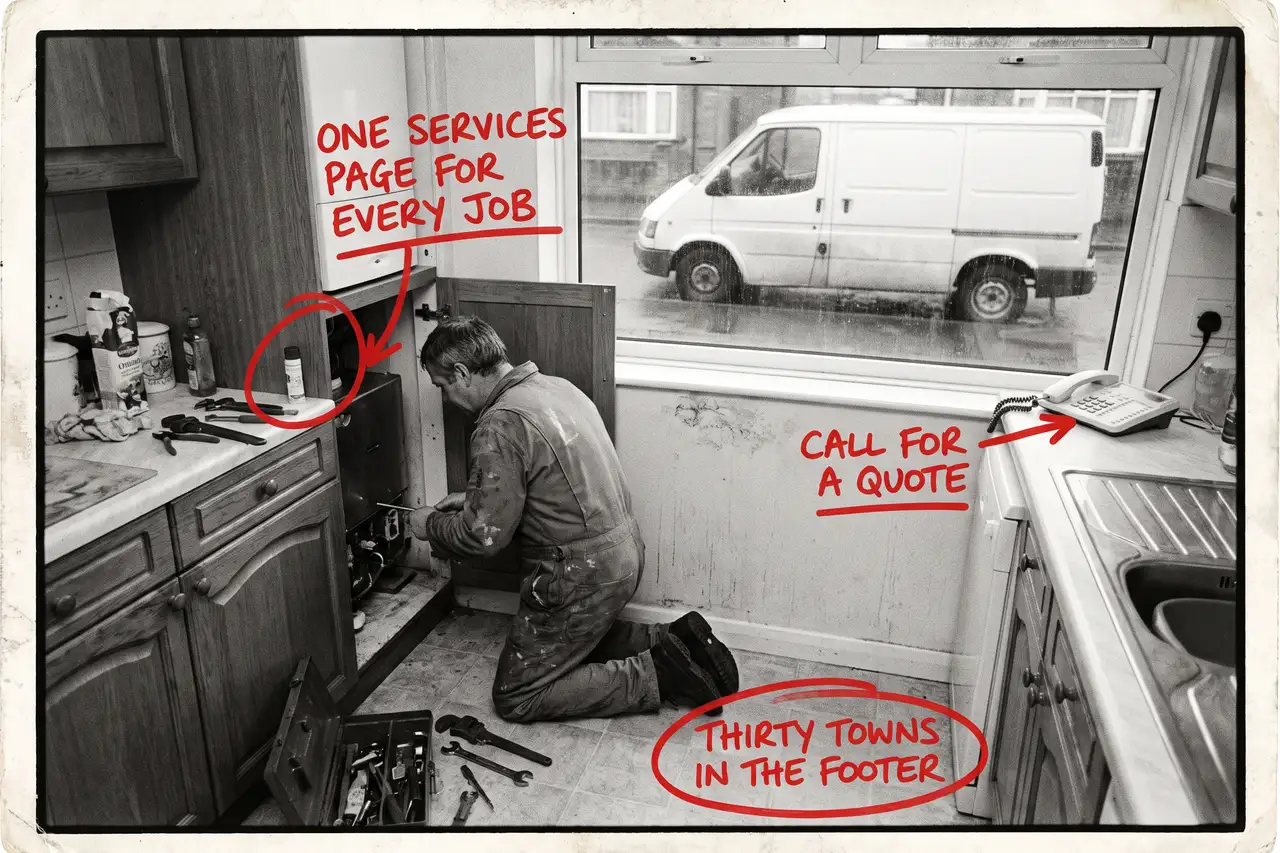
Most plumbing websites put both on one ‘services’ page, so the emergency caller scrolls past paragraphs about bathrooms to find the number, and the boiler buyer finds nothing to read. Give emergencies their own short page with the number first and the call-out fee on it, and give planned work the room to explain itself.
On a phone, the emergency number is the first thing on the screen and it is tap-to-call. Nobody with water on the floor fills in a form.
No page for the jobs that pay
Boiler replacement, boiler repair, bathroom fitting, landlord gas safety checks, underfloor heating, leak detection. Different searches by different people with different budgets, and most plumbing websites answer all of them with one page that lists twelve services in a row.
Google cannot rank a list against a page that explains the job properly, and the person reading a list cannot tell whether you fit boilers every week or have done two.
Write a page for each job you want more of. What it involves, what it usually costs and what changes that, how long it takes, what the customer needs to do beforehand and what happens on the day. Start with the two or three jobs that pay for the van, not the full list.
‘Call for a quote’ on the boiler page
People search ‘how much does a new boiler cost’ before they ring anyone, and they will find an answer whether or not it is yours. If your boiler page says ‘call for a quote’, they assume you are the expensive one and ring the site that gave a range.
Put a price range on the page, say what moves it (the type of boiler, moving it, the state of the pipework, whether the old one comes out in the price) and what is included. You do not need a fixed price for a job nobody has seen. You need to be the site that was honest about money when the others were not.
That page is also what AI tools quote when someone asks what a new boiler should cost in the UK, so it earns its place twice.
You list thirty towns and rank in none of them
A mobile trade lives on town searches, and a footer that lists every town within an hour ranks for none of them. ‘Plumber High Wycombe’ and ‘plumber Beaconsfield’ are different searches by different people, and Google needs a page about each to show you for either.
Pick the six or eight towns you genuinely want to be called out to. Give each its own page: the jobs you do most there, the kinds of houses and boilers you see, how long it takes you to get there, and the number. Do not write the same page eight times with the town name swapped. If you cannot say something true about the town, you do not need the page yet.
Set the Business Profile service area to the same towns, so the map and the site agree.
You are counting visits, not calls by job
A plumbing website can double its visits and produce no more calls, usually because the visits are people two counties away, DIYers looking up how to bleed a radiator, or your own competitors.
Put a tracked phone number on the site so you know which calls came from it, and note the job and the town for each. In Search Console, look at which searches you appear for and whether they are the job and town searches you want. If your biggest search is your own name, the site is not bringing you anyone new yet.
Once you can see calls by job type and town, you know which town page to write next and whether the lead site is still worth paying. Judge the site on that, not on the visit count.
Common Mistakes
If you are still searching how to get more plumbing leads after a couple of months of changes, one of these is usually why.
- Redesigning the website before fixing the Business Profile. The emergency call comes from the map, and the map does not care how the homepage looks.
- Listing every town you would drive to. A footer list ranks for nothing. Six real town pages beat thirty names.
- Hiding the boiler price. Buyers find a number somewhere, and if it is not yours they assume the worst about you.
- A contact form as the main call to action. Nobody with a burst pipe fills in a form. The number goes first, and it has to be tap-to-call.
- Judging it after a month. The profile can move in weeks. Job and town pages take months to rank. Fix the list, then give it a quarter.
DIY lane vs done for you lane
DIY lane:
Fix the Google Business Profile first: the right categories, a service area that matches the towns you cover, the real hours including any out-of-hours cover, photos of you and the van, every review answered and a review request at every job. Split emergency and planned work onto separate pages with the number first on the emergency one. Write a page for each of your two or three best jobs with a price range on it, and a page for each of your six best towns with something true about each.
Then put a tracked number on the site and leave it alone for a couple of months while you watch calls by job and town.
Done for you lane:
This is the first two months of our SEO & AI service for plumbers. Business Profile sorted, emergency and planned work split, job pages written with the prices on them, town pages built for the places you want calls from, the page about you written, structured data added so Google and the AI tools can read it all, and call tracking by job and town set up.
You get told which jobs and towns are now bringing calls, which are not yet, and why. Then we keep going.
Related Guides on the wall
If you are working out how to get more plumbing leads from your own website, these three cover the individual fixes in more depth.
- Local SEO Checklist Guide for the Business Profile, the service area and the town pages, in order.
- Why Is My Business Not Showing On Google Maps? for getting into the map box in the first place.
- Why Is My Electrician Website Not Getting Calls? for the same problem in a neighbouring trade, with the emergency call at the centre of it.
How Do I Get More Plumbing Leads FAQs

Fix the Google Business Profile, split emergency and planned work onto their own pages, write a page per job with a price range, and a page per town you cover. People are already searching the job and the town. The plumber who answers those searches best gets the call, and did not pay anyone for it.
More than almost any other trade. The emergency call is decided in the map box before anyone opens a website, and the map box is built from Business Profiles. A complete profile with the right categories, a service area, real hours and answered reviews is the single biggest thing most plumbers can fix.
Yes. A call-out fee, a price range for the common jobs such as a new boiler, and what changes them. People search the price before they ring, and a site that gives a range is trusted over one that says ‘call for a quote’.
As many towns as you genuinely want to be called out to, usually six to ten, each with the jobs you do there and something true about the place. A list of thirty towns in the footer ranks for none of them. Set the Business Profile service area to match.
The Business Profile can move within weeks once it is fixed and reviews start arriving. Job and town pages usually take a quarter or two to rank. Judge it over six months on calls by job and town, not on visits, and keep whatever else is bringing work running until your own pages carry the load.
Getting more plumbing leads from your own website is nearly always a matter of the profile, the price and the person, in that order. Fix the map result first, put the price and your face on the site, and the rest follows from there.
Like this guide?
Tell Google you want more like it. One click, no sign-up, and FlyPost guides start showing up more often in your search results.
Add FlyPost as a preferred sourceTakes you to Google, then straight back here.