Why Is My Electrician Website Not Getting Calls?
The six things that are usually wrong, in the order to check them
If you are asking why is my electrician website not getting calls, you have probably done what everyone does. Paid a mate or a web firm, got a homepage with a van photo, a list of services and a phone number, and waited. The site looks fine. The jobs still come from word of mouth and Checkatrade, and the website has brought in a handful of enquiries, half of them asking if you do PAT testing in Dundee.
That is normal, and it is rarely one big problem. It is a short list of things that decide which electrician gets the call, and most of them are not on the website at all.
Quick Version
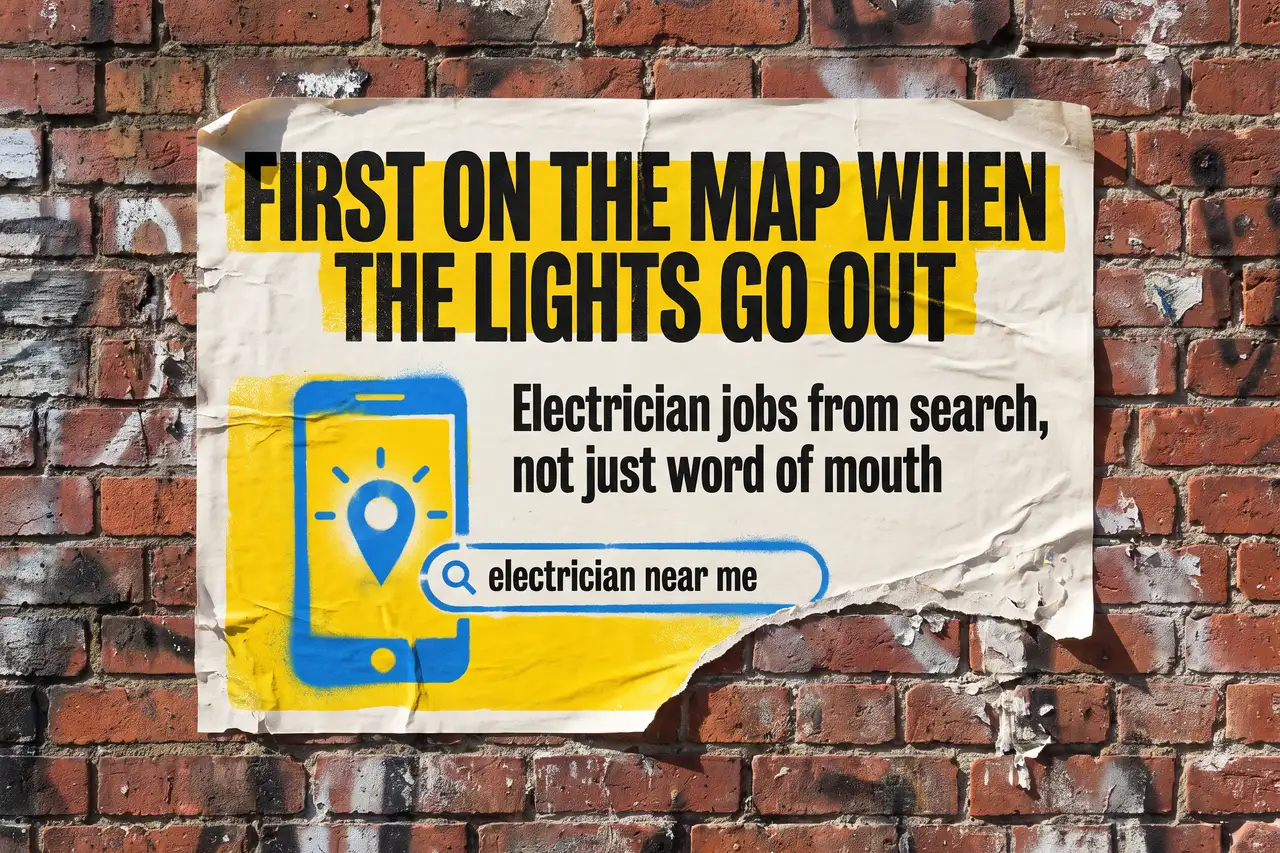
People find an electrician two ways: the map result for ‘electrician near me’, and a page that matches the job and the town. Most electricians’ websites win neither, because the Business Profile is half empty and the site has one page for every job.
The six things to check, in order:
- Your Google Business Profile is thin, or the category is wrong
- Every job is on one services page
- Your areas are a list in the footer, not pages
- Your registration, insurance and pricing are not in words anywhere
- You have not answered the questions people ask before they search for an electrician
- You are counting visits when you should be counting calls by job
Most firms have four of these at once. None of them needs a new website.
Not Sure where to start?
All of this is a couple of weekends if you know how people search for electricians, and a year of wondering if you do not. If you would rather someone fixed the profile, wrote the job and area pages and told you plainly which jobs are now coming from search, that is what our SEO & AI service for electricians does.
Why Is My Electrician Website Not Getting Calls? The Full Guide
Work through these in order. The Business Profile comes first because for most electricians it is where the calls actually come from, and it moves faster than anything else on the list.
Your Google Business Profile is thin, or the category is wrong
Search ‘electrician near me’ from your phone. The map with three firms is what everyone sees first, and those three came from Google Business Profiles, not websites. If you are not in that box, or you are in it with a name, a number and three old reviews, the emergency call went to somebody else before your site was ever an option.
Open your profile as a customer would. Is the primary category ‘Electrician’, not ‘Contractor’ or ‘Electrical supply store’? Is the service area set to the towns you actually cover rather than one postcode? Are there photos of your work, your van and you, or just the logo? Is every service you offer listed, in the words customers use? Has every review been answered, including the grumpy one?
Then start asking for reviews properly. A short message with the link after every finished job. Recent reviews matter more than old ones, and the firm with forty from this year beats the firm with a hundred from 2021.
This is an afternoon’s work and it moves faster than anything else here. Our guide to why a business is not showing on Google Maps covers the mechanics if the profile is missing altogether.
Every job is on one services page
Someone with a new electric car types ‘EV charger installation’ and their town. A landlord types ‘EICR’ and their town. Someone with a 1970s fuse box types ‘consumer unit replacement cost’. Those are different people, with different budgets, on different days.
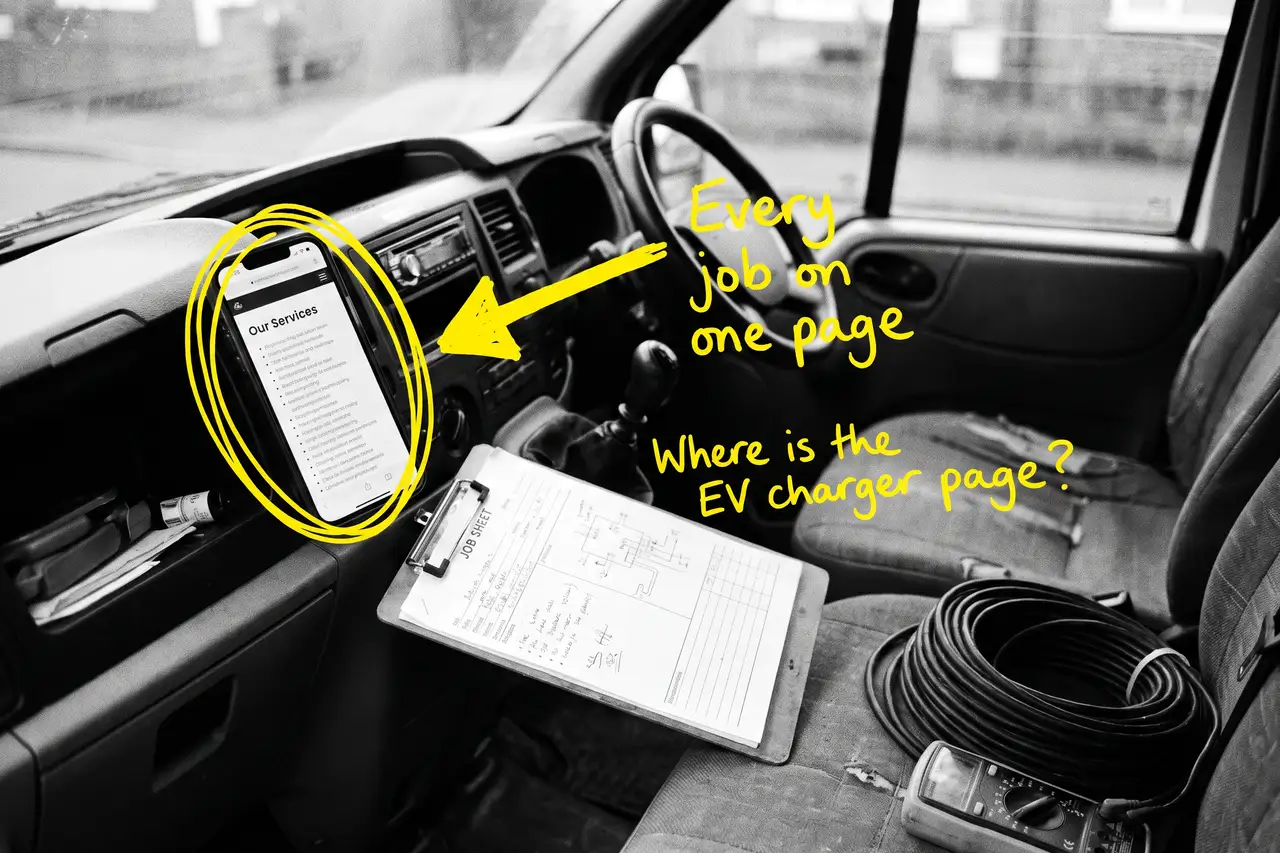
Most electricians answer all three with a services page that says rewires, testing, lighting, EV chargers, fault finding, and a phone number. Google cannot rank a bullet point for a search that another firm has given a whole page to, and the customer cannot tell from a bullet point whether you actually do that job or just list it.
Write a page for each job you want more of. What it involves, how long it takes, a price range or how you price it, what the customer gets at the end, which areas you do it in, and three photos of that job done. Link it from the navigation and from the homepage.
Start with the two or three jobs that make you the most money, not the full list.
Your areas are a list in the footer, not pages
Your footer says you cover Buckinghamshire and Berkshire. Your customer searches ‘electrician Beaconsfield’. Google has nothing from you about Beaconsfield, because a list of town names is not a page, so the firm down the road with a plain page about its Beaconsfield work gets the call.
You do not need a page for every village. Two or three for the towns where you want more work, each with the jobs you have done there, the kinds of property you see there and anything local that matters, such as a lot of 1930s semis with original wiring. That is the local detail a customer in that town wants to read.
We built our own area pages for FlyPost on the same principle. The ones that rank have real local substance. The ones that are the same paragraph with the town name swapped do not, and Google is good at spotting the difference.
Your registration, insurance and pricing are not in words anywhere
The two things a customer worries about when hiring an electrician are whether the work will be safe and whether they will be overcharged. A NICEIC or NAPIT logo in the footer answers neither, because most people do not know what it means.
Say it in words, near the top of every job page. What your registration means for the customer. That you are Part P registered and what certificate they get at the end. That you carry public liability insurance and for how much. How you price: hourly, fixed quote, call-out fee or not.
Then put a price range on the jobs where you can. ‘A full rewire on a three-bed semi is typically between X and Y’ does not lock you in and it does answer the question everyone has and nobody asks. The firm that publishes a range gets the call from the customer who has already accepted it.
You have not answered the questions people ask before they search for an electrician
A fortnight before someone searches for an electrician, they search ‘how much does a rewire cost’, ‘do I need an EICR to rent out my house’, ‘can I fit my own EV charger’ or ‘why does my RCD keep tripping’. Those searches are where the customer decides whether to hire anyone at all and roughly what to expect.
A firm that answers them plainly, on its own site, meets the customer first and is trusted by the time they are ready. It is also what AI tools cite when somebody asks the same thing in ChatGPT or Google’s AI Mode.
Write a short, honest page for each. Say when a customer does not need an electrician. That honesty is what makes the ones who do ring you rather than the firm that pretends everything is urgent.
You are counting visits when you should be counting calls by job
An electrician’s website can double its visits and take no more work, usually because the visits are apprentices looking for a course, DIYers reading the RCD page, or people in the wrong county.
Put a tracked phone number on the site and a simple quote form, and look at which page each call or form came from. In Search Console, look at which searches you appear for and whether they are jobs and towns you want. If ‘electrician jobs’ or ‘electrician course’ is your biggest search, your careers page is doing the ranking and your job pages are not.
Once the calls start, count them by job type and town. That tells you which page to build out next and which work the website is actually bringing in.
Common Mistakes
If you are still asking why is my electrician website not getting calls after a couple of months of changes, one of these is usually why.
- Rebuilding the website before fixing the Business Profile. The profile is what people ring for emergency and near me searches, and a new theme changes nothing about it.
- Listing every job you have ever done. ‘All electrical work undertaken’ ranks for nothing. Pick the jobs you want more of and give each one a page.
- Hiding prices to avoid scaring people off. It does the opposite. The customer who cannot find a range assumes the worst and rings a firm that published one.
- Buying reviews or asking only happy customers. Google can tell, and so can customers. Ask everyone, after every job, and answer every review including the bad ones.
- Judging it after a month. The profile can move in weeks. Job and area pages take months to rank. Fix the list, then give it a quarter.
DIY lane vs done for you lane
DIY lane:
Fix the Google Business Profile first: category, service area, photos of real work, every service listed, every review answered, and a review request after every job. Write a page for each of your two or three best jobs, with a price range. Write two or three area pages with real local substance. Put your registration, insurance and pricing in words near the top.
Then answer the four pre-search questions, put a tracked number on the site, and leave it alone for a couple of months while you watch calls by job type.
Done for you lane:
This is the first two months of our SEO & AI service for electricians. Business Profile and listings sorted, job pages and area pages written, proof and pricing put into words, structured data added so Google and the AI tools can read it all, call tracking set up.
You get told which jobs and towns are now bringing calls, which are not yet, and why. Then we keep going.
Related Guides on the wall
If you are working out why is my electrician website not getting calls, these three cover the individual fixes in more depth.
- Why Is My Business Not Showing On Google Maps? for getting the Business Profile into the map result in the first place.
- Local SEO Checklist Guide for the full local checklist once the profile is showing.
- Website Enquiry Tracking: Stop Guessing Where Leads Come From for tracking which page each call actually came from.
Why Is My Electrician Website Not Getting Calls FAQs

Because looking professional is not what gets the call. For emergency and near me searches the Google Business Profile gets it, and for planned jobs a page matching the job and the town gets it. A good-looking homepage that says all electrical work undertaken does neither.
Ranges, yes. A typical range for a rewire, a consumer unit change, an EICR or an EV charger does not lock you in, and it answers the question every customer has. The people who ring after reading it are better informed and less likely to argue about the quote.
No. Two or three for the towns where you want more work, each with real local detail, will do more than twenty copies with the town name changed. Google is good at spotting the copies and ignores them.
The Business Profile can move within weeks once it is fixed and reviews start coming in. Job and area pages usually take a quarter or two to rank. Judge the whole thing over six months, not six weeks.
It brings work, and it also takes a cut and puts you next to your competitors. A proper profile and a site with job pages bring the customer to you directly, and those customers are not comparing you against four other quotes on the same screen.
An electrician’s website not getting calls is nearly always a findability problem wearing a design problem’s clothes. Start with the Business Profile, because that is where the emergency calls come from, then give each job you want its own page, and the rest follows from there.
Like this guide?
Tell Google you want more like it. One click, no sign-up, and FlyPost guides start showing up more often in your search results.
Add FlyPost as a preferred sourceTakes you to Google, then straight back here.