
Digital Marketing News Mid-October 2026: The Spam Update Winds Down, Fake Authors Get Flagged And Google Ads Grabs Your Offers
Everything that actually moved in search and ads this week, and what a busy business owner should do about it
Digital marketing news mid-October 2026 is mostly Google tidying up after itself. The spam update that started in late September looks close to done, and Google has spelled out what it now treats as faking it.
There is also a Google Ads change that switches itself on from Monday 12 October, so if you run ads, that is the one with a deadline.
The Quick Version
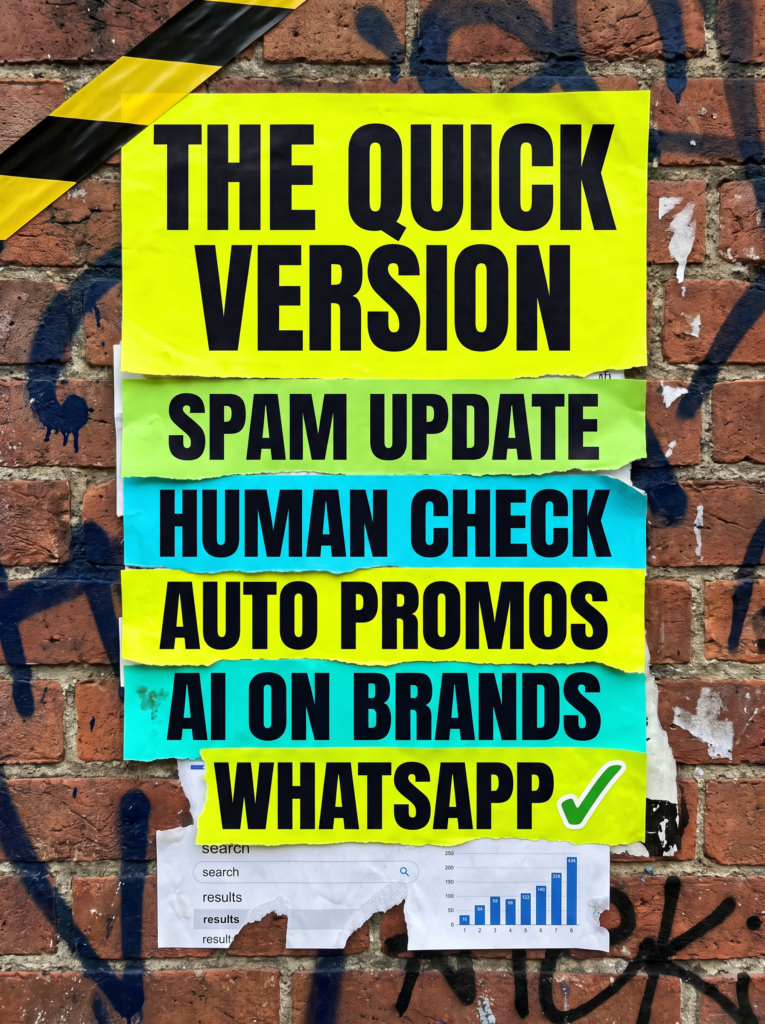
If you have two minutes, here is the week in five lines. Two are about how Google judges your content, one is about your ads, one is about AI answers and one is about your Google listing.
- Google’s September 2026 spam update hit in three waves and looks close to finished. If you do not cut corners, there is nothing to fix.
- Google now calls it critical to fact-check AI-written content by hand, and says fake author names and AI headshots are a sign of a low-quality page.
- From 12 October, Google Ads can pull offers from your website into some Search and Performance Max ads automatically unless you switch it off.
- AI Overviews are now showing for most big brand-name searches, usually further down the page, so check what Google shows when people search your name.
- Google’s local panel is showing WhatsApp buttons for businesses, so make sure any WhatsApp number on your profile is one somebody actually answers.
None of it needs a Tuesday-morning emergency. The ads setting is the only item with a date on it, so start there if it applies to you.
Not sure what to act on first?
If you run Google Ads with location assets, start with the automated promotions setting, because it has a date on it. After that, the most useful hour you can spend is reading your own pages the way Google now says it does: who wrote this, is it accurate and does it actually help?
If you would rather someone else took a look, our free website review picks out one visibility issue, one enquiry issue and one practical improvement to start with.
The Full Guide
When people read the digital marketing news mid-October 2026, they mostly want to know which bits touch their own business. Here is each story in plain English, with what (if anything) to do about it.
The September spam update came in three waves and is nearly done
Google announced its September 2026 spam update on 24 September and said this one would roll out over around two weeks rather than the usual couple of days. Ranking trackers spiked on 25 to 27 September, again on 30 September and again from 4 to 6 October, which Search Engine Roundtable reads as the third and probably final wave.
At a Google Search Central event in Barcelona, Google explained why there have been so many spam updates this year: there is far more new content than before, and Google is now using AI to help catch spam. According to one attendee’s recap, Google’s Gary Illyes warned that scaled content is becoming more of a problem than link spam, and the recap’s advice was to expect more spam updates.
We checked our own site while the trackers lit up. Semrush’s daily UK data for flypostmarketing.com shows ranking keywords rising from 175 on 24 September to 185 on 7 October, with no dip on any of the spike days. One small site proves nothing about yours, but a busy tracker chart is not the same thing as your traffic falling.
What to do: if you have not been churning out pages in bulk or buying links, there is nothing to fix. If you do have a stack of near-identical pages, one per town or service, now is a good time to ask whether each one says something useful.
Google wants a human to check AI content, and a real name on it
Google updated its guidance on AI-generated content to say it is critical to manually factcheck and review all AI-generated content for accuracy before publishing. Its reasoning is blunt: AI tools predict a likely sequence of words rather than look facts up, so they can get things wrong with total confidence.
Google also added a line to its helpful content guidance warning against deceptive authorship information. Made-up author names, AI-generated headshots and false credentials are now described as a form of deception and a signal of a low-quality page.
What to do: if AI helps write your blog or service pages, have someone who knows the subject read every page before it goes live. Put a real name on it, or simply the business name, rather than an invented expert with a generated face.
Google Ads starts adding offers from your website on 12 October
Google has emailed some advertisers to say that from 12 October 2026 it will automatically pull promotions from your website into your ads, things like coupons and deals. It only applies to Search and Performance Max campaigns with linked location assets that do not already have promotion assets attached.
It is switched on by default. To turn it off, go to your account-level automated assets settings, find Automated Promotions and select Off.
What to do: if your website still shows last month’s offer, or a deal that only applies at one branch, either tidy the site or switch the setting off before Monday. An ad promising a discount you no longer honour is a quick way to pay for an awkward phone call.
AI Overviews now show up for most big brand searches
Searching a big brand’s name used to bring up its own site and not much else. One test of around 100 large brands found AI Overviews showing for 93% of them, and DemandSphere reported that AI Overviews on branded searches tripled in September. In most of the examples, the AI answer sat further down the page, below the company’s own result.
That data covers big brands, not local firms, so treat it as a direction of travel rather than something happening to your name today.
What to do: search your business name once a month and look at what comes up, AI answer or not. If your website, opening hours or service list are out of date, fix those first, because they are the parts you control.
Your Google listing may now have a WhatsApp button
Google is now showing WhatsApp buttons in the local panel in search results, next to call, directions, website and share, so people can message a business directly. Google previously asked businesses to add WhatsApp numbers to their Business Profile, and more recently added numbers itself for some businesses.
What to do: open your Business Profile and check whether a WhatsApp number is listed. If it is, make sure it goes to a phone somebody checks during working hours, and remove it if nobody does. An unanswered message is an enquiry you never knew you lost.
Common Mistakes
If the digital marketing news mid-October 2026 has you itching to change everything, these are the overreactions to avoid.
- Rewriting pages that were doing fine because a rank tracker spiked during the spam update.
- Deleting every page AI helped write. The new guidance asks you to check it properly.
- Inventing an author bio to look more expert. Google now calls that deception.
- Leaving automated promotions on without checking which offers your website still shows.
- Adding a WhatsApp number to your listing that nobody watches.
DIY lane vs done for you lane
DIY lane:
Check the automated promotions setting before 12 October. Read your AI-assisted pages and put a real name on them. Search your own business name. Check which WhatsApp number your profile shows. Leave the rest of the site alone while the spam update settles.
Done for you lane:
We read this every week so you do not have to. If you would rather have a second pair of eyes on your site, the free website review is a sensible first step, and it starts with one visibility issue, one enquiry issue and one practical improvement.
Related Guides on the wall
If you are working through the digital marketing news mid-October 2026, these guides cover the practical side in more depth.
Digital Marketing News Mid-October 2026 FAQs
The September 2026 spam update, which rolled out in three waves between 24 September and 6 October and looks close to finished. Sites that do not mass-produce thin pages or buy links have nothing to fix.
Google’s updated guidance says it is critical to manually fact-check and review AI-generated content before publishing. It also warns against fake author names, AI-generated headshots and false credentials, which it calls a signal of a low-quality page.
Go to your account-level automated assets settings, find Automated Promotions and select Off. From 12 October 2026 it applies to Search and Performance Max campaigns with linked location assets that have no promotion assets attached.
It is now common for big brands, with one test finding AI Overviews for 93% of around 100 brands checked. There is less data on small local businesses, so search your own name and see what comes up.
Google has started showing WhatsApp buttons in the local panel. It has previously asked businesses to add WhatsApp numbers to their Business Profile and has added them itself for some, so check which number your profile shows.
Like this guide?
Tell Google you want more like it. One click, no sign-up, and FlyPost guides start showing up more often in your search results.
Add FlyPost as a preferred sourceTakes you to Google, then straight back here.