


AI Search Visibility: How Small Businesses Get Cited

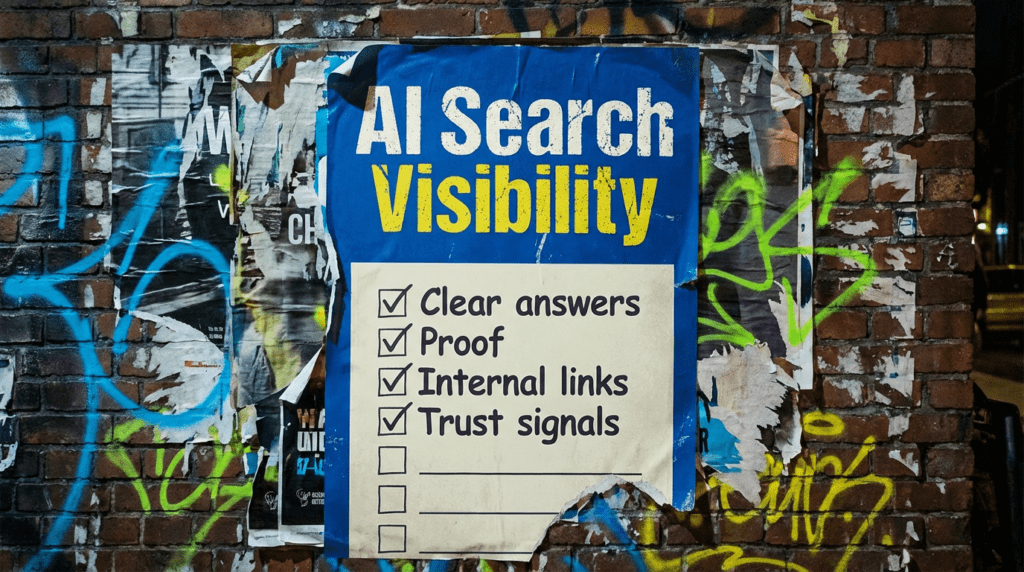
A straight-talking guide to helping your site get found, get cited, and stay useful when search starts answering the question before the click.
AI search visibility comes from clear, useful, trustworthy pages, not clever tricks or AI fluff. If your site is hard to crawl, vague on the point, or packed with content that says a lot without saying much, you are making life harder for yourself. Search is getting more answer-led, which means the pages that win are usually the ones that explain things clearly, prove they know what they are talking about, and make the next step obvious.
This is not about gaming AI. It is about making your content easier to understand, easier to trust, and easier to surface when someone is looking for a real answer.
The Quick version
If you just want the short version, here it is:
- Make sure your important pages can be crawled and indexed
- Answer real questions in plain English
- Add proof, examples, and specifics
- Tighten headings, structure, and internal links
- Use schema where it genuinely helps
- Do not publish bland AI sludge and hope for the best
The basics still do the heavy lifting. Clear pages, helpful content, and solid structure beat trendy jargon every time.
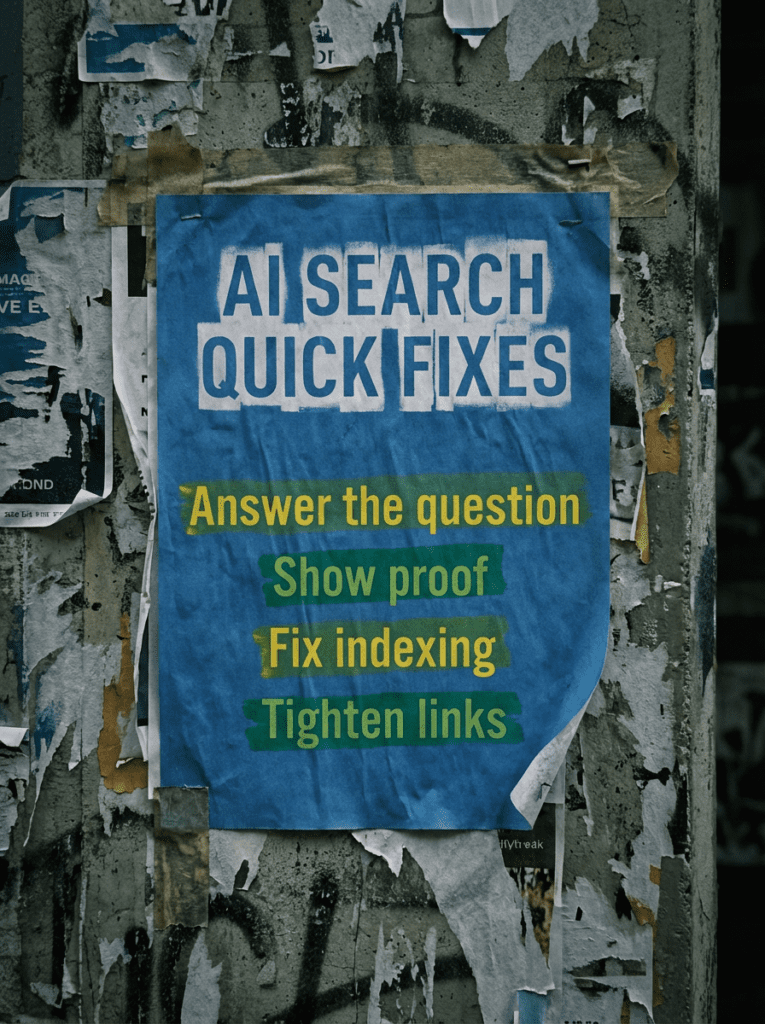
FIX ORDER
The biggest mistake with AI search visibility is starting at the flashy end. People jump straight to AI tools, schema, or whatever new acronym LinkedIn is pretending matters this week, while the basics are still held together with chewing gum.
Fix it in this order:
- Indexing and crawlability
- Page clarity and intent match
- Proof and trust signals
- Internal links and topical structure
- Measurement and iteration
If your page is not indexed, not linked properly, or not saying anything useful, no amount of “AI optimisation” magic dust is going to save it.
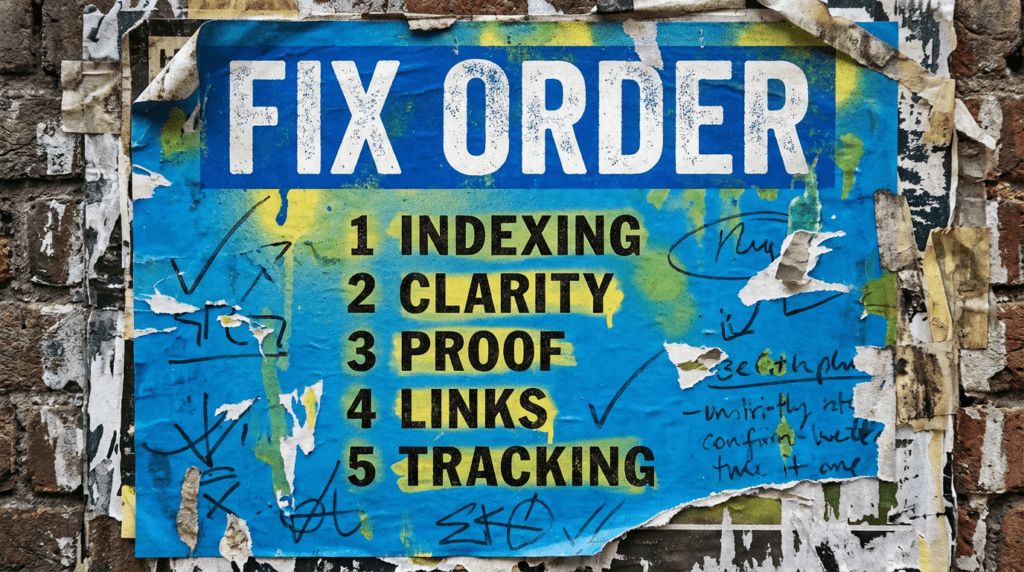
OUR FULL GUIDE TO AI SEARCH VISIBILITY
What AI search visibility actually means
AI search visibility means your pages are easier to find, easier to understand, and more likely to be pulled into answer-led search experiences.
In plain English, your page should make three things obvious fast:
- What the page is about
- Why someone should trust it
- What they should do next
That is it. No secret handshake. No special robot language. Just clear, useful pages that do their job properly.
Start with pages worth citing
If the page is thin, vague, generic, or sounds like it was assembled by a machine that has never run a business in its life, it is not a strong citation candidate.
A page with decent AI search visibility usually does a few simple things well:
- Answers a specific question or solves a specific problem
- Explains the point quickly
- Includes useful detail, not just filler
- Sounds like someone who knows the subject actually wrote it
For small businesses, that often means improving the pages you already have before pumping out twenty half-baked blog posts. One strong service page and one genuinely useful guide will usually do more than a content graveyard full of “top tips”.
Make trust obvious
Plenty of pages are easy to understand. Fewer are easy to trust.
That means adding things like:
- Real examples
- Clear service detail
- Specific claims you can stand behind
- Proof points or outcomes
- A clear business identity
- Sensible supporting pages around the topic
If you are a local business, this is where local trust signals matter too. A solid service page, a decent Google Business Profile, and consistent business information help people decide whether you are the real deal or just another site making noise.
Sort crawlability and indexation before you get clever
This bit is boring. It is also where a lot of sites quietly lose.
Before you start worrying about AI visibility, check:
- Is the page indexed?
- Is it linked from other important pages?
- Does it sit in a sensible content cluster?
- Do the title and heading make the topic obvious?
- Can search engines actually crawl it?
Format answers for humans first
A lot of AI search visibility is really just good information design.
- A clean definition early
- Strong H2s
- Short sections
- Direct answers near the top
- Examples where they help
- A sensible next step
That helps the human skim the page without getting lost, and it makes the page easier to follow in answer-led search too. What you do not need is robotic question and answer copy jammed into every paragraph like you are trying to train a lab rat.
Use AI as a helper, not the finished product
AI is useful for speeding things up. It is not an excuse to publish six pages of polished nothing.
- Speed up outlines
- Organise ideas
- Spot gaps
- Pressure-test headings
Do not use it to flood your site with empty pages that all sound tidy and say nothing new. The quickest way to become forgettable is to sound polished while adding no value.
Measure the right things
One of the easiest ways to waste time is getting obsessed with whether your brand appeared in one AI answer somewhere on the internet at 11:43 on a Tuesday.
Start with the basics:
- Impressions for relevant queries
- Clicks to the right pages
- Leads and enquiries
- Assisted conversions
- Visibility growth for important topics
- Whether your best pages are being supported by internal links
That is the bit too many people miss. Visibility matters, but business outcomes matter more.
COMMON MISTAKES THAT HURT AI SEARCH VISIBILITY
Here are the mistakes that usually trip people up:
- Publishing vague pages with no clear point
- Writing content that sounds clever but says nothing useful
- Ignoring internal links
- Relying on AI to write everything without adding any real substance
- Chasing “AI mentions” before fixing indexing and structure
- Treating the site like a pile of separate pages instead of a connected content system
A lot of this comes down to fix order. People love skipping to the shiny bit. Sadly, the shiny bit usually sits on top of boring stuff that still needs doing.
COMMON MISTAKES THAT HURT AI SEARCH VISIBILITY
Here are the mistakes that usually trip people up:
- Publishing vague pages with no clear point
- Writing content that sounds clever but says nothing useful
- Ignoring internal links
- Relying on AI to write everything without adding any real substance
- Chasing “AI mentions” before fixing indexing and structure
- Treating the site like a pile of separate pages instead of a connected content system
A lot of this comes down to fix order. People love skipping to the shiny bit. Sadly, the shiny bit usually sits on top of boring stuff that still needs doing.
DIY lane vs done for you lane
DIY lane:
If you are handling this yourself, focus on one important page at a time. Tighten the opening, improve the structure, add proof, add internal links, and make sure the page is indexed. That gets you further than most businesses ever bother going.
Done for you lane:
If you do not want the homework, that is where a proper AI search optimisation service comes in. The DIY version is useful, but the done for you version is about saving time, getting the order right, and avoiding the usual mess of half-finished fixes and random content.
RELATED GUIDES ON THE WALL
If you’re working on AI search visibility, these guides will help you sort the technical basics, strengthen visibility, and clean up the pages that need to be found first.
If you would rather someone handled this properly, our AI SEO packages build the SEO foundations first, then the AI-search layer on top. From £749/month.
- Read the Technical SEO Checklist for WordPress if your site structure, crawlability, or page setup is holding you back.
- Check Page not indexed in Google Search Console if important pages are still not appearing in search at all.
- Use the Local SEO Checklist Guide if you want stronger local visibility alongside broader search improvements.
AI search visibility FAQs

AI search visibility is how well your pages can be found, understood, and surfaced in answer-led search experiences. It comes from clear, useful, trustworthy content and solid technical basics.
A bit, but not as much as people make out. The foundations are still the same: clear pages, good structure, useful content, and proper technical basics.
Not usually. Use structured data where it genuinely helps explain the page and matches the visible content. It is useful support, not a magic trick.
It can help if it supports quality work, but it should not be the finished product. AI is a helper, not a substitute for having something worth saying.
Start with impressions, clicks, leads, and whether the right pages are gaining visibility. Do not build your whole strategy around stalking one answer box like a maniac.

Quick tip
Rather have us handle this instead of DIY-ing it? That is literally the job.

Straight talking marketing that gets results.
No pressure, no jargon. Just a clear look at what’s stopping your site from bringing in more enquiries.
Get my free website reviewLike this guide?
Tell Google you want more like it. One click, no sign-up, and FlyPost guides start showing up more often in your search results.
Add FlyPost as a preferred sourceTakes you to Google, then straight back here.