
How Do I Get More Valuation Leads?
The pages sellers search for before they pick an agent, and most agency websites do not have
If you are searching how to get more valuation leads, you have probably already done the obvious. The portal subscription is paid, the boards are out, the branch window is fresh and the website was redone not long ago with a property search on the homepage and a big valuation button. Yet the valuation diary is thin, the instructions you do win come from people who already knew you, and the corporate agency down the road seems to get every seller who searched on their phone.
That is rarely one big problem. It is a short list of things a seller looks for before they invite anyone round, and most agency websites answer none of them because they were built to show listings rather than to win instructions.
Quick Version
Sellers find an agent three ways: the map result for ‘estate agents near me’, a search for the town or area they live in, and a comparison search once they have shortlisted two or three and want to know the fee and what happens at the valuation. Most agency websites win none of them, because the site is a listings search, the areas are a list and the valuation is a button.
The six things to check, in order:
- Your website is a listings search, not a set of area pages
- The valuation is a button, not a page
- Nobody can find your fee
- Each branch does not have its own Google Business Profile
- Lettings is a tab
- You are counting visits, not valuation requests by area
Most agencies have four of these at once. None of them needs a new website, and none needs to come out of the portal budget.
Not Sure where to start?
All of this is a few quiet weekends if you know how sellers search for an agent and how to write an area page that ranks, and a year of wondering if you do not. If you would rather someone wrote the area and valuation pages, put the fee on the site, sorted the branch profiles and told you plainly which areas are now bringing valuation requests, that is what our SEO & AI service for estate agents does.
How Do I Get More Valuation Leads? The Full Guide
Work through these in order. The area pages come first because they are where the sellers you do not already know come from, and the valuation page comes second because it decides whether those sellers book the visit or just take the number.
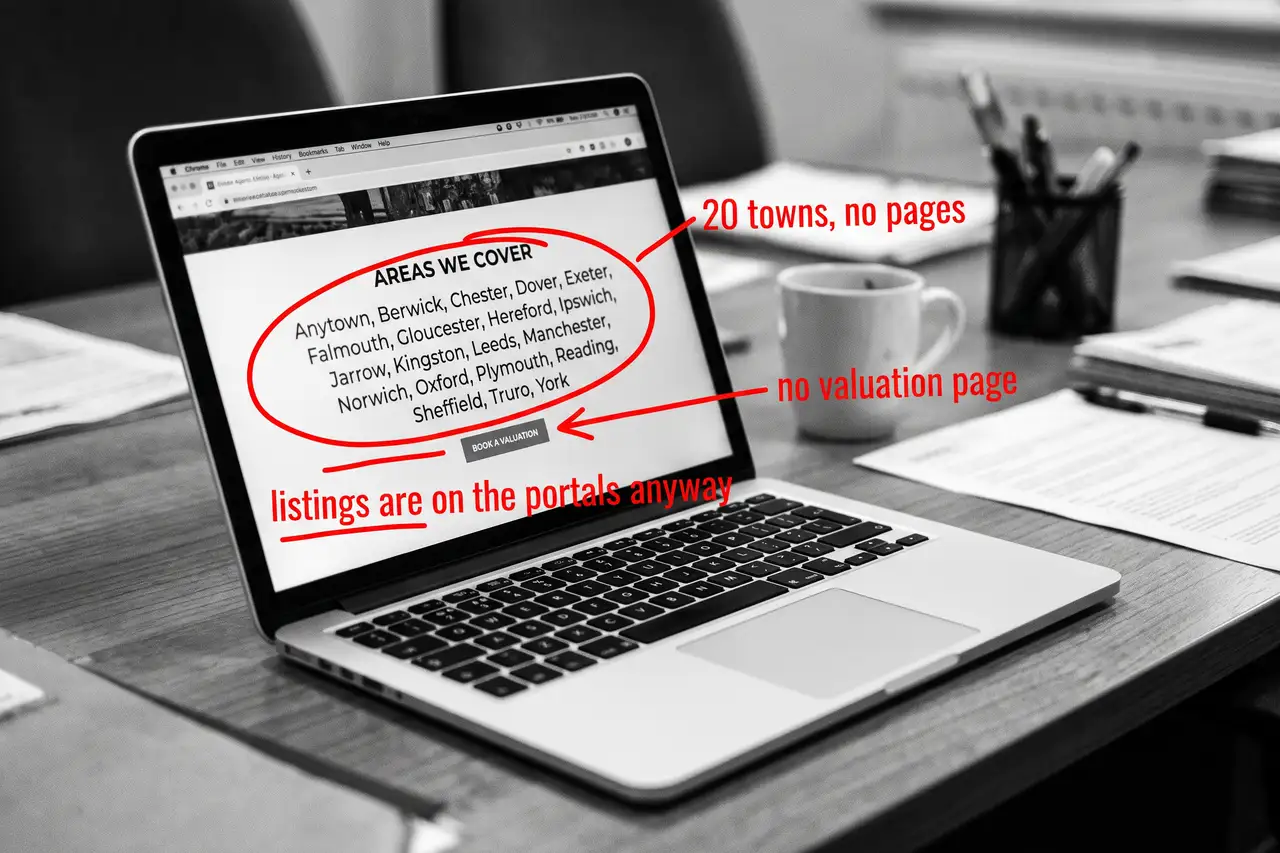
Your website is a listings search, not a set of area pages
A seller in Beaconsfield types ‘estate agents Beaconsfield’. A landlord types ‘letting agents Amersham’. Someone thinking about downsizing types ‘how much is my house worth’ and their town. Those are different people on different days, and most agency websites answer all of them with a property search box, an about page and a list of towns in the footer.
The listings cannot do this job. Every property already has a better page on the portal, and yours dies when it completes, taking whatever Google learned about it. The pages that last are the ones about the place: what you have sold there, the property types and the streets, who the buyers are, which branch covers it and how a seller books a valuation there.
Write one for each area you genuinely want instructions from. Start with the six or eight that make the branch its money, not every village on the sign. Put real sales on it, with the road and the type of house rather than the price. Link each area page to the branch page and to the valuation page. We built our own area pages the same way, and they only started working once each one had something on it that was true of that town and nowhere else.
The valuation is a button, not a page
The highest-intent search on the whole site is ‘free house valuation’ plus your town, and on most agency websites it lands on a bare form, or on an instant-valuation widget that hands over a number and a phone call from a call centre. The seller gets the number, feels no closer to choosing you, and rings whoever else came up.
Give the valuation its own page. The difference between the instant figure and a visit, who will come round, how long it takes, what they will look at, what you will ask, what you charge and what happens next if they instruct you. Then the form, with as few fields as you can stand. Say plainly that a valuation is not a commitment.
That page ranks for the valuation searches on its own, and the seller who arrives at your form having read it has already half chosen you.
Nobody can find your fee
Sellers search ‘estate agent fees UK’ and ‘how much commission do estate agents charge’ before they invite anyone round, and they will find an answer whether or not it is yours. If your site says ‘contact us for our fees’, they assume you are the expensive one and they arrive at the valuation already negotiating.
Publish a fees page in plain text. The percentage or the fixed fee, what it includes, what the online agents leave out, whether there is a withdrawal fee and when it is paid. Do the same for lettings: let only, rent collection, fully managed, and the set-up costs, in a table rather than a PDF.
That page is also what AI tools cite when someone asks what an agent should charge, so it earns its place twice.
Each branch does not have its own Google Business Profile
Search ‘estate agents near me’ from your phone, from a customer’s road. The map with three agencies is what every seller sees first, and those three came from Google Business Profiles, not websites. If your branch is not in that box, or it is in it with the head office address, a logo instead of a photo and reviews nobody answered, the seller shortlisted someone else.
Open each branch profile as a seller would. Does each branch have its own, with its own address, phone number and hours? Is the primary category right, with a lettings secondary where lettings applies? Are the photos the actual branch and the actual team? Are recent sales and lets posted? Has every review been answered, including the one about the viewing that was cancelled?
Then ask for reviews at completion and at the start of a tenancy, with the link, and ask the client to mention the road. A review that says ‘sold our house on Station Road in three weeks’ does more than ten that say ‘great service’.
Lettings is a tab
Landlords are a different buyer with different questions, and they search differently: ‘letting agents’ plus the town, ‘fully managed or let only’, ‘what does a letting agent charge’, ‘what do I need to let my flat’. On most agency websites all of that is answered by one page hung off the main menu.
Give lettings its own section. Area pages for landlords where the stock is, a plain fees page, a landlord guide that answers the practical questions without pretending to be a solicitor, and a page that says what fully managed actually means at your branch. Set up the Business Profile so lettings shows as a service.
A landlord who finds a proper lettings section instructs you for the flat and then, often enough, for the house they sell later.
You are counting visits, not valuation requests by area
An agency website can double its visits and produce no more valuations, usually because the visits are buyers browsing listings, tenants looking for a flat, or people checking what the house down the road went for.
Put a tracked phone number on the site, keep the valuation form short, and make sure each request records which page it came from. In Search Console, look at which searches you appear for and whether they are the area and valuation searches you want. If your biggest search is a property address, the listings are doing the ranking and the area pages are not.
Once you can see valuation requests by area and branch, you know which area page to write next and which branch the website is actually feeding. Report that to the partners instead of the visit count.
Common Mistakes
If you are still searching how to get more valuation leads after a couple of months of changes, one of these is usually why.
- Rebuilding the property search before writing the area pages. The search box is for buyers. Sellers want the page about their town.
- Letting a widget be the valuation page. The instant figure gives the seller a number and no reason to choose you.
- Hiding the fee. Sellers find a number somewhere, and if it is not yours they arrive negotiating.
- One Business Profile for the whole agency. Each branch needs its own, or the second branch does not exist to Google.
- Judging it after a month. The profiles can move in weeks. Area and valuation pages take months to rank. Fix the list, then give it a quarter.
DIY lane vs done for you lane
DIY lane:
Write a page for each of your six best areas, with real sales and the branch that covers it. Give the valuation its own page that explains the visit, and put the fee in plain text beside it. Fix each branch’s Google Business Profile: own address, own phone, the right categories, photos of the branch and the team, every review answered, and a review request at every completion.
Then give lettings its own section with its own fees page, put a tracked number on the site, and leave it alone for a couple of months while you watch valuation requests by area.
Done for you lane:
This is the first two months of our SEO & AI service for estate agents. Area pages written for the places you want instructions from, the valuation and fees pages written, Business Profiles sorted for every branch, lettings given its own section, structured data added so Google and the AI tools can read it all, and valuation tracking by area set up.
You get told which areas and branches are now bringing valuation requests, which are not yet, and why. Then we keep going.
Related Guides on the wall
If you are working out how to get more valuation leads from your own site, these three cover the individual fixes in more depth.
- Local SEO Checklist Guide for the branch profile, the service area and the area pages, in order.
- Why Is My Business Not Showing On Google Maps? for getting each branch into the map result in the first place.
- Service Page Checklist: Turn More Visits Into Enquiries for turning the valuation page into one that earns the request.
How Do I Get More Valuation Leads FAQs

Write a page for each area you want instructions from, give the valuation its own page that explains the visit, publish your fee, fix each branch’s Google Business Profile and give lettings its own section. Sellers are already searching for an agent in their town. The agency that answers those searches best gets the valuation, and it is not shared with everyone else on the portal.
They bring names and numbers, and some of those become valuations if someone rings quickly. What they do not do is give the seller a reason to choose you over the next agency with the same widget. A written valuation page in front of the tool, explaining the visit and the fee, turns more of those numbers into booked appointments.
Yes. Sellers search the fee before they invite anyone round, and the agency that explains its fee and what it includes is trusted before it is visited. Hiding it reads as expensive, and a plain fees page is also what AI tools cite when someone asks what an agent should charge.
As many areas as you genuinely want instructions from and have sold in, usually six to ten per branch, each with real sales and something true of that place. A list of thirty villages with a sentence each ranks for none of them. Set each branch’s Business Profile service area to match.
The Business Profiles can move within weeks once they are fixed and reviews start arriving. Area, valuation and fees pages usually take a quarter or two to rank, and the spring market shows it fastest. Judge it over six months on valuation requests by area, not on visits, and keep the portal running while your own pages catch up.
Getting more valuation leads is nearly always a matter of writing for the seller and the town rather than for the buyer and the listing. Start with the area pages and the valuation page, put the fee where people can find it, and the rest follows from there.
Like this guide?
Tell Google you want more like it. One click, no sign-up, and FlyPost guides start showing up more often in your search results.
Add FlyPost as a preferred sourceTakes you to Google, then straight back here.