
How To Get More Construction Leads Without Buying Them
The six things clients and their consultants search for that most construction websites do not answer
If you are searching how to get more construction leads, you have probably already tried the obvious. A lead platform or a tender portal, a monthly fee, and a stream of opportunities that six other contractors received at the same moment, half of them for work you would never price. The website, meanwhile, is a drone shot, one services page that covers everything from extensions to industrial units, a gallery with no words and an enquiry form that fills up with people wanting a quote for a porch.
The clients you actually want are searching right now. Developers, facilities managers, architects and quantity surveyors building a tender list are typing the type of work, the sector and the county into Google and into AI tools, and your website has nothing to say about any of them.
Quick Version
Clients search the type of work and the sector first, the area throughout, and the contractor’s name last, once you are already on the list. Most construction websites answer none of that, so the invitation goes to a portal, a national or whoever had a page about fit-outs in that county.
The six things to check, in order:
- Your site has one services page for every kind of work
- There are no sector pages, so the client cannot see themselves
- Your projects are photos with no words
- The site never says what size of job you take
- Your accreditations and people are a logo strip
- You are counting visits, not enquiries by type of work
Most construction companies have four of these at once. None of them needs a new website, and all of them can be done from the office in the quiet weeks.
Not Sure where to start?
All of this is a few weeks of somebody’s time if you know how clients and consultants search for a contractor and how to write a page that ranks for a type of work in a county, and a year of paying for leads if you do not. If you would rather someone wrote the work and sector pages, turned your projects into pages, spelt out the accreditations and told you plainly which searches are now bringing tender invitations, that is what our SEO & AI service for construction companies does.
How To Get More Construction Leads Without Buying Them: The Full Guide
Work through these in order. The work and sector pages come first because they are where the enquiries you actually want come from, and the project pages come second because they are what a consultant reads before your name goes on the tender list.
Your site has one services page for every kind of work
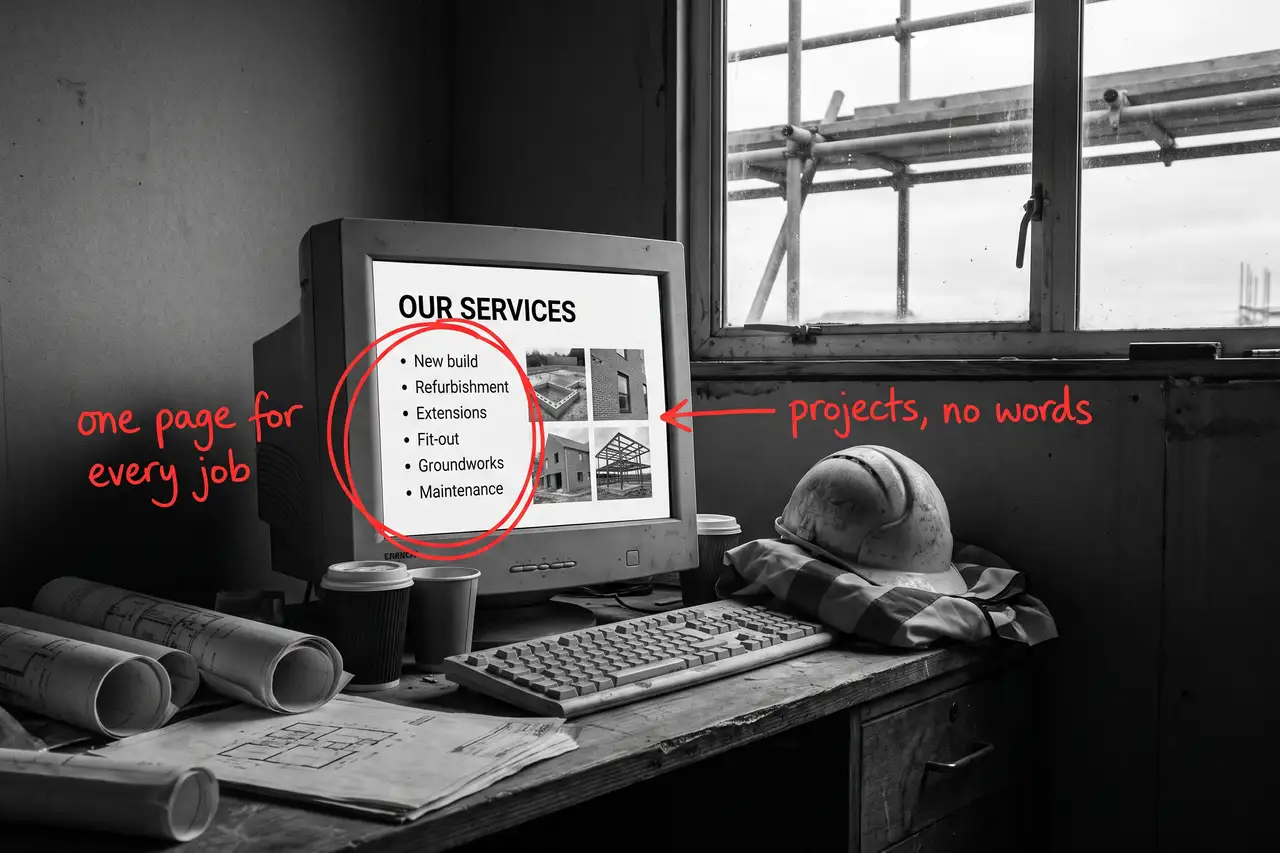
A developer types ‘design and build contractor’ and the county. A facilities manager types ‘commercial refurbishment contractors’. An architect types ‘groundworks contractor near me’ for a client’s scheme. A homeowner with planning consent types ‘building company’ and the town. Those are different people with different budgets, and most construction websites answer all of them with one page that says new build, refurbishment, extensions, fit-out, groundworks and maintenance, under a drone shot.
Google cannot rank a list against a page that explains the work properly, and the buyer cannot tell from a list whether you run fit-outs every month or did one once.
Write a page for each type of work you want more of. What it involves, how you run it, the contract forms you work under, the typical project size, how the pricing works and what the client needs to have ready before you can price it. Start with the two or three types of work that pay for the business, not the full list.
There are no sector pages, so the client cannot see themselves
A school business manager, a care home operator, a warehouse landlord and a housing developer all want the same thing before they ring: proof you have built for someone like them and understand what makes their site awkward. Term-time working, residents in the building, a live loading bay, a planning condition. ‘Education construction contractor’, ‘care home building contractors’ and ‘industrial construction companies’ are searches with a real buyer behind them.
Give each sector you want more of a page. The projects you have done in it, the compliance and safety points that come with it, how you phase work around a live operation, and who at your company knows the sector. Link every project page in that sector to it.
A logo wall of past clients does none of this. A sector page with three real projects and a paragraph on working around a live kitchen does all of it.
Your projects are photos with no words
A finished project is the best sales material you have, and on most construction websites it is a gallery of drone shots with a location and nothing else. Google cannot rank a photo, an AI tool cannot cite one, and the quantity surveyor comparing you with two other firms at 9pm cannot tell what they are looking at.
Turn your best projects into pages. One per project: the client type, the sector, the scope, the value band, the programme, the contract form, the problems on site and how you solved them, and the contracts manager who ran it. Six to ten photos with captions that say what is in them. Twenty of those pages rank for type of work plus sector plus area on their own, and they are what puts your name on the list.
Link each project page from the work page it belongs to and from the sector page. That is the whole site starting to work as one thing.
The site never says what size of job you take
The biggest waste in construction marketing is not being invisible, it is being visible for the wrong work. A company that wants commercial projects worth hundreds of thousands and ranks for ‘builders near me’ spends its week quoting porches and single-storey extensions, and the developer who did find the site assumed it was a small builder because nothing said otherwise.
Say plainly what you take and what you do not. Minimum project value, the counties you work in, whether you do design and build, whether you take domestic work at all, and the sectors you stay out of. On the homepage, on the contact page, in the Business Profile description.
Then check Search Console. If your biggest searches are for work you do not want, the page ranking for them needs rewriting or removing, and the pages for the work you do want need building. Saying no on the website is what gets the enquiries worth pricing.
Your accreditations and people are a logo strip
Before a client or their consultant adds you to a tender list they check three things: your accreditations, your insurance and who will actually run the job. Most construction websites answer with a row of badges in the footer and a team page with three job titles and no faces.
Put it in words on one page. Which accreditations you hold and what each one covers, your insurance limits, your health and safety approach as far as you can honestly state it, and your registered company details so the name matches everywhere. Then a page per director and contracts manager: the projects they have run, the sectors they know and how to reach them.
That is what turns a tender list into a phone call, and it is what AI tools draw on when someone asks which contractors in your county are set up for a type of work.
You are counting visits, not enquiries by type of work
A construction website can double its visits and produce no more tender invitations, usually because the visits are people looking for a job on site, students, or homeowners two counties away.
Put a tracked phone number on the site and a short enquiry form on every work page that asks the type of work, the sector, the rough value and the location, and record where each enquiry came from. In Search Console, look at which searches you appear for and whether they are the work, sector and area searches you want. If ‘construction jobs’ is your biggest search, your careers page is doing the ranking and your work pages are not.
Once you can see enquiries by type of work and sector, compare what a serious enquiry costs you from your own pages against the lead platform’s fee. That comparison is usually the point at which the budget moves.
Common Mistakes
If you are still searching how to get more construction leads after a couple of months of changes, one of these is usually why.
- Writing for ‘construction company’ instead of the type of work and the sector. The generic term belongs to the nationals and the portals. ‘Commercial refurbishment contractor’ plus your county belongs to whoever explains it best.
- Letting the gallery do the talking. A drone shot cannot rank and cannot be cited. Every project you are proud of needs words around it.
- Hiding the project size. If the site never says where you start, the enquiry form fills with porches and the developers assume you are small.
- Leaving accreditations as badges. A consultant needs to read what you hold and what it covers, not squint at a footer.
- Judging it after a month. Work and project pages take months to rank, and construction buying cycles are long. Fix the list, then judge it over two quarters on tender invitations.
DIY lane vs done for you lane
DIY lane:
Write a page for each of your two or three best types of work, with how you run them, typical project size and how pricing works. Write a page for each sector that pays for the business, with the projects and the points about working around a live site. Say on the homepage and the contact page what size of job you take and where. Spell out accreditations, insurance and key people on one page.
Then turn your ten best projects into pages with the client type, scope and value band, put a tracked number and a short form on every work page, and leave it alone for a couple of months while you watch enquiries by type of work.
Done for you lane:
This is the first two months of our SEO & AI service for construction companies. Work and sector pages written, your best projects turned into pages, the site made plain about project size and area, accreditations and people spelt out, Business Profile sorted, structured data added so Google and the AI tools can read it all, and enquiry tracking by type of work set up.
You get told which types of work and sectors are now bringing enquiries, which are not yet, and why. Then we keep going.
Related Guides on the wall
If you are working out how to get more construction leads from your own site, these three cover the individual fixes in more depth.
- Service Page Checklist: Turn More Visits Into Enquiries for turning each type of work into a page that ranks and gets the enquiry.
- Why Is My Homepage Ranking Instead Of My Service Page? for when the drone-shot homepage outranks the pages that should be doing the work.
- Local SEO Checklist Guide for the Business Profile and the counties you cover, in order.
How To Get More Construction Leads FAQs

Write a page for each type of work you want more of, a page for each sector, turn your best projects into pages with the value band, say plainly what size of job you take and spell out your accreditations. Clients and their consultants are already searching the type of work and the county. The contractor that explains it best gets the invitation, and it is not shared with six other firms.
Portals are useful for public sector work you could not otherwise see, and a lead platform can plug a quiet quarter. The maths only works if you track enquiries won rather than leads received, because a bought lead is usually priced by several contractors at once. An enquiry from your own sector page arrives having read how you work and seen three projects like theirs. Compare cost per project won, not cost per lead.
As bands, yes. A minimum project value on the site and a value band on each project page tell a developer whether to ring you and tell the homeowner with a porch not to. You do not publish rates. You stop attracting the enquiries you would never price.
As many sectors as you genuinely want work in and have built in, usually four or five, each with real projects and the compliance and phasing points that come with it. A footer list of twelve industries ranks for none of them. Start with the sector that pays for the business.
The Business Profile can move within weeks once it is fixed. Work, sector and project pages usually take a quarter or two to rank, and construction buying cycles are long, so the first tender invitation from a page may come months after it starts ranking. Give it six months on enquiries by type of work, and keep the portal running until your own pages are carrying the load.
Getting more construction leads without buying them is nearly always a matter of writing for the type of work, the sector and the county rather than for the words ‘construction company’. Start with the two or three types of work that pay for the business and the projects that prove them, and the rest follows from there.
Like this guide?
Tell Google you want more like it. One click, no sign-up, and FlyPost guides start showing up more often in your search results.
Add FlyPost as a preferred sourceTakes you to Google, then straight back here.