

How To Get More Landscaping Clients Without Paying For Leads
The six things homeowners search for that most landscaping websites do not answer
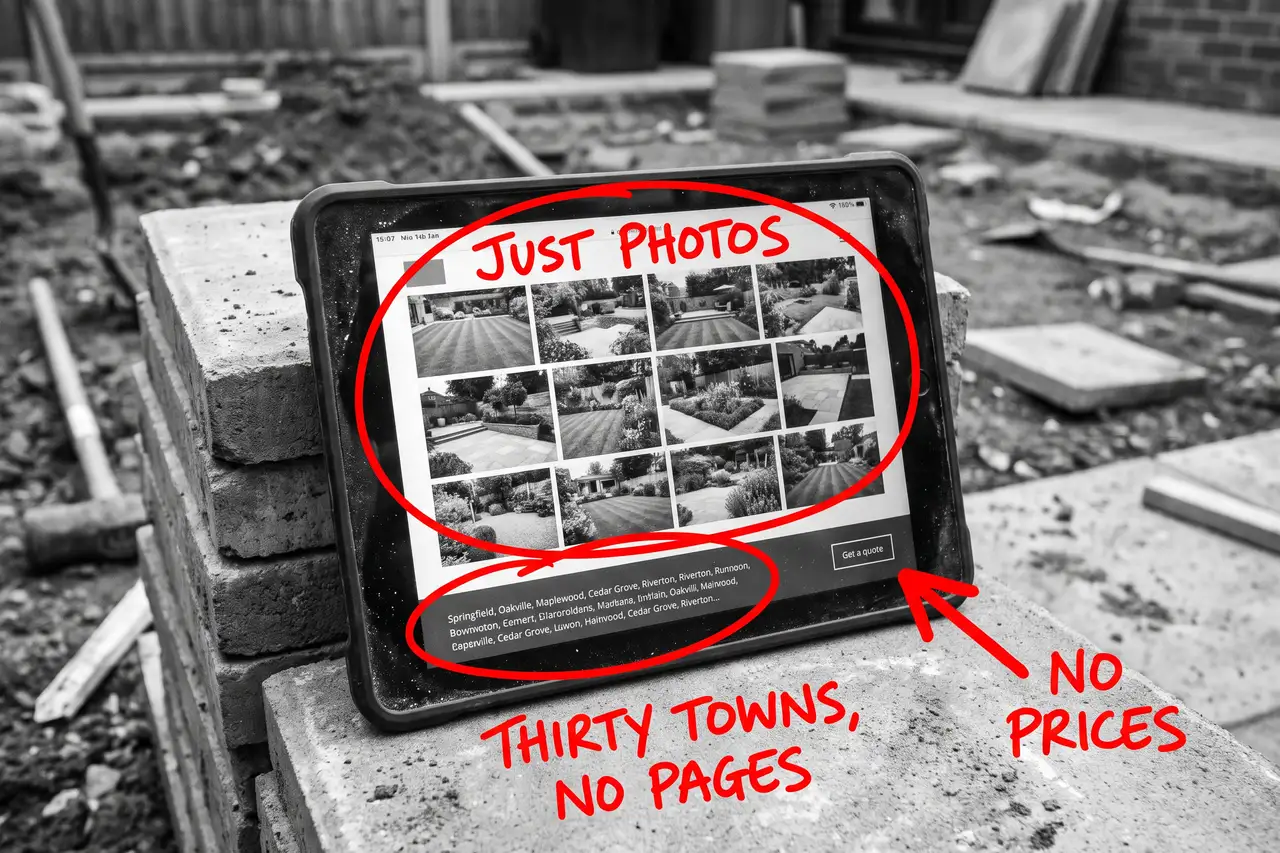
If you are searching how to get more landscaping clients, you have probably already tried the obvious route. A lead platform, a monthly fee, and a stream of enquiries that five other landscapers received at the same moment, half of them for a job that turns out to be a fence panel. The website, meanwhile, is a photo gallery, a list of thirty towns in the footer and a ‘get a quote’ form that fills up with people selling you SEO.
The homeowners you actually want are searching right now. They are just not searching for you, because they are searching the job and the town and a rough price, and your website has nothing to say about any of them.
Quick Version
Homeowners search the job and the price first, the company second and the town throughout. Most landscaping websites answer none of those, so the enquiry goes to a lead platform, a national franchise or whoever had a page about patios in that town.
The six things to check, in order:
- Your site is a gallery, not a set of job pages
- You have not answered the price question
- Your Google Business Profile is thin, in the wrong category or has no real service area
- Your projects are photos with no words
- You are ranking for the jobs you do not want
- You are counting visits, not quotes by job
Most landscaping companies have four of these at once. None of them needs a new website, and all of them can be done in the quiet months.
Not Sure where to start?
All of this is a few winter weekends if you know how homeowners search for a landscaper and how to write a page that ranks for a job in a town, and a year of paying for leads if you do not. If you would rather someone wrote the job and pricing pages, turned your projects into pages, sorted the profile and told you plainly which searches are now bringing quotes, that is what our SEO & AI service for landscapers does.
How To Get More Landscaping Clients Without Paying For Leads: The Full Guide
Work through these in order. The job pages come first because they are where the quotes you actually want come from, and the pricing page comes second because it decides whether those quotes are worth your evening.
Your site is a gallery, not a set of job pages
A homeowner with a muddy back garden types ‘patio installers’ and their town. Someone with a cracked drive types ‘block paving driveway’ and the town. Someone who has just finished an extension types ‘garden design and build near me’. A facilities manager types ‘grounds maintenance contractor’ and the town. Those are different people, with different budgets, on different days, and most landscaping websites answer all of them with a homepage slider and a services page that says patios, driveways, fencing, decking, turfing, and a phone number.
Google cannot rank a thumbnail against a page that gives the job a proper explanation, and the homeowner cannot tell from a thumbnail whether you lay porcelain every week or did one once.
Write a page for each job you want more of. What it involves, the materials you use and why you use them, how long it takes, what can go wrong on a bad site and how you handle it, roughly what it costs and how the quote works. Start with the two or three jobs that pay for the business, not the full list, and write them in the winter when the phone is quiet.
You have not answered the price question
Before a homeowner contacts any landscaper, they search ‘how much does a patio cost UK’, ‘resin driveway cost per m2’ or ‘garden landscaping cost’. They are not looking for the cheapest. They are looking for a number, because a company that hides its prices is assumed to be expensive, and because they do not want to waste an evening on a quote they cannot afford.
Landscapers hate publishing prices because every garden is different, and that is fine. Write a page that explains how you price: what a patio of a given size in a given material usually lands between, what pushes it up (access, levels, drainage, removing the old one), what pushes it down, and what is included. Say what your minimum job is. Say whether the design is charged separately.
That page ranks for the price searches on its own, it filters out the enquiries you would never win, and it is what AI tools cite when someone asks what a patio should cost.
Your Google Business Profile is thin, in the wrong category or has no real service area
Search ‘landscapers near me’ from your phone, from a customer’s street. The map with three companies is what every homeowner sees first, and those three came from Google Business Profiles, not websites. If you are not in that box, or you are in it as ‘Gardener’ with a logo instead of a photo and six reviews, the homeowner rang somebody else.
Open the profile as a homeowner would. Is the primary category ‘Landscaper’, with ‘Paving contractor’ or ‘Landscape designer’ as secondaries, rather than ‘Gardener’ or ‘Contractor’? Is it set up as a service area business covering the towns you actually work in? Are the photos finished jobs with the town in the caption, or stock images and a van? Are the services listed in the words homeowners use? Has every review been answered, including the one about the mess?
Then ask for reviews properly, at handover, with the link, and ask the customer to mention the job and the town. A review that says ‘brilliant porcelain patio in Marlow’ does more than ten that say ‘great service’.
Your projects are photos with no words
A finished garden is the best sales material you have, and on most sites it is a jpeg in a slider with no caption. Google cannot rank a photo, an AI tool cannot cite one, and the homeowner comparing you with two other firms at 10pm cannot tell what they are looking at.
Turn your best projects into pages. One per project: the town, what the client wanted, what was there before, the materials and why you chose them, the problems (drainage, access, a slope, a tree with a preservation order) and how you solved them, how long it took and roughly what it cost. Six to ten photos with captions. Twenty of those pages rank for job plus town on their own, and they are what turns a visitor into a form.
Link each project from the job page it belongs to and from the town page for where it was built. That is the whole site starting to work as one thing.
You are ranking for the jobs you do not want
The biggest waste in landscaping marketing is not being invisible, it is being visible for the wrong work. A company that wants design and build jobs and ranks for ‘gardener near me’ spends every March fielding calls about hedges and lawns and never gets to the patio quotes because the diary is full of site visits that go nowhere.
Say plainly what you do and what you do not do. On the homepage, on the contact page, in the Business Profile description. If you do not do maintenance, say so and, if you are generous, name someone who does. Say your minimum job size. Say how far you travel. Say whether you take design-only work.
Then check Search Console. If your biggest searches are for jobs you do not want, the page ranking for them needs rewriting or removing, and the pages for the jobs you do want need building. Saying no on the website is what gets the quotes worth quoting for.
You are counting visits, not quotes by job
A landscaping website can double its visits and produce no more good quotes, usually because the visits are people looking for garden ideas, a gardening job, or a landscaper two hundred miles away.
Put a tracked phone number on the site and a short quote form on every job page that asks which job and which town, and record where each enquiry came from. In Search Console, look at which searches you appear for and whether they are the jobs and towns you want. If ‘garden ideas’ is your biggest search, your blog is doing the ranking and your job pages are not.
Once you can see quotes by job and town, compare what a good quote costs you from your own pages against the lead platform’s monthly fee. That comparison is usually the point at which the budget moves.
Common Mistakes
If you are still searching how to get more landscaping clients after a couple of months of changes, one of these is usually why.
- Writing for ‘landscapers’ instead of the job and the town. The generic word belongs to the platforms and the franchises. ‘Patio installers’ plus your town belongs to whoever explains it best.
- Hiding the price. Homeowners search it before they contact anyone, and a page with honest ranges gets the enquiry from someone who has already accepted the number.
- Letting the gallery do the talking. A photo cannot rank and cannot be cited. Every project you are proud of needs words around it.
- Ranking for the work you do not want. If the site never says you do not do lawn care, the spring phone fills with mowing enquiries.
- Judging it after a month. The profile can move in weeks. Job and project pages take months to rank, and the season matters. Fix the list in winter, then judge it over the summer, on quotes.
DIY lane vs done for you lane
DIY lane:
Write a page for each of your two or three best jobs, with materials, timescales and how the quote works. Write the pricing page with honest ranges and your minimum job. Fix the Google Business Profile: category set to Landscaper, a real service area, photos of finished jobs with the town in the caption, every review answered, a review request at every handover. Say on the homepage what you do not do.
Then turn your ten best projects into pages with the town and the brief, put a tracked number and a short form on every job page, and leave it alone for a couple of months while you watch quotes by job and town.
Done for you lane:
This is the first two months of our SEO & AI service for landscapers. Job and pricing pages written, your best projects turned into pages, Business Profile sorted with the right category and service area, town pages built for the places you actually want work in, the site made plain about what you do and do not do, structured data added so Google and the AI tools can read it all, and quote tracking by job set up.
You get told which jobs and towns are now bringing quotes, which are not yet, and why. Then we keep going.
Related Guides on the wall
If you are working out how to get more landscaping clients from your own site, these three cover the individual fixes in more depth.
- Service Page Checklist: Turn More Visits Into Enquiries for turning each job into a page that ranks and gets the quote.
- Local SEO Checklist Guide for the profile, the service area and the town pages, in order.
- Why Is My Business Not Showing On Google Maps? for getting into the map result for ‘landscapers near me’ in the first place.
How To Get More Landscaping Clients FAQs

Write a page for each job you want more of, publish honest price ranges, fix the Google Business Profile so you show for ‘landscapers near me’ with the right category and service area, turn your best projects into pages, and put a short quote form on every job page. Homeowners are already searching the job and the town; the company that explains it best gets the quote, and it is not shared with five other firms.
Sometimes, as a stopgap in a quiet spring, and the maths only works if you track quotes won rather than leads received. A bought lead is usually sold to several landscapers at once and the homeowner often has no budget yet. An enquiry from your own patio page arrives having read how you price and seen three you built nearby. Compare cost per job won, not cost per lead.
Yes, as ranges with an explanation of how you price. Every garden is different, and the page can say so, but a homeowner who searches ‘how much does a patio cost’ and finds a straight answer on your site trusts you before they have met you. Hiding it costs more good quotes than any number you could publish.
As many towns as you genuinely want work in and have done work in, usually five or six, each with real projects from that town. A footer list of thirty places with a sentence each ranks for none of them. Set the Business Profile service area to match, and link each town page to the projects you built there.
The Business Profile can move within weeks once it is fixed and reviews start arriving. Job, pricing and project pages usually take a quarter or two to rank, and the season matters: build in winter, judge over the summer. Give it six months, on quotes by job, and keep the lead platform running until your own pages are carrying the load.
Getting more landscaping clients without buying them is nearly always a matter of writing for the job and the town rather than for the word ‘landscaper’. Start with the two or three jobs that pay for the business and the pricing page, build them in the quiet months, and the rest follows from there.
Like this guide?
Tell Google you want more like it. One click, no sign-up, and FlyPost guides start showing up more often in your search results.
Add FlyPost as a preferred sourceTakes you to Google, then straight back here.