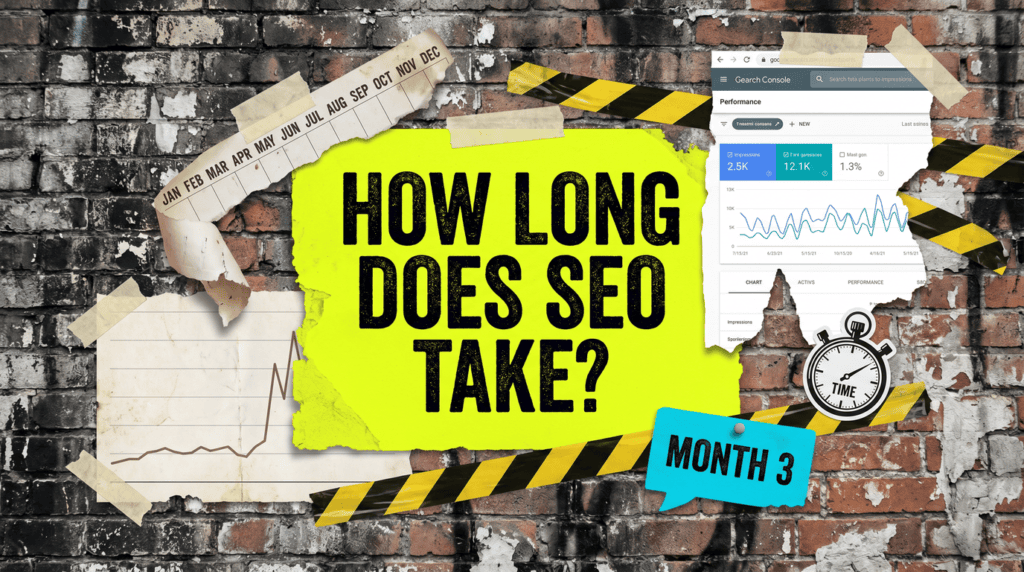
How Long Does SEO Take To Work?
The honest timeline, and what should be happening while you wait
How long does SEO take to work is the question every business owner asks somewhere around month three, usually while staring at a flat traffic graph and an invoice that arrived anyway. The honest answer is three to six months for movement, and six to twelve for money that actually shows up in the bank.
That range is close to useless on its own, though. What matters is whether the right things are happening in the quiet months, because a site that is going to work in month eight looks very different in month two from a site that never will.
How Long Does SEO Take To Work? The Quick Version
Nothing about SEO breaks the moment you start. It just stays invisible for a while, and most people cancel during the invisible bit.
Here is the shape of it for a typical small business site:
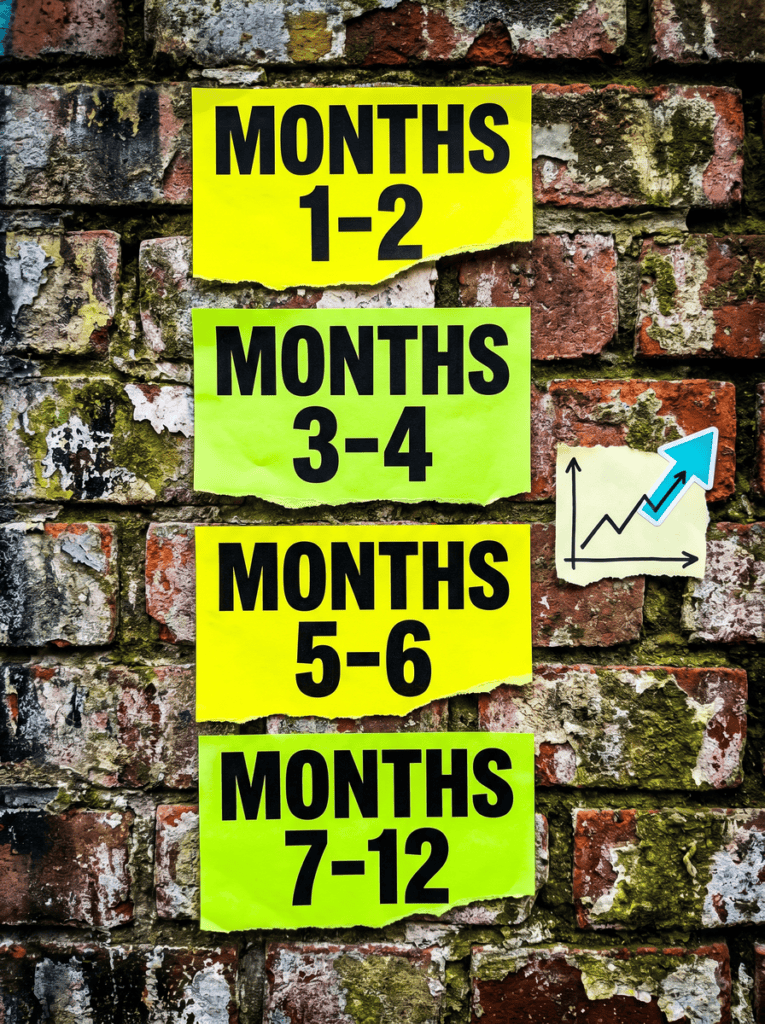
- Months 1–2: fixes, content and links go in. Rankings barely twitch. This is normal, not a rip-off.
- Months 3–4: long-tail and low-competition terms start showing up. Impressions climb before clicks do.
- Months 5–6: the terms that actually mean something start moving. First real enquiries.
- Months 7–12: compounding. The pages you published in month two are ranking, and your cost per lead starts falling.
The wait is real, but it is not passive. If you are six months in and nobody can tell you what changed on your site, the problem is not the timeline. It is the work.
Not Sure Where To Start?
Most people who ask about timelines are really asking whether they are being taken for a ride. Fair enough. The way to answer that is to look at what is actually being done each month, and whether it lines up with what your site needs.
How Long Does SEO Take To Work? The Full Guide
When someone asks how long does SEO take to work, they usually expect a number. The number is less useful than knowing which stage you are in, and what should be visible by the end of each one. Google’s own SEO Starter Guide is blunt about it: some changes take hours, others take several months.
Month One To Three: Nothing Visible, Plenty Happening
The first stretch is groundwork, and it is the least satisfying part of the whole thing. Technical fixes, page structure, keyword mapping and the first batch of content all land here.
Google has to crawl and re-evaluate everything you have changed, and it does not do that on your schedule. A new page can sit for weeks before it settles into a position, and a changed page has to be reassessed against a result set that has not moved.
You will see almost nothing in your traffic report. What you should see is a growing list of indexed pages, a Search Console picking up impressions on terms you never used to appear for, and a plan you could read out loud.
Month Three To Six: Movement You Can Actually See
This is where the graph starts bending. Not on the money terms yet, on the long, specific, low-competition ones nobody else bothered to write about.
Impressions rise before clicks, and clicks rise before enquiries. That order matters, because it means a rising impression count in month three is genuine progress even though it has not paid for itself.
By month five or six you should be able to point at a handful of pages ranking on page one for something real, and at least one enquiry you can trace back to organic search. If none of that exists by month six, something is wrong and it is worth saying so out loud.
Month Six To Twelve: When SEO Starts Paying For Itself
Somewhere in here the maths flips. The pages you paid for months ago keep bringing people in without you paying again, and your cost per lead slides downwards while your ad costs do not.
This is the entire argument for SEO, and it is also why the early months feel so bad. You are paying for an asset that has not been delivered yet.
The compounding is the point. A page that ranks in month eight is still ranking in month twenty, and the one you publish next month starts from a stronger site than the last one did.
What Makes It Faster (And What Makes It Slower)
Not every site is on the same clock, and the gap between the fast ones and the slow ones is enormous.
Faster: an established domain with some history, a niche nobody is fighting over, a site that is technically sound already, and a local focus rather than a national one. Slower: a brand new domain, a competitive sector like law or finance, a pile of technical problems to clear first, or a business trying to rank nationally against people spending ten times more.
Local is the big one for most small businesses. Ranking for “emergency plumber Bristol” is a different sport from ranking for “plumber”, and the difference in timeline can be six months.
How To Tell It Is Working Before The Traffic Arrives
You do not have to sit blind for six months. There are signals well before the traffic that tell you whether the thing is on track.
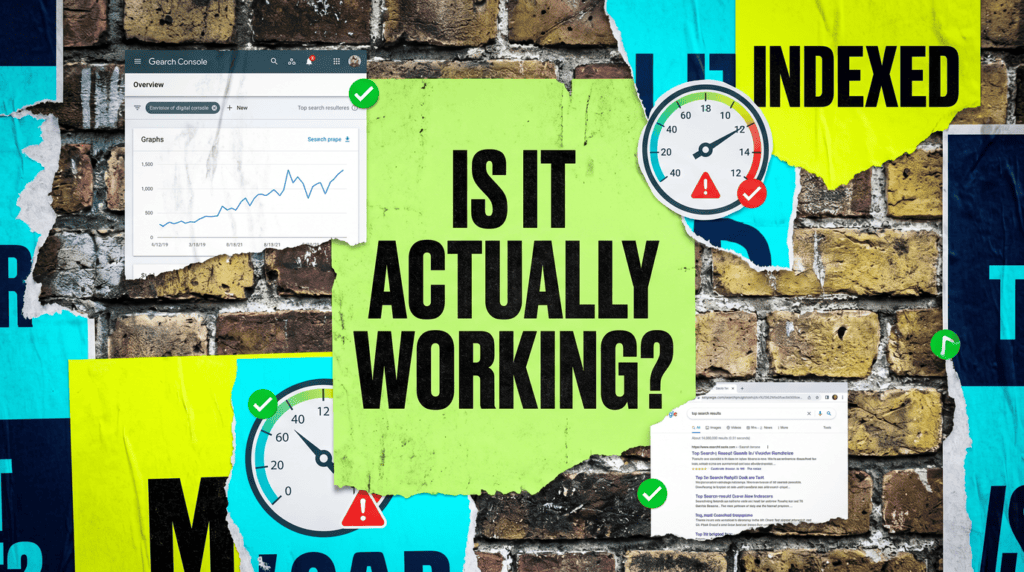
Watch impressions in Search Console rather than clicks, because they move first. Then check how many pages are returning “indexed” rather than “discovered”. Finally, track your average position on your target terms creep from 40 to 25 to 14, because that climb is invisible in your traffic report right up until it crosses onto page one, and then it is not.
If those three are moving, the traffic is coming. If they are all flat at month four, waiting longer will not fix it.
Common Mistakes
If you are still asking how long does SEO take to work after a year of paying someone, one of these is usually the reason.
- Restarting the clock every few months. Switching agency, changing strategy, rewriting the site. Each one resets you close to zero. The businesses that win are frequently the ones that were merely consistent.
- Chasing terms you cannot win. If you are a two-person firm targeting the same keyword as a national brand with a hundred-person marketing team, the timeline is not six months. It is never.
- Judging it on rankings alone. Ranking first for something nobody searches is not a result. Ranking eighth for something with real intent behind it usually is.
- Publishing and stopping. Six blog posts in month one and nothing after is not a strategy, it is a burst of enthusiasm. The compounding needs something to compound.
- Not measuring the start. If nobody wrote down where you were in month zero, nobody can prove where you got to in month nine.
Do It Yourself, Or Get It Done For You
DIY lane:
Set up Search Console properly and record your baseline. Pick five terms you could realistically win and write the best page on the internet for each of them. Fix the obvious technical problems.
Then leave it alone for three months and actually let it work, which is by far the hardest part.
Done for you lane:
We will tell you what your realistic timeline is before you spend anything, based on your domain, your competition and the state of your site, not a generic three-to-six months.
Then we do the work and show you the leading indicators every month, so you are never sitting in the dark wondering whether it is happening.
Related Guides on the wall
If you are working out how long does SEO take to work, these guides will help you make sense of what should be happening around it.
- Why Am I Not Ranking On Google?
- Why Is SEO So Expensive? What You’re Actually Paying For
- What Does An SEO Agency Do? Monthly SEO Work Explained
- SEO Rankings Up But Traffic Down? What Changed
- Use Google Business Profile optimisation if you are local, because that is usually where movement appears first.
How Long Does SEO Take To Work FAQs

Longer than for an established one, usually six to twelve months before anything meaningful, because Google has no history to trust yet. A new domain has to earn its way in, and there is no shortcut that survives contact with an algorithm update.
Occasionally, on very low-competition local terms, or on a site that had a fixable technical problem holding it back. Treat any agency that promises it as the default rather than the exception as a warning sign.
Three months is early, and flat traffic at that point is normal. What is not normal is flat impressions and no new indexed pages. That combination means the work is not landing, and more time will not rescue it.
No, but rankings do decay if you stop entirely, because your competitors do not. Most businesses drop to a lighter maintenance level once the main pages are established, rather than stopping dead.
No. Ads work the day you switch them on and stop the day you switch them off. SEO is slow to start and keeps working after you stop paying, which is why most small businesses end up running both.
Six months feels like a long time, right up until you realise you have already been waiting eighteen and nobody ever told you what was supposed to happen.
Like this guide?
Tell Google you want more like it. One click, no sign-up, and FlyPost guides start showing up more often in your search results.
Add FlyPost as a preferred sourceTakes you to Google, then straight back here.