

Why Is My Vet Practice Not Getting New Clients?
The six things pet owners cannot find, in the order to fix them
If you are asking why is my vet practice not getting new clients, you have probably already ruled out the obvious. The clinical work is good, the reviews you do have are kind, the team is stable, and the website was redone a couple of years ago and looks perfectly fine. Yet new registrations have flattened, and the corporate practice on the retail park seems to get every new puppy in town.
That is rarely one big problem. It is a short list of things a pet owner looks for before they register anywhere, and most practice websites answer none of them because they were written for the practice rather than the owner.
Quick Version
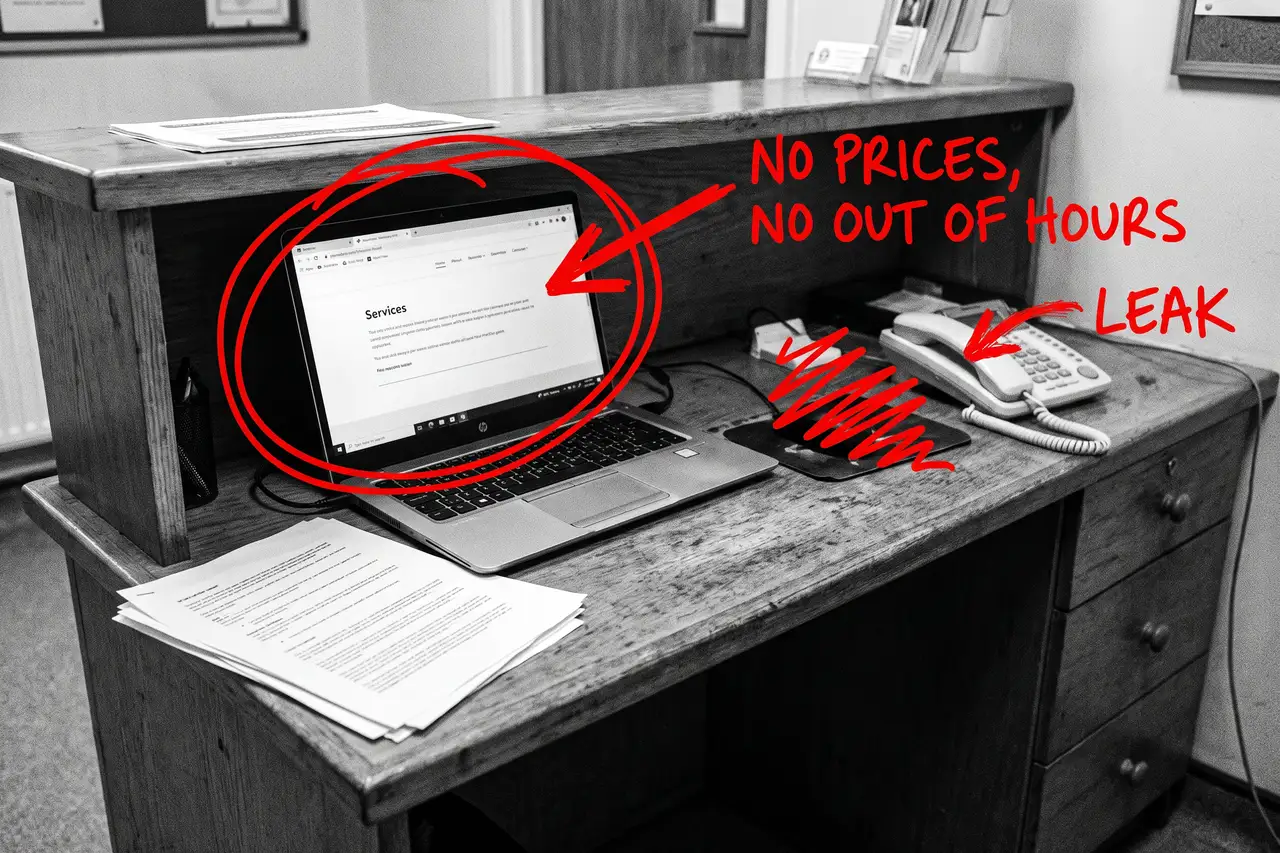
Pet owners find a vet three ways: the map result for ‘vets near me’, a search for a specific service and its price, and a panicked search for an emergency vet. Most practice websites win none of them, because the Business Profile is half finished, the prices are hidden and out of hours is a line in the footer.
The six things to check, in order:
- Your Google Business Profile is thin, wrong or shared between branches
- There is no page for ’emergency vet’ and out of hours
- Every service is on one page
- Your prices are not on the website
- Registering is a phone call or a PDF
- You are counting visits when you should be counting registrations
Most practices have four of these at once. None of them needs a new website, and none needs a marketing budget beyond somebody’s time.
Not Sure where to start?
All of this is a couple of weekends if you know how pet owners search for a vet, and a year of wondering if you do not. If you would rather someone fixed the profile, built the price and out-of-hours pages, sorted registration and told you plainly which services are now bringing new clients, that is what our SEO & AI service for vets does.
Why Is My Vet Practice Not Getting New Clients? The Full Guide
Work through these in order. The Business Profile comes first because for most practices it is where the new registrations actually come from, and it moves faster than anything else on the list.
Your Google Business Profile is thin, wrong or shared between branches
Search ‘vets near me’ from your phone, from the car park. The map with three practices is what every new owner sees first, and those three came from Google Business Profiles, not websites. If you are not in that box, or you are in it with an old photo, no services and eleven reviews, the puppy registered somewhere else before your site was ever an option.
Open your profile as an owner would. Is the primary category ‘Veterinarian’ rather than ‘Animal hospital’ or ‘Pet store’? Does each branch have its own profile with its own address and phone, or does head office own the lot? Are the hours right, and is the out-of-hours arrangement mentioned in the description? Are there photos of the building, the consult rooms and the team? Are the services listed, in the words owners use? Has every review been answered, including the one about the bill?
Then ask for reviews properly. A short message with the link after every visit that went well. Recent reviews matter more than old ones, and the practice with forty from this year beats the one with a hundred from 2021.
There is no page for ’emergency vet’ and out of hours
‘Emergency vet near me’ at 11pm is the most urgent search in the sector and the most valuable new client you will get, because the owner who was looked after at midnight registers the whole household. Most practice websites answer it with opening hours and a phone number that goes to a recorded message.
Write one page. Who covers your nights, weekends and bank holidays. If it is your own team, say so and what it costs. If it is a partner emergency clinic, say which one, where it is, how far, what to expect on arrival and what number to ring. Put the same information in the Business Profile description and in the footer of every page.
If you do not provide out-of-hours care, say so plainly and say who does. Owners register in daylight with the practice that was honest about the night.
Every service is on one page
An owner with a new kitten types ‘kitten vaccinations’ and the town. Someone with a rabbit types ‘rabbit vet near me’. A worried owner types ‘dog dental treatment cost’. Those are different people, on different days, with different questions, and most practice websites answer all three with a services page that says vaccinations, neutering, dentistry, microchipping, and a phone number.
Google cannot rank a bullet point against a practice that gave the service a whole page, and the owner cannot tell from a bullet point whether you actually treat rabbits or whether the receptionist will suggest somewhere else.
Write a page for each service you want more of. What it involves, what happens on the day, roughly what it costs, how to book it and a photo of the room it happens in. Start with the three that bring in the most new clients, usually vaccinations, neutering and dental, not the full list.
Your prices are not on the website
Before an owner chooses a practice, they search the price. ‘Vet consultation fee’, ‘how much to neuter a cat UK’, ‘dog vaccinations cost’. They are not looking for the cheapest; they are looking for a number, because a practice that hides its prices is assumed to be expensive.
Publish a price list, on a page, in plain text, consultation fee first. Vaccinations, neutering, dental scale and polish, microchipping and your health plan, as ranges where the animal’s size changes the cost. It does not lock you in and it does answer the question every owner has and few will ask at the desk.
Price transparency is also what the vet pricing review has pushed the whole sector towards, so publishing now puts you ahead of the practices that are still arguing about it. It is also what AI tools cite when someone asks what a procedure should cost.
Registering is a phone call or a PDF
Every search on this list ends in one action: a new client registering. On most practice websites that means ‘call us to register’, a PDF form to print, or a button to a portal that opens with no explanation of what it is. The owner who found you at 9pm on a phone gives up and registers with the practice that had a form.
Build a registration page. What happens after they register, how long it takes, what to bring to the first visit, whether they can register before they need you, and a form that works on a phone with no more fields than you actually need. Link it from the navigation, the Business Profile and the bottom of every service page.
If you use a practice management portal for registration, put a page in front of it that explains what it is and what to expect, so nobody lands on a login screen cold.
You are counting visits when you should be counting registrations
A practice website can double its visits and register nobody extra, usually because the visits are students, people googling a symptom in another county, or someone looking for a vet nurse job.
Put a proper form on the registration page and a tracked phone number on the site, and look at which page each registration or call came from. In Search Console, look at which searches you appear for and whether they are the services and towns you want. If ‘vet nurse jobs’ is your biggest search, your careers page is doing the ranking and your service pages are not.
Once you can see registrations by page, you know which service page to build next and which branch the website is actually feeding. Report that to the partners instead of the visit count.
Common Mistakes
If you are still asking why is my vet practice not getting new clients after a couple of months of changes, one of these is usually why.
- Rebuilding the website before fixing the Business Profile. The profile is what people ring and register from for ‘vets near me’, and a new theme changes nothing about it.
- Hiding prices to avoid being compared. Owners compare anyway, and they assume the practice with no prices is the expensive one.
- Treating out of hours as small print. It is the highest-value search you get, and a line in the footer does not rank or reassure.
- One profile for three branches. Each branch needs its own, with its own address, phone, hours and photos, or two of them do not exist to Google.
- Judging it after a month. The profile can move in weeks. Service and price pages take months to rank. Fix the list, then give it a quarter.
DIY lane vs done for you lane
DIY lane:
Fix the Google Business Profile first, one per branch: category, hours, out-of-hours note, photos of the real building and team, every service listed, every review answered, and a review request after every good visit. Write the out-of-hours page. Publish a price list in plain text. Build a registration page with a form that works on a phone.
Then write a page for each of your three biggest services, put a tracked number on the site, and leave it alone for a couple of months while you watch registrations by page.
Done for you lane:
This is the first two months of our SEO & AI service for vets. Business Profiles sorted for every branch, the out-of-hours and price pages written, registration rebuilt so it works on a phone, service pages written, structured data added so Google and the AI tools can read it all, and registration tracking set up.
You get told which services and branches are now bringing new clients, which are not yet, and why. Then we keep going.
Related Guides on the wall
If you are working out why is my vet practice not getting new clients, these three cover the individual fixes in more depth.
- Why Is My Business Not Showing On Google Maps? for getting each branch into the map result in the first place.
- Google Business Profile optimisation for the full profile checklist once you are showing.
- Service Page Checklist: Turn More Visits Into Enquiries for turning each service into a page that ranks and registers.
Why Is My Vet Practice Not Getting New Clients FAQs

Because good reviews only help once someone has found you. For ‘vets near me’ the Google Business Profile decides who gets seen, and for service and price searches a page matching the question decides. A practice with kind reviews, a thin profile and no prices on the site is invisible to the owner who never got as far as the reviews.
Yes. Owners search the price before they choose a practice, and the ones who register having read it are easier clients. Consultation fee, vaccinations, neutering and dental as a minimum, as ranges where the animal’s size matters. It is also where the whole sector is being pushed, so publishing now costs you nothing later.
Yes, if the branches have their own address and take their own registrations. One profile with the head office address means the other branches do not exist for ‘vets near me’ in their own towns. Each needs its own hours, phone, photos and reviews.
The Business Profile can move within weeks once it is fixed and reviews start coming in. Service, price and out-of-hours pages usually take a quarter or two to rank. Judge the whole thing over six months, not six weeks, and judge it on registrations, not visits.
Locally, yes. The groups run template websites that leave the same gaps in every town: hidden prices, a vague out-of-hours line, one profile for several branches. An independent practice that fixes those four things has a better local presence than most groups manage, without a marketing department.
A vet practice not getting new clients is nearly always a findability problem wearing a design problem’s clothes. Start with the Business Profile, because that is where the registrations come from, then answer the out-of-hours and price questions plainly, and the rest follows from there.
Like this guide?
Tell Google you want more like it. One click, no sign-up, and FlyPost guides start showing up more often in your search results.
Add FlyPost as a preferred sourceTakes you to Google, then straight back here.