

How Do I Get More Leads For My Manufacturing Business?
The six things an engineer or a procurement team checks before a supplier makes the shortlist, and most manufacturer websites answer none of them
If you are searching how to get more manufacturing leads, you have probably already done the obvious. The kit is good, the quality system is in place, the order book is full from the same three or four customers you have had for years, you do a trade show or two and the website was redone a while ago with a drone shot of the factory, a capabilities page and a PDF catalogue. Yet new enquiries are rare, the ones that do arrive are for one-off jobs you would rather not quote, and the buyers in the sectors you want seem to end up with a supplier that explained itself better online.
That is rarely one big problem. It is a short list of things an engineer or a procurement team checks before a supplier makes the shortlist, usually with a drawing in one hand and three tabs open, and most manufacturer websites answer none of them because they were written for the managing director rather than the buyer doing the searching.
Quick Version
A buyer finds a new supplier three ways: a search for the process plus a material or a location, a search for a part or a product with a specification attached, and a search for a capability plus their sector once they need proof you understand their standards. Most manufacturer websites win none of them, because every capability is on one page, the catalogue is a PDF and nothing on the site says what you can make, how fast, and to which approvals.
The six things to check, in order:
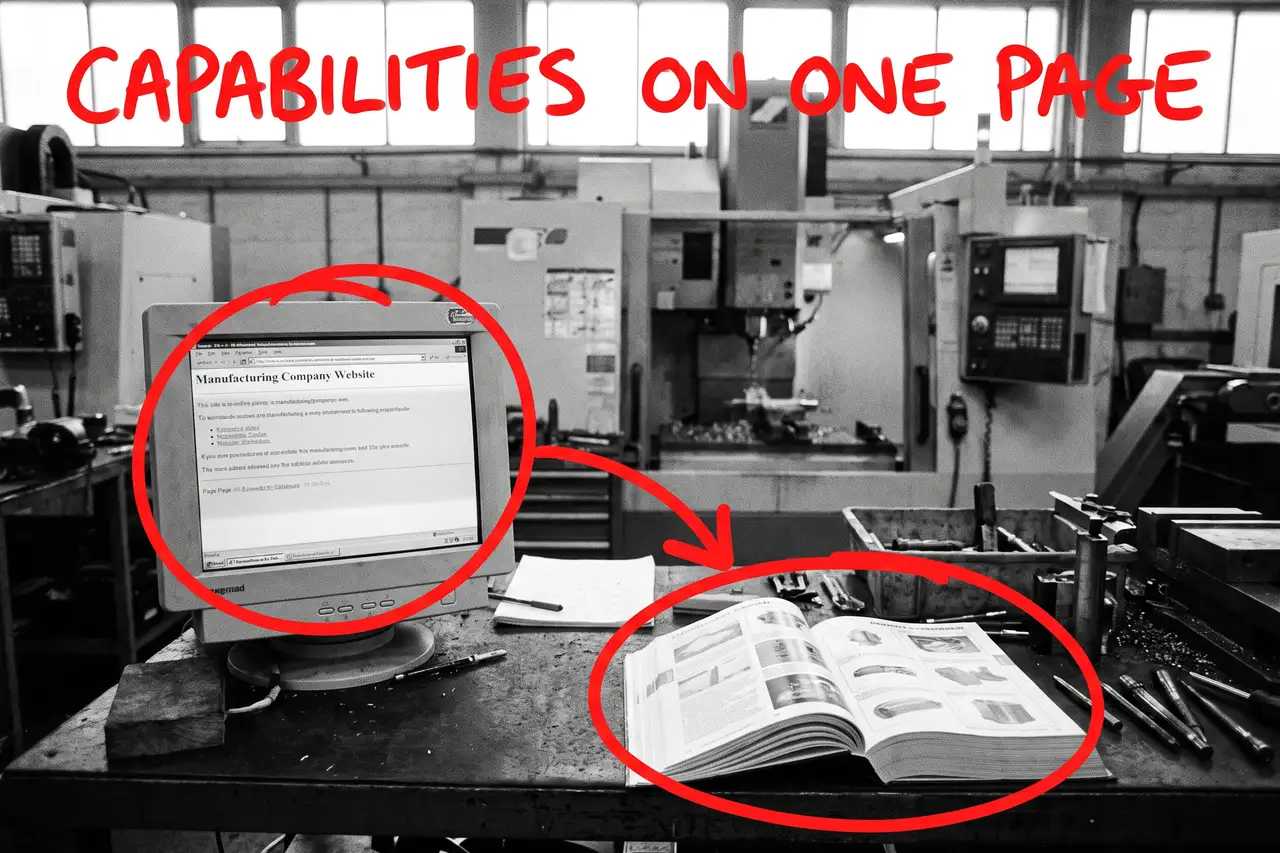
- Every capability is on one page
- The catalogue is a PDF
- There are no sector pages, so the buyer cannot see themselves
- The quote form asks for everything and says nothing
- The approvals are a logo strip
- You are counting visits, not quote requests by capability
Most manufacturers have four of these at once. None of them needs a new website, and none of them needs another trade show.
Not Sure where to start?
All of this is a few weeks of somebody’s time if you know how a buyer searches for a supplier and how to write a capability page that ranks, and another year of waiting for the phone if you do not. If you would rather someone wrote the capability and sector pages, got the catalogue out of the PDF, put the lead times and approvals in words and told you plainly which searches are now bringing quote requests, that is what our SEO & AI service for manufacturers does.
How Do I Get More Leads For My Manufacturing Business? The Full Guide
Work through these in order. The capability pages come first because they are where the quote requests worth having come from, and the catalogue comes second because it is the biggest thing on most manufacturer websites that Google cannot read.
Every capability is on one page
A design engineer types ‘CNC machining’ and the county. A buyer types ‘sheet metal fabrication UK’ or ‘precision turned parts supplier’. A production manager types ‘powder coating service near me’. Three different buyers with three different jobs, and most manufacturer websites answer all of them with one capabilities page that lists machining, fabrication, welding, finishing, assembly and ‘much more’.
Google cannot rank a bullet point against a page that explains the process properly, and the engineer cannot tell from a list whether five-axis machining is what you do or something you also do.
Write a page for each capability you want more of. The processes and the kit, the materials you work in, the sizes and tolerances you hold, typical batch sizes and lead times, the sectors that use it and what you need to quote. Start with the two or three capabilities that pay for the business, not the full list.
The catalogue is a PDF
If you make standard products or parts, the catalogue is the most valuable thing on your website and on most manufacturer sites it is a forty-page PDF behind a download button. Google indexes a PDF badly, nobody can filter it on a phone, and a buyer searching the part number or the product type with a specification never finds it.
Put the products on pages. One page per product range, with the sizes, materials, finishes, tolerances, minimum quantities and lead times on the page as text and a drawing to download if they want it. If you have hundreds of parts, start with the ranges the buyers you want actually search for.
Those pages rank for the part and product searches on their own, they give AI tools something to cite when an engineer asks who makes a given component in the UK, and they feed the quote form with buyers who already know what they want.
There are no sector pages, so the buyer cannot see themselves
A rail buyer wants to know you understand their approvals and their documentation. A medical device buyer wants traceability and cleanroom assembly. A food machinery buyer wants stainless, hygiene and quick turnaround on spares. On most manufacturer websites the only evidence is a row of customer logos with no words next to them, or a ‘sectors served’ list in the footer.
Write a page for each sector you want more of. What those customers typically need, the standards and approvals that apply, what you make for firms like them and what the first order looks like. If you have supplied that sector, say so in general terms without naming anyone you are not allowed to.
Four or five proper sector pages beat a logo wall, and each one ranks for the capability plus the sector, which is exactly what the procurement team types once they need proof.
The quote form asks for everything and says nothing
A buyer with a drawing wants to know three things before they send it: what your minimum order is, roughly what the lead time is and what you need from them to quote. On most manufacturer websites the answer is a form with twelve required fields and a promise that ‘a member of the team will be in touch’.
Say plainly how a quote works: send us the drawing or the spec and the quantity, we come back within a stated number of working days with any questions, and a quote follows. State your minimums and typical lead times by capability. Then ask for the drawing, the quantity and a phone number, and nothing else.
Keep the long form for the buyers who prefer it, but do not make it the front door. The buyer who has to fill in twelve fields to find out your minimum order is already on the next tab.
The approvals are a logo strip
ISO 9001, the sector approvals you hold, the materials certification you can supply and the kit you run all mean something, but on most manufacturer websites they are a row of badges in the footer and nothing else. A buyer outside your trade cannot tell what an approval lets you supply, and an AI tool cannot cite a logo.
Write each one out. What the approval or certification is, what it covers, what it lets you supply and to whom, and when it was last audited. Put the kit list on the capability pages with capacities, not in a brochure. Name the people: who runs quality, who runs production, how long they have done it.
That is what a procurement team reads before they add you to a shortlist, and it is what AI tools draw on when an engineer asks which suppliers hold a given approval.
You are counting visits, not quote requests by capability
A manufacturer website can double its visits and win no new customers, usually because the visits are people looking for a job, students, or someone on another continent searching a product you once wrote a blog post about.
Put a tracked phone number on the site, keep the quote form short and ask which capability or product the request is for, and record which page each quote request came from. In Search Console, look at which searches you appear for and whether they are the processes, products and sectors you want. If your biggest search is a blog post about a material grade, the blog is doing the ranking and the capability pages are not.
Once you can see quote requests by capability and sector, you know which page to write next and which part of the business the website is actually feeding. Report that to the board instead of the visit count.
Common Mistakes
If you are still searching how to get more manufacturing leads after a couple of months of changes, one of these is usually why.
- Writing for the managing director instead of the engineer. A page about heritage and values ranks for nothing a buyer types and answers no question a drawing raises.
- Leaving the catalogue in a PDF. It is the most searchable thing you own and nobody can search it.
- Hiding lead times and minimums. Buyers assume the worst when a supplier will not say, and the quote form fills up with jobs you would never take.
- Letting the logos do the talking. A customer logo wall and a row of approval badges tell a buyer nothing about what you would make for them. Words do.
- Judging it after a month. Capability, product and sector pages take a quarter or two to rank, and manufacturing buying cycles are long. Fix the list, then judge it over a year.
DIY lane vs done for you lane
DIY lane:
Write a page for each of your two or three main capabilities, with materials, sizes, tolerances, lead times and what you need to quote. Get the product ranges out of the PDF and onto pages with the specifications as text. Write a page for each sector you want more of. State your minimums and lead times and shorten the quote form to the drawing, the quantity and a phone number. Write out every approval and certification and what it lets you supply.
Then put a tracked number on the site, ask which capability on the quote form, and leave it alone for a quarter while you watch quote requests by capability and sector.
Done for you lane:
This is the first two months of our SEO & AI service for manufacturers. Capability and sector pages written for the work you want more of, the catalogue rebuilt as pages buyers and Google can read, lead times and minimums published, the quote route shortened, approvals and the team put in words, manufacturer structured data added so Google and the AI tools can read it all, and quote tracking by capability set up.
You get told which capabilities, products and sectors are now bringing quote requests, which are not yet, and why. Then we keep going.
Related Guides on the wall
If you are working out how to get more manufacturing leads from your own website, these three cover the individual fixes in more depth.
- Service Page Checklist: Turn More Visits Into Enquiries for turning each capability page into one that ranks and gets the quote request.
- Why Is My Homepage Ranking Instead Of My Service Page? for when the homepage outranks the capability pages that should be doing the work.
- AI Search Visibility: How Small Businesses Get Cited for what AI tools look for before they name a supplier in an answer.
How Do I Get More Leads For My Manufacturing Business FAQs

Write a page for each capability and sector you want more of, get the catalogue out of the PDF and onto pages, publish your lead times and minimums, shorten the quote form and put your approvals in words. Buyers are already searching the process, the part and the sector. The supplier that answers those searches best gets the drawing.
Yes, as typical figures by capability with what moves them. Buyers check both before they send a drawing, and a supplier that will not say is assumed to be slow or expensive. A plain statement also filters out the one-off jobs you would never take.
It is close to invisible. Google indexes a PDF badly, nobody can filter it on a phone and the part and product searches go to suppliers with the specifications on real pages. Put the ranges buyers search for on pages first and keep the PDF as a download.
For every sector you want more of, yes. Four or five proper sector pages that say what you make for firms like them and which approvals apply beat a logo wall, and each one ranks for the capability plus that sector, which is what procurement types when they need proof.
Capability, product and sector pages usually take a quarter or two to rank, and manufacturing buying cycles are long, so judge it over a year on quote requests by capability rather than on visits. The product pages often move first because almost nobody else has them.
Getting more manufacturing leads from your own website is nearly always a matter of writing for the engineer with the drawing rather than for the managing director. Start with the capability pages, get the catalogue out of the PDF, put the lead times and the approvals in words, and the rest follows from there.
Like this guide?
Tell Google you want more like it. One click, no sign-up, and FlyPost guides start showing up more often in your search results.
Add FlyPost as a preferred sourceTakes you to Google, then straight back here.