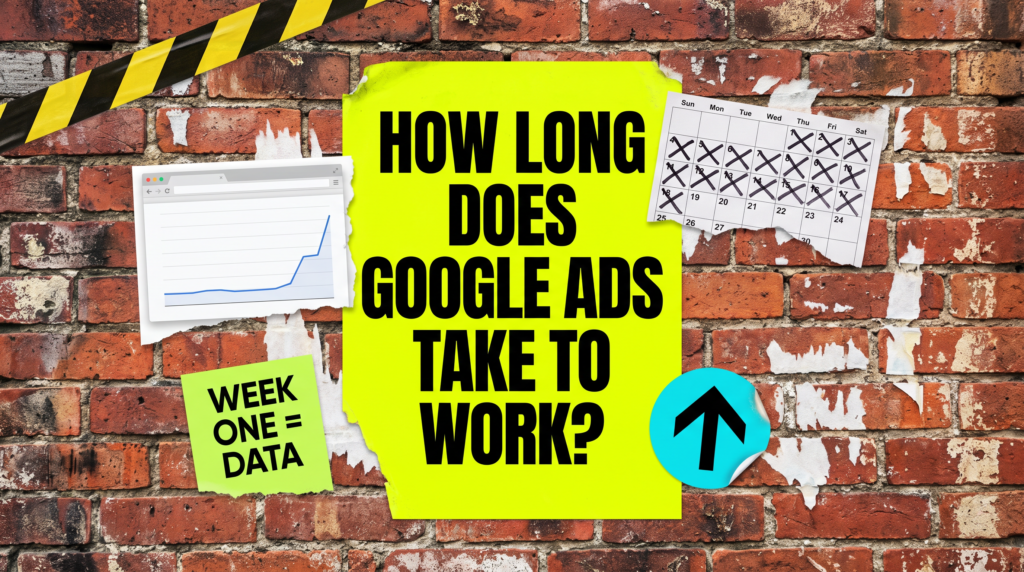
HOW LONG DOES GOOGLE ADS TAKE TO WORK? WHAT TO EXPECT WEEK BY WEEK
The first fortnight tells you almost nothing on its own. Here is what is actually happening while you wait, and the point at which the numbers are worth judging.
How long does Google Ads take to work is a question people usually ask about ten days in, when the spend is very real and the enquiries are not. That gap between money going out and anything coming back is horrible, and it makes perfectly sensible business owners do the one thing guaranteed to make it worse.
THE QUICK VERSION
Google Ads does not fail slowly and then suddenly work. It gathers data, gets less wasteful, and gets cheaper per enquiry, and almost all of that happens in the second and third month rather than the first.
Here is the short version if you want to stop reading now:
- Week one is you buying data, not leads. Treat the spend as tuition.
- Smart bidding campaigns go through a learning period. Google puts this at around seven days, but it runs longer when conversions are thin.
- Every significant edit you make restarts that learning period, which is why fiddling daily keeps you stuck at the start.
- Two to four weeks in you get your first honest signals: search terms, click-through rate, whether the clicks are even the right people.
- Real cost per enquiry improvements normally land somewhere in month two and month three.
- Judge the account at 90 days on cost per enquiry and enquiry quality, not on week two’s click count.
- If you sell something people research for weeks, add that research time on top before you expect to see anything.
None of that means you sit on your hands for three months. It means you spend the first month fixing waste rather than staring at the conversion column willing it to move.
NOT SURE WHERE TO START?
If your ads have been running long enough that the waiting has turned into worrying, the useful thing is usually not more patience. It is a proper look at what the account has already told you, because most struggling accounts are sitting on three weeks of search term data nobody has read.

OUR FULL GUIDE TO HOW LONG GOOGLE ADS TAKES TO WORK
When someone asks how long does Google Ads take to work, they are usually hoping for a single number. The honest answer is that different things happen on different timescales, and knowing which is which is what stops you killing a campaign a fortnight before it would have turned.
1. WEEK ONE: YOU ARE BUYING DATA, NOT LEADS
In the first week your campaign has no history. Google does not yet know which searches convert for you, which times of day are worth bidding on, or what a good click looks like on your site, so it spreads your money around and finds out.
That means week one is expensive per enquiry almost by definition. Judging the account on it is like judging a new hire on their first Monday. The number you should be watching is not conversions, it is whether the search terms report is full of searches you would actually want to pay for.
2. THE LEARNING PERIOD, AND WHY IT KEEPS RESTARTING
If you are using a smart bidding strategy such as Maximise Conversions or Target CPA, the campaign enters a learning period while Google’s system works out how to bid. Google’s own guidance puts this at roughly seven days, and says the duration depends on how many conversions you get, how long it takes a click to turn into a conversion, and which bid strategy you picked.
Here is the part that catches people out. Meaningful changes reset it. Change the bid strategy, move the target dramatically, restructure the ad groups, and the clock starts again. A business owner checking in nervously every morning and nudging something each time can keep a campaign in learning for a month without ever realising why.
3. WEEKS TWO TO FOUR: THE FIRST SIGNALS WORTH READING
By the end of the second week you have enough to read, as long as you read the right things. Search terms tell you whether your keywords are attracting buyers or browsers. Click-through rate tells you whether the ad matches what people expected to find.
What you still do not have is a reliable cost per enquiry. A handful of conversions is noise, not a trend, and small budgets take longer to escape that noise.
This is the window where the work pays. Add negative keywords, cut the searches that were never going to buy, tighten locations, and fix whatever the landing page is doing to the traffic you already paid for.
4. MONTHS TWO AND THREE: WHERE THE REAL GAINS COME FROM
Once the account has a few weeks of clean conversion data, two things start compounding. Google’s bidding gets better at picking the clicks that convert, and your own waste-cutting has removed the searches that were quietly eating the budget.
That is why cost per enquiry usually falls fastest in month two and month three rather than month one. The same budget starts buying better clicks. Most accounts that end up working well look ordinary at day 30 and obviously fine by day 90.
5. WHAT MAKES IT TAKE LONGER THAN IT SHOULD
Some accounts genuinely need longer, and it is usually one of a short list of reasons. A long buying cycle, where people compare quotes for three weeks before choosing, delays every signal by three weeks. A small budget starves the account of the conversion volume it needs to learn from.
Broken or missing conversion tracking is the worst of them, because the campaign is optimising towards nothing and you are optimising on numbers that are not real.
The usual culprits, in the order worth checking:
- Conversion tracking that is not firing, or is counting the wrong thing
- A budget too small to produce steady conversions
- A long consideration cycle that has not finished yet
- Constant edits restarting the learning period
- A landing page that converts badly, so paid traffic never becomes an enquiry
COMMON MISTAKES
If you are still asking how long does Google Ads take to work after a couple of months of tinkering, the delay is usually self-inflicted. These are the ones we see most.
- Turning campaigns off in week two because the cost per enquiry looks awful. It is supposed to.
- Changing the bid strategy every few days, which resets the learning period each time.
- Judging success on clicks and impressions rather than enquiries and what they are worth.
- Running with conversion tracking that was never verified, so every decision after that is guesswork.
- Cutting the budget the moment it feels expensive, which slows learning and makes it take longer still.
- Expecting paid search to fix a website that was never going to convert visitors in the first place.
DIY lane vs done for you lane
DOING IT YOURSELF
Entirely doable if you are disciplined. Set conversion tracking up properly and test it before you spend anything. Give the campaign a fortnight without meaningful edits. Read the search terms report weekly and add negatives. Then leave the bidding alone and look again at 90 days.
GETTING US TO DO IT
We run the first 90 days as a plan rather than a panic: tracking verified up front, waste cut weekly, and changes made deliberately so the learning period is not constantly restarting. You get told what the numbers mean while they are still ugly, which is the part most people are missing. Here is how our PPC management works.
RELATED GUIDES
If you are working out how long does Google Ads take to work, these guides cover the things that usually decide the answer.
HOW LONG DOES GOOGLE ADS TAKE TO WORK FAQS

Expect useful signals in two to four weeks and a fair verdict at around 90 days. Smart bidding campaigns spend roughly the first week in a learning period, and cost per enquiry usually improves most in months two and three once there is enough conversion data to bid on.
Because the campaign has no history yet, so it is spreading your budget across searches it has not learned to judge. Week one is data collection. Look at whether the search terms are the kind of searches you would want to pay for, and worry about conversion rate later.
Significant changes do, including switching bid strategy, moving a target sharply or restructuring ad groups. Google’s guidance ties the length of the learning period to conversion volume, conversion delay and bid strategy, so constant edits keep resetting the clock.
Ninety days with proper conversion tracking, a budget that produces steady conversions, and weekly waste-cutting. If you have not had that, you have not really tested Google Ads yet, you have tested a version of it that was never set up to work.
A bit. Verify conversion tracking before launch, start tighter rather than broader, use a budget that produces conversions rather than a trickle, and stop making daily changes. You cannot skip the learning, but you can stop restarting it.
Google Ads rewards patience far more than it rewards fiddling. Give it a clean setup, ninety days and a weekly hour of waste-cutting, and you will know exactly what it can do for you.
Like this guide?
Tell Google you want more like it. One click, no sign-up, and FlyPost guides start showing up more often in your search results.
Add FlyPost as a preferred sourceTakes you to Google, then straight back here.