

How Do I Get More Clients For My Law Firm?
The six things a worried person checks before they ring a solicitor, and most law firm websites answer none of them
If you are searching how to get more clients for a law firm, you have probably already done the obvious. The work is good, the referrals from accountants and estate agents keep coming, the firm is on the Law Society directory and a couple of review sites, and the website was redone a few years ago with a team photo, a departments page and a contact form. Yet new enquiries from the website are rare, half of them are for work you do not want, and the firm across town seems to get the conveyancing and the family work that used to come to you.
That is rarely one big problem. It is a short list of things a worried person checks before they ring a solicitor, usually late at night with something that has just gone wrong, and most law firm websites answer none of them because they were written for the partners rather than for the person searching.
Quick Version
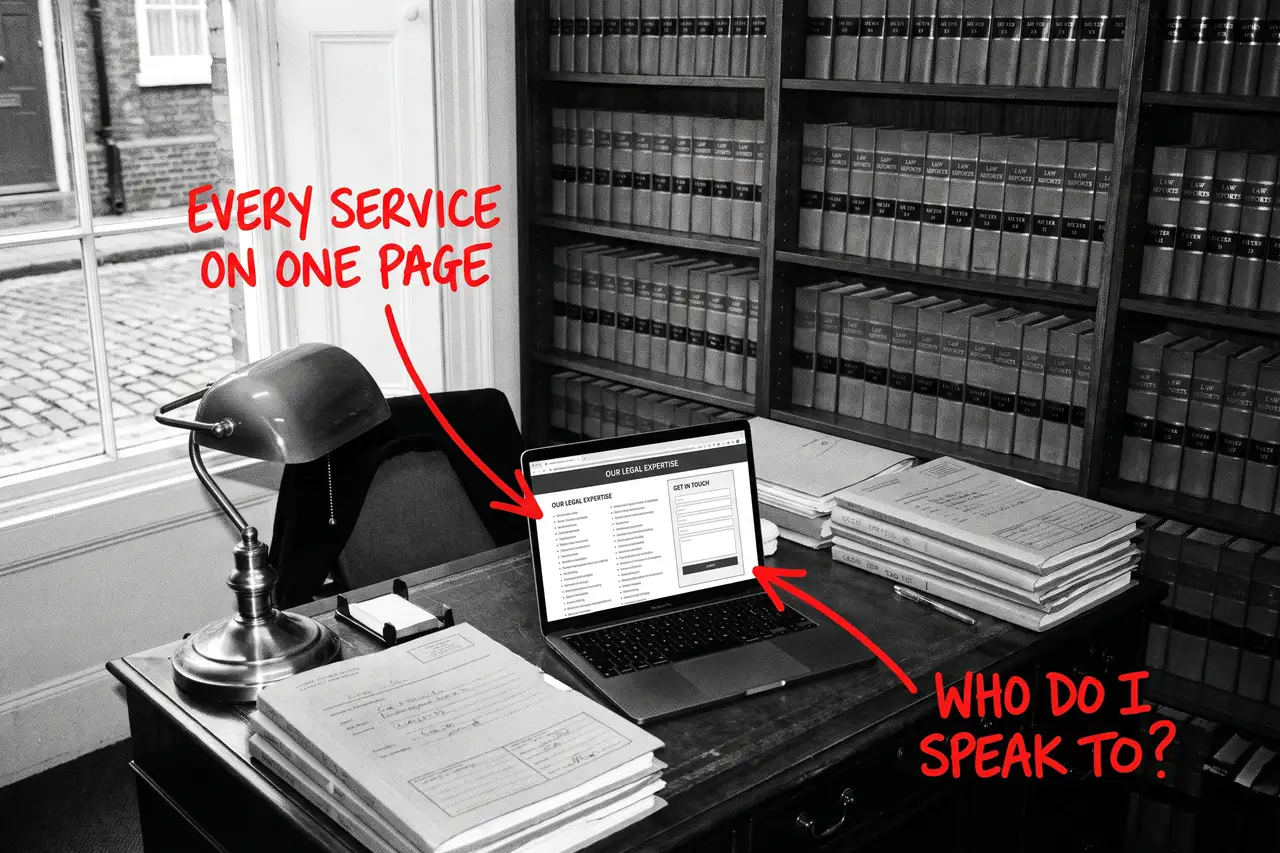
A client finds a solicitor three ways: a search for the service plus the town, a search for the cost of the thing they need, and a search for a person once they have been recommended a name. Most law firm websites win none of them, because every service is a paragraph under a department, the fees are a table nobody can find, and the solicitors are a page of photos with no link to the work.
The six things to check, in order:
- Every practice area is a paragraph under a department
- The headings are the firm’s, not the client’s
- The fees are a rule, not a page
- The solicitor and the service live apart
- The enquiry route is a wall
- You are counting visits, not enquiries by practice area
Most firms have four of these at once. None of them needs a new website, and none of them needs another networking breakfast.
Not Sure where to start?
All of this is a few weeks of somebody’s time if you know how clients search for a solicitor and how to write a practice area page that ranks, and another year of relying on referrals if you do not. If you would rather someone wrote the practice area pages, built the fee pages, joined the solicitors to the work and told you plainly which searches are now bringing enquiries, that is what our SEO & AI service for solicitors does.
How Do I Get More Clients For My Law Firm? The Full Guide
Work through these in order. The practice area pages come first because they are where the enquiries worth having come from, and the fees come second because the cost search is the one most firms lose without knowing it.
Every practice area is a paragraph under a department
Someone types ‘conveyancing solicitor’ and the town. Someone else types ‘divorce solicitor near me’, ’employment solicitor for unfair dismissal’ or ‘will writing solicitor’ with the area. Four different people with four different worries, and most law firm websites answer all of them with a Private Client page that lists wills, probate, lasting powers of attorney, trusts and tax in one paragraph each.
Google cannot rank a paragraph against a page that explains the service properly, and the person searching cannot tell from a list whether you do contested probate every week or once a year.
Write a page for each service you want more of. Who it is for, what the process looks like from first call to finish, roughly what it costs and what moves the number, how long it takes, and who at the firm does it. Start with the three or four services that pay for the practice, not everything the firm has ever done.
The headings are the firm’s, not the client’s
Law firm websites are organised the way the firm is: Private Client, Dispute Resolution, Commercial, Residential Property. Nobody outside the profession searches any of those words. They search ‘neighbour dispute solicitor’, ‘solicitor for buying a house’, ‘unfair dismissal claim’ and ‘contesting a will’.
Name the pages in the words the client types and keep the department names for the menu if you must. The page about contested wills is called contesting a will. The page about residential property is called conveyancing, and if clients in your town say ‘house solicitor’, the page says that too.
This is not dumbing down. It is the difference between a page Google can match to a search and a page only another solicitor would find.
The fees are a rule, not a page
For conveyancing, uncontested probate and a few other services, firms already have to publish price information. On most law firm websites that information is a table on a page called Pricing or Transparency, linked from the footer, written to satisfy the rule rather than to answer the person searching ‘how much does conveyancing cost’.
Turn the table into a page that explains. What the fee covers, what the disbursements are and why, what makes it more or less, what the first meeting costs, and how you charge for the services where there is no fixed fee. Put it in the main navigation and link it from every practice area page.
That page ranks for the cost searches on its own, it filters out the enquiries you would never win, and it is what AI tools cite when someone asks what a solicitor should charge for probate.
The solicitor and the service live apart
People choose a person for a divorce, a will or a dispute. On most law firm websites the team page is a grid of photos with a job title, and the service pages have no names on them at all. So a client reads about family law, cannot see who would handle it, and rings the firm whose family solicitor was on the page.
Link them both ways. Each practice area page names the solicitors who do that work with a line on their experience in it, and each profile links to the services that person actually handles, with something more than a job title: what they do most, how long they have done it, what clients say.
That is what a client reads before they ring, it is what a referrer sends on, and it is what AI tools draw on when someone asks which solicitors near them do a particular kind of work.
The enquiry route is a wall
A legal enquiry is usually a worried person with something that has gone wrong. On most law firm websites the enquiry route is a form with eight fields and a promise that someone will be in touch, or a switchboard number and office hours. Nobody says what happens next.
Write it out. Who reads the form and how quickly they ring back, whether the first conversation is free or what it costs, what to have to hand, and what happens after that. Put the direct line for each practice area on its page. Keep the form short: name, number, what it is about.
The firm that explains the first step gets the call from the person who was too anxious to ring a switchboard, and that is a lot of people.
You are counting visits, not enquiries by practice area
A law firm website can double its visits and open no more files, usually because the visits are recruitment agencies, law students, people in another county reading a news post, or existing clients looking for the office address.
Put a tracked phone number on the site, make the form ask which service it is about, and record which page each enquiry came from. In Search Console, look at which searches you appear for and whether they are the practice areas and the town you want. If your biggest search is the firm’s name, the site is confirming referrals, not bringing anyone new.
Once you can see enquiries by practice area, you know which page to write next and which part of the firm the website is actually feeding. Report that to the partners instead of the visit count.
Common Mistakes
If you are still searching how to get more clients for a law firm after a couple of months of changes, one of these is usually why.
- Writing for the partners instead of the client. A page about the firm’s heritage and values ranks for nothing a worried person types.
- Keeping the department names as page names. Nobody searches Private Client. They search the thing that has happened to them.
- Treating the fee page as a compliance job. It is the page the cost search lands on, and the one most firms hide in the footer.
- Leaving the team page as a photo grid. A client chooses a person. If the service page has no name on it, they choose someone else’s.
- Judging it after a month. Practice area and fee pages take a quarter or two to rank, and legal work is decided slowly. Fix the list, then judge it over a year.
DIY lane vs done for you lane
DIY lane:
Write a page for each of your three or four main services in the words clients use, with the process, a fee range and the solicitor who does it. Turn the price information into a page that explains, and put it in the navigation. Link every solicitor profile to the work they do and every service page to the people who do it. Write out what happens after an enquiry and put a direct line on each practice area page. Fix the Business Profile for each office to match.
Then put a tracked number on the site, ask which service on the form, and leave it alone for a quarter while you watch enquiries by practice area.
Done for you lane:
This is the first two months of our SEO & AI service for solicitors. Practice area pages written in client words for the work you want more of, the fee pages rebuilt to explain rather than comply, the solicitors joined to their services, the enquiry process put in words, the Business Profile for each office sorted, legal service structured data added so Google and the AI tools can read it all, and enquiry tracking by practice area set up.
You get told which practice areas are now bringing enquiries, which are not yet, and why. Then we keep going.
Related Guides on the wall
If you are working out how to get more clients for a law firm from your own website, these three cover the individual fixes in more depth.
- Service Page Checklist: Turn More Visits Into Enquiries for turning each practice area page into one that ranks and gets the call.
- Why Is My Homepage Ranking Instead Of My Service Page? for when the firm’s name outranks the practice area pages that should be doing the work.
- AI Search Visibility: How Small Businesses Get Cited for what AI tools look for before they name a firm in an answer.
How Do I Get More Clients For My Law Firm FAQs

Write a page for each practice area you want more of in the words clients use, turn the fee information into a page that explains, join the solicitors to their services, write out what happens after an enquiry and fix the Business Profile for each office. People are already searching the service, the cost and the town. The firm that answers those searches best gets the call.
For conveyancing, uncontested probate and the other services where price information is already required, yes, and on a page that explains rather than a table in the footer. For the rest, say how you charge and what a first meeting costs. People search the cost before they ring anyone, and a firm that will not say is assumed to be expensive.
For the searches that matter, yes. A service plus the town is won by the firm with a proper page, a fee explained and a solicitor named, not by a national brand. The online conveyancers have no page for your town and no solicitor a client can meet.
For every one you want more of, yes, named in the words clients use. A dozen proper pages beat a departments page, and each one carries the solicitor who does that work and a link to the fee page for it.
The Business Profile can move within weeks once it is fixed. Practice area and fee pages usually take a quarter or two to rank, and legal decisions are made slowly, so judge it over a year on enquiries by practice area rather than on visits.
Getting more clients for a law firm from your own website is nearly always a matter of writing for the worried person rather than for the partners. Start with the practice area pages and the fee page, put names on the work, and the rest follows from there.
Like this guide?
Tell Google you want more like it. One click, no sign-up, and FlyPost guides start showing up more often in your search results.
Add FlyPost as a preferred sourceTakes you to Google, then straight back here.