

How Do I Get More Clients For My Accountancy Firm?
The six things business owners check before they choose an accountant, and most firm websites answer none of them
If you are searching how to get more clients for an accountancy firm, you have probably already done the obvious. The website was redone a couple of years ago, the firm is on the professional body’s directory, the partners go to the networking breakfast, and the referrals still come. They just come more slowly than they used to, the new clients skew towards one-off tax returns, and the online-only firm with the price on its homepage keeps winning the limited companies that search on a phone.
That is rarely one big problem. It is a short list of things a business owner checks before they ring an accountant, and most firm websites answer none of them because they were written for other accountants rather than for the person choosing one.
Quick Version
A business owner finds an accountant three ways: a search for the client type or the service and the town, a comparison search on cost once they have decided to use someone, and a check on the firm and its people once you are on the shortlist. Most firm websites win none of them, because the services are a list, the fees are hidden and the people are a grid of headshots.
The six things to check, in order:
- Your website lists services, and business owners search for themselves
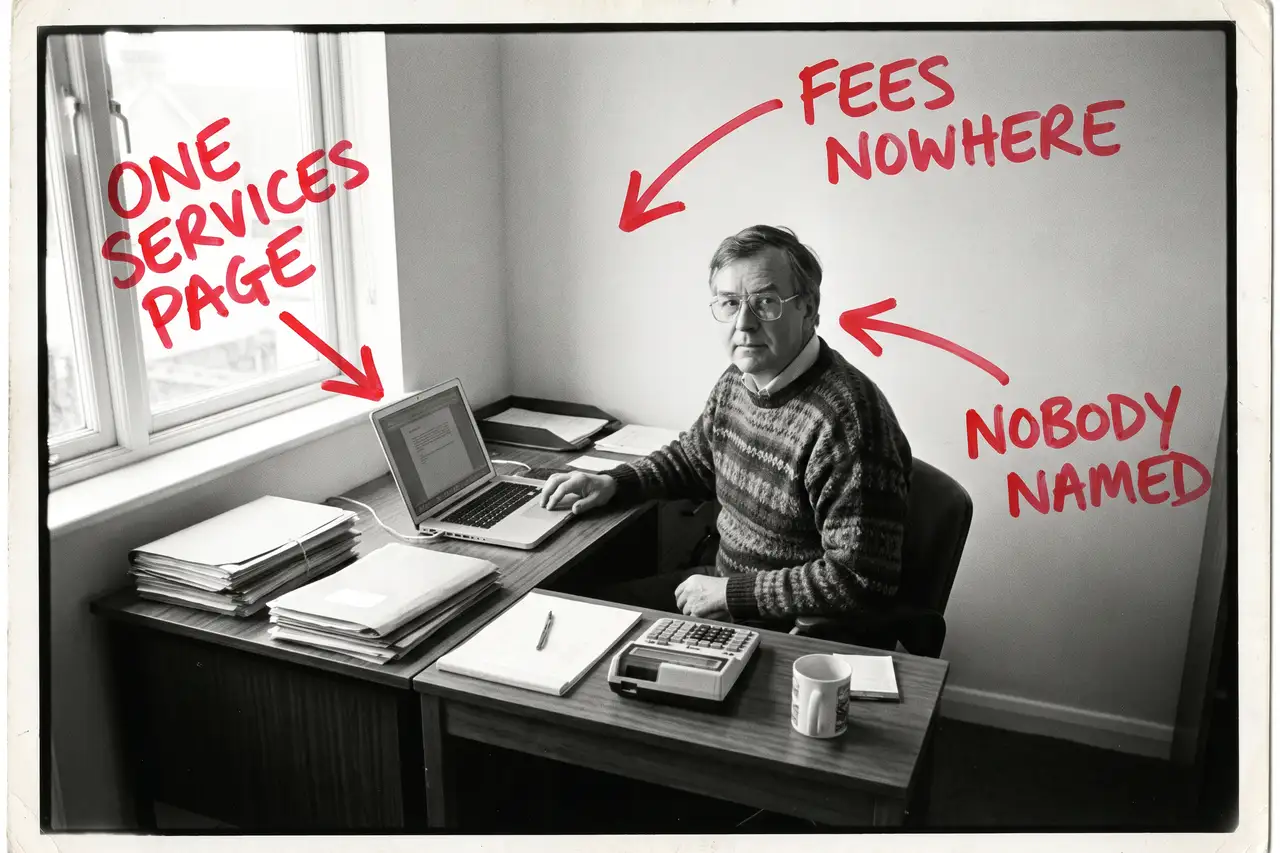
- ‘Accounts, tax, payroll, VAT’ on one page
- Fees nowhere, while the online firms publish theirs
- Nobody in the firm is on the page
- The enquiry form asks for turnover before it asks for a name
- You are counting visits, not new-client enquiries by type
Most firms have four of these at once. None of them needs a new website, and none needs to wait for the quiet season after January.
Not Sure where to start?
All of this is a few weeks of somebody’s time if you know how business owners search for an accountant and how to write a client-type page that ranks, and a year of watching the referrals slow if you do not. If you would rather someone wrote the client-type pages, explained the fees, gave each accountant a page, fixed the profile and told you plainly which client types are now bringing enquiries, that is what our SEO & AI service for accountants does.
How Do I Get More Clients For My Accountancy Firm? The Full Guide
Work through these in order. The client-type pages come first because they are where the business owners you do not already know come from, and the fees come second because they decide whether those owners ring you or the online firm.
Your website lists services, and business owners search for themselves
A contractor searches ‘accountant for contractors’ and the town. A landlord with three flats searches ‘accountant for landlords’. A founder searches ‘accountant for startups’. A shop owner searches ‘small business accountant near me’. Each one is a different person with a different worry, and most firm websites answer all of them with a services list and a ‘who we help’ line in the footer.
Give each client type you want more of its own page, written for that owner rather than for another accountant. What they usually need from you, the thing that trips people like them up (IR35, section 24, marketplace VAT, the first year-end), how you work with them through the year, roughly what it costs and which accountant in the firm looks after them.
A page like that ranks for the search the owner actually makes and gives them somewhere to see themselves. A list of twelve industries does neither.
‘Accounts, tax, payroll, VAT’ on one page
Year-end accounts, self assessment, corporation tax, VAT returns, payroll, bookkeeping, management accounts, company formation. Different searches at different points in the year, some from people in a panic in January and some from a company outgrowing its bookkeeper in June, and most firm websites answer all of them with one page and a list.
Google cannot rank a list against a page that explains the service properly, and the owner reading a list cannot tell whether you do payroll for fifty companies or reluctantly for three.
Write a page for each service you want more of. What it involves, who it is for, what you need from the client, what usually affects the cost and what happens after they get in touch. Start with the two or three services that bring the monthly clients, not the full list.
Fees nowhere, while the online firms publish theirs
Business owners search ‘how much does an accountant cost’ before they ring anyone, and the online-only firms answer it with a monthly price on the homepage. If your site says ‘contact us for a quote’, the owner assumes you are the expensive one and either rings the online firm or arrives at the first meeting negotiating.
Explain the fee model in plain text. Monthly packages for a limited company and what each includes, a from price for a sole trader return, what adds to it (payroll, VAT, a second director), and when it is invoiced. You do not have to publish a full rate card. You have to be the local firm that explained how it works when the others said ‘it depends’.
That page is also what AI tools cite when someone asks what an accountant should cost, so it earns its place twice.
Nobody in the firm is on the page
A business owner is choosing the person who will see every bank statement they have, and a firm with a team grid of headshots and ‘Director’ under each one tells them nothing. The online firm at least has a chat window with a name on it.
Give each accountant a page: qualification and professional body, what they specialise in, how long they have done it, the kind of clients they look after and a direct way to reach them. Link it from the client-type pages they cover. Then fix the reviews. Most firms’ Business Profiles carry a handful of reviews, some from staff, so ask clients at the year-end meeting, with the link, and ask them to mention what you sorted out.
A review that says ‘took over our limited company accounts mid-year and got the VAT straight’ does more than ten that say ‘great accountants’.
The enquiry form asks for turnover before it asks for a name
Business owners do not want a quote from a form. They want a short conversation with the person who would look after them, and a form that asks for turnover, entity type, employee count and current accountant before it asks what they need loses the enquiry on a phone.
Ask for a name, an email, what they need help with and when suits. Say plainly what happens next: a call with a named accountant, no charge, and no pressure to move before the year end if that is easier. Put a phone number next to the form that goes to a person, not a voicemail that says the office is closed for lunch.
Then send the enquiry to the accountant who covers that client type, not to a shared inbox that gets looked at on Friday.
You are counting visits, not new-client enquiries by type
A firm’s website can double its visits and win no new clients, usually because the visits are people looking for a job in accounts, students, or existing clients looking for the portal login.
Put a tracked phone number on the site, keep the enquiry form short and give it a field for what they need, and record where each new-client enquiry came from and what type of client it was. In Search Console, look at which searches you appear for and whether they are the client-type and service searches you want. If your biggest search is your own name, the site is not bringing you anyone new yet.
Once you can see enquiries by client type and service, you know which page to write next and which accountant the website is actually feeding. Report that to the partners instead of the visit count.
Common Mistakes
If you are still searching how to get more clients for an accountancy firm after a couple of months of changes, one of these is usually why.
- Writing for other accountants. The business owner wants the page about their situation, not a list of services in the firm’s own language.
- One ‘who we help’ list. A list ranks for none of them. Four real client-type pages beat twelve names.
- Hiding the fee model. Owners find a price somewhere, and if it is not yours they assume the worst about you.
- A long enquiry form. Turnover and entity type can wait for the call. On a phone, four fields is the limit.
- Judging it after a month. The Business Profile can move in weeks. Client-type and service pages take months to rank, and switching accountants is a slow decision that often waits for a year end. Fix the list, then give it two quarters.
DIY lane vs done for you lane
DIY lane:
Write a page for each of your four best client types, for the business owner, with the worry it solves, the accountant who covers it and how the fees work. Write a page for each of your two or three main services. Explain the fee model in plain text. Give each accountant a page and link it from their client types.
Then shorten the enquiry form to four fields, ask clients rather than staff for the next ten reviews, put a tracked number on the site and leave it alone for a couple of months while you watch enquiries by client type.
Done for you lane:
This is the first two months of our SEO & AI service for accountants. Client-type pages written for the owner, service pages written, the fee model explained, a page per accountant, the Business Profile sorted, the enquiry form shortened, structured data added so Google and the AI tools can read it all, and enquiry tracking by client type set up.
You get told which client types and services are now bringing enquiries, which are not yet, and why. Then we keep going.
Related Guides on the wall
If you are working out how to get more clients for an accountancy firm from your own site, these three cover the individual fixes in more depth.
- Service Page Checklist: Turn More Visits Into Enquiries for turning each client-type and service page into one that ranks and gets the enquiry.
- Why Is My Homepage Ranking Instead Of My Service Page? for when the homepage outranks the pages that should be doing the work.
- Local SEO Checklist Guide for the Business Profile, the reviews and the towns you serve, in order.
How Do I Get More Clients For My Accountancy Firm FAQs

Write a page for each client type you want more of, for the business owner rather than for another accountant, explain your fee model in plain text, give each accountant a page and ask clients for reviews. Business owners are already searching the client type and the town. The firm that answers those searches best gets the call, and it did not have to wait for a referral.
The model, yes: monthly packages for a limited company, a from price for a sole trader return, what is included and what adds to it. Owners search the cost before they ring anyone, and the online-only firms already answer it. You can explain how it works without publishing a full rate card.
If you want business owners to find you, yes. ‘Accountant for contractors’ or ‘accountant for landlords’ with the town is the search an owner makes, and a ‘who we help’ list ranks for none of them. Four or five proper client-type pages give the owner a page where they can see themselves.
Because that is the search it answers. A site that ranks for ‘tax return accountant’ in January brings people who need a tax return in January. Build the client-type pages and the monthly fee page for the limited companies and contractors you want, and the enquiries start to match.
The Business Profile can move within weeks once client reviews start arriving. Client-type and service pages usually take a quarter or two to rank, and switching accountants is a slow decision that often waits for a year end. Judge it over six months on enquiries by client type, and keep the referral work running until your own pages carry the load.
Getting more clients for an accountancy firm from your own website is nearly always a matter of writing for the business owner rather than the accountant. Start with the client-type pages and the fees, put the people on the page, and the rest follows from there.
Like this guide?
Tell Google you want more like it. One click, no sign-up, and FlyPost guides start showing up more often in your search results.
Add FlyPost as a preferred sourceTakes you to Google, then straight back here.