

Why Is My Physio Clinic Not Getting New Patients?
The six things patients cannot find, in the order to fix them
If you are asking why is my physio clinic not getting new patients, you have probably already ruled out the obvious. The clinical work is good, the patients you do have come back and send their partners, the therapists are excellent, and the website was redone not long ago and looks perfectly respectable. Yet new patient bookings have gone flat, and the chain clinic in the retail park seems to get everyone who searched on their phone.
That is rarely one big problem. It is a short list of things a patient in pain looks for before they book anywhere, and most clinic websites answer none of them because they were written for the clinic rather than the patient.
Quick Version
Patients find a physio three ways: the map result for ‘physio near me’, a search for a specific condition or treatment, and a comparison search once someone has recommended physio and they want to know the price and whether they need a referral. Most clinic websites win none of them, because the Business Profile is half finished, every condition is on one page and booking is a phone number.
The six things to check, in order:
- Your Google Business Profile is thin, in the wrong category or shared between clinics
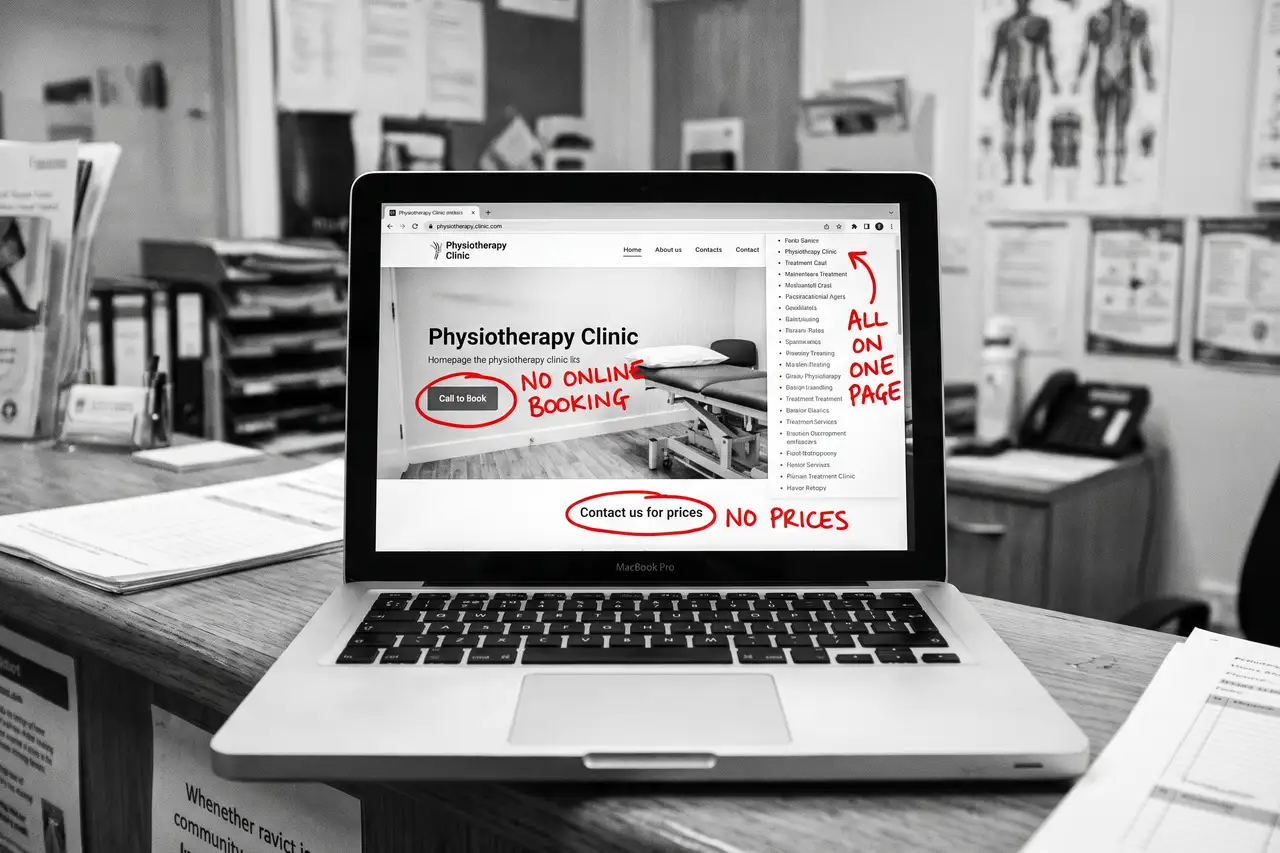
- Every condition and treatment is on one page
- Prices, insurance and the referral question are not answered
- Booking is a phone number with reception hours
- Your therapists are a group photo
- You are counting visits when you should be counting bookings
Most clinics have four of these at once. None of them needs a new website, and none needs a marketing budget beyond somebody’s time.
Not Sure where to start?
All of this is a couple of weekends if you know how patients search for a physio, and a year of wondering if you do not. If you would rather someone fixed the profile, wrote the condition and price pages, put booking on every page and told you plainly which conditions are now bringing new patients, that is what our SEO & AI service for physiotherapists does.
Why Is My Physio Clinic Not Getting New Patients? The Full Guide
Work through these in order. The Business Profile comes first because for most clinics it is where the new patients actually come from, and it moves faster than anything else on the list.
Your Google Business Profile is thin, in the wrong category or shared between clinics
Search ‘physio near me’ from your phone, from the car park. The map with three clinics is what every new patient sees first, and those three came from Google Business Profiles, not websites. If you are not in that box, or you are in it with a stock photo, no services and nine reviews from 2022, the patient booked somewhere else before your site was ever an option.
Open your profile as a patient would. Is the primary category ‘Physiotherapist’ rather than ‘Physical therapy clinic’, ‘Sports medicine clinic’ or ‘Medical clinic’? Does each clinic have its own profile with its own address and phone, or does the first site own the lot? Are the hours right, including early and evening slots? Are there photos of the treatment rooms, the gym space and the team? Are the services listed, in the words patients use? Has every review been answered, including the one about the parking?
Then ask for reviews properly. A short message with the link after every discharge or every session that went well. Recent reviews matter more than old ones, and the clinic with forty from this year beats the one with a hundred from before the pandemic.
Every condition and treatment is on one page
Someone with a shoulder they cannot lift types ‘frozen shoulder physio’ and the town. A runner types ‘plantar fasciitis shockwave’. A new mum types ‘pelvic health physio near me’. Someone six weeks after a knee replacement types ‘physio after knee replacement’. Those are different people, in different amounts of pain, on different days, and most clinic websites answer all four with a ‘what we treat’ page that lists back, neck, shoulder, knee, sports injuries, and a phone number.
Google cannot rank a bullet point against a clinic that gave the condition a whole page, and the patient cannot tell from a bullet point whether you have a pelvic health specialist or whether the next available therapist will have a go.
Write a page for each condition and treatment you want more of. What it usually is, what happens at the first assessment, how many sessions it tends to take, who at the clinic treats it, what it costs and how to book. Start with the six or eight that bring the patients you are best at, not the full list, and never pretend to diagnose. The page tells a patient what a physio would look at, not what is wrong with them.
Prices, insurance and the referral question are not answered
Before a patient books a private physio they search three things: ‘how much is a physio session’, ‘do I need a GP referral for physio’ and whether their insurer will pay. They are not looking for the cheapest clinic. They are looking for a number, because a clinic that hides its prices is assumed to be expensive, and they are looking for permission to book without going through the GP first.
Publish a price page in plain text. Initial assessment, follow-up, any packages, and what a session includes. Say plainly that no referral is needed for self-pay patients. Then explain how insurance works at your clinic: which insurers you are registered with, whether you bill them directly, what the patient needs to bring, and what happens if the policy has an excess. Most clinics mention insurers with a row of logos and nothing else, and the patient rings the insurer’s own network instead.
The same price page is what AI tools cite when someone asks what physio should cost, so it earns its place twice.
Booking is a phone number with reception hours
Every search on this list ends in one action: a new patient booking a first appointment. On most clinic websites that means a phone number that goes to voicemail after six, a contact form that asks for a description of the problem, or a link to a booking system that opens cold with no explanation. The patient who found you at 10pm with a back spasm gives up and books with the clinic that showed them Tuesday at 8am.
Put online booking on every page, not just the contact page, with the next available slot visible and the option to choose a therapist. Say what happens at the first session, how long it lasts, what to wear and what to bring. If your practice management system has a booking widget, use it and put a short page in front of it so nobody lands on a login screen.
Keep the phone number too. Older patients and referrers still ring. But the booking button is what turns the late-night search into a diary entry.
Your therapists are a group photo
Patients choose a person. A friend says ‘ask for Sarah, she sorted my shoulder’, the patient searches Sarah’s name and the clinic, and finds a ‘meet the team’ page with one paragraph and no way to book with her. Or a consultant recommends a specialist in pelvic health and the patient cannot tell from the group photo which of your six physios that is.
Give each therapist a page. Name, photo, what they treat and what they are especially good at, HCPC registration and CSP membership in words, the postgraduate courses that matter, the sports or the populations they work with, and a button that books with them specifically. That page ranks for their name, turns word of mouth into appointments, and tells the patient with the specific problem exactly who to book.
It also matters to the AI tools. A clinic whose therapists are named, registered and described gets recommended over a clinic whose team is a photo and a first-name list.
You are counting visits when you should be counting bookings
A clinic website can double its visits and book nobody extra, usually because the visits are students, people googling an exercise in another county, or someone looking for a physiotherapy job.
Put a tracked phone number on the site and make sure the booking system tells you which page each new patient came from. In Search Console, look at which searches you appear for and whether they are the conditions and towns you want. If ‘physio jobs’ or ‘stretches for lower back pain’ is your biggest search, your careers page or your blog is doing the ranking and your condition pages are not.
Once you can see new patient bookings by page, therapist and clinic, you know which condition page to build next and which site the website is actually feeding. Report that to the partners instead of the visit count.
Common Mistakes
If you are still asking why is my physio clinic not getting new patients after a couple of months of changes, one of these is usually why.
- Rebuilding the website before fixing the Business Profile. The profile is what people ring and book from for ‘physio near me’, and a new theme changes nothing about it.
- Hiding prices to avoid being compared. Patients compare anyway, and they assume the clinic with no prices is the expensive one.
- Writing about anatomy instead of the patient’s problem. A page on the biomechanics of the shoulder does not rank for ‘frozen shoulder physio near me’ and does not book anyone.
- One profile for two clinics. Each site needs its own, with its own address, phone, hours and photos, or one of them does not exist to Google.
- Judging it after a month. The profile can move in weeks. Condition and price pages take months to rank. Fix the list, then give it a quarter.
DIY lane vs done for you lane
DIY lane:
Fix the Google Business Profile first, one per clinic: category set to Physiotherapist, hours including early and evening slots, photos of the real rooms and team, every service listed, every review answered, and a review request after every discharge. Publish a price page in plain text that says no referral is needed and explains insurance. Put online booking on every page.
Then write a page for each of your six biggest conditions and a page for each therapist, put a tracked number on the site, and leave it alone for a couple of months while you watch bookings by page.
Done for you lane:
This is the first two months of our SEO & AI service for physiotherapists. Business Profiles sorted for every clinic, the price and insurance page written, booking put on every page, condition and therapist pages written, structured data added so Google and the AI tools can read it all, and booking tracking set up.
You get told which conditions, therapists and clinics are now bringing new patients, which are not yet, and why. Then we keep going.
Related Guides on the wall
If you are working out why is my physio clinic not getting new patients, these three cover the individual fixes in more depth.
- Why Is My Business Not Showing On Google Maps? for getting each clinic into the map result in the first place.
- Google Business Profile optimisation for the full profile checklist once you are showing.
- Service Page Checklist: Turn More Visits Into Enquiries for turning each condition into a page that ranks and books.
Why Is My Physio Clinic Not Getting New Patients FAQs

Because good reviews only help once someone has found you. For ‘physio near me’ the Google Business Profile decides who gets seen, and for condition searches a page matching the question decides. A clinic with kind reviews, a thin profile and no prices on the site is invisible to the patient who never got as far as the reviews.
Yes. Patients search the price before they choose a clinic, and the ones who book having read it turn up. Initial assessment, follow-up and packages as a minimum, plus a plain line saying no referral is needed and how insurance works with you. It is also what AI tools cite when someone asks what physio should cost.
For every condition you want more of, yes. Six or eight proper pages beat a list of forty body parts. Each one says what the condition usually is, what the first session involves, how many sessions it tends to take, who treats it and how to book, without pretending to diagnose anyone.
The Business Profile can move within weeks once it is fixed and reviews start coming in. Condition, price and therapist pages usually take a quarter or two to rank. Judge the whole thing over six months, not six weeks, and judge it on bookings, not visits.
Locally, yes. The chains run template websites that leave the same gaps in every town: hidden prices, a generic conditions list, one profile for several clinics, therapists you cannot book by name. An independent clinic that fixes those four things has a better local presence than most chains manage, without a marketing department.
A physio clinic not getting new patients is nearly always a findability problem wearing a design problem’s clothes. Start with the Business Profile, because that is where the bookings come from, then answer the price and referral questions plainly and let people book from their phone, and the rest follows from there.
Like this guide?
Tell Google you want more like it. One click, no sign-up, and FlyPost guides start showing up more often in your search results.
Add FlyPost as a preferred sourceTakes you to Google, then straight back here.