


Service Page Checklist: Turn More Visits Into Enquiries

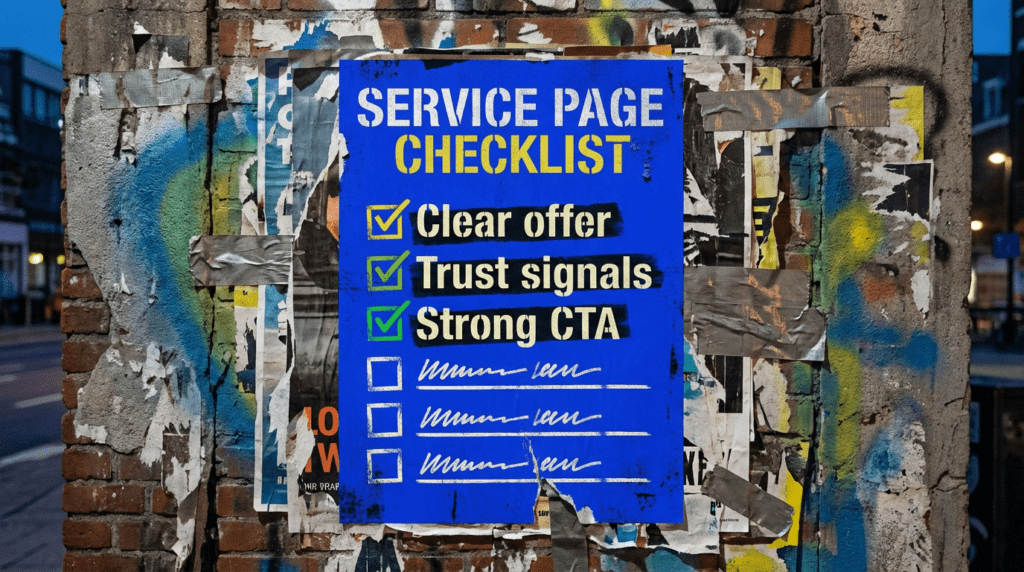
A strong service page checklist helps small businesses build pages that explain the offer properly, build trust faster, and make it easier for the right people to get in touch.
Our service page checklist is for small businesses with service pages that feel a bit vague, thin, or too focused on sounding nice instead of actually helping someone decide. If the page gets visits but not many decent enquiries, this is one of the first things worth fixing.
You can DIY the basics in this guide. If you want the time-saving version, we can tighten the page properly and turn it into something that does more than just sit there looking professional.
The quick version
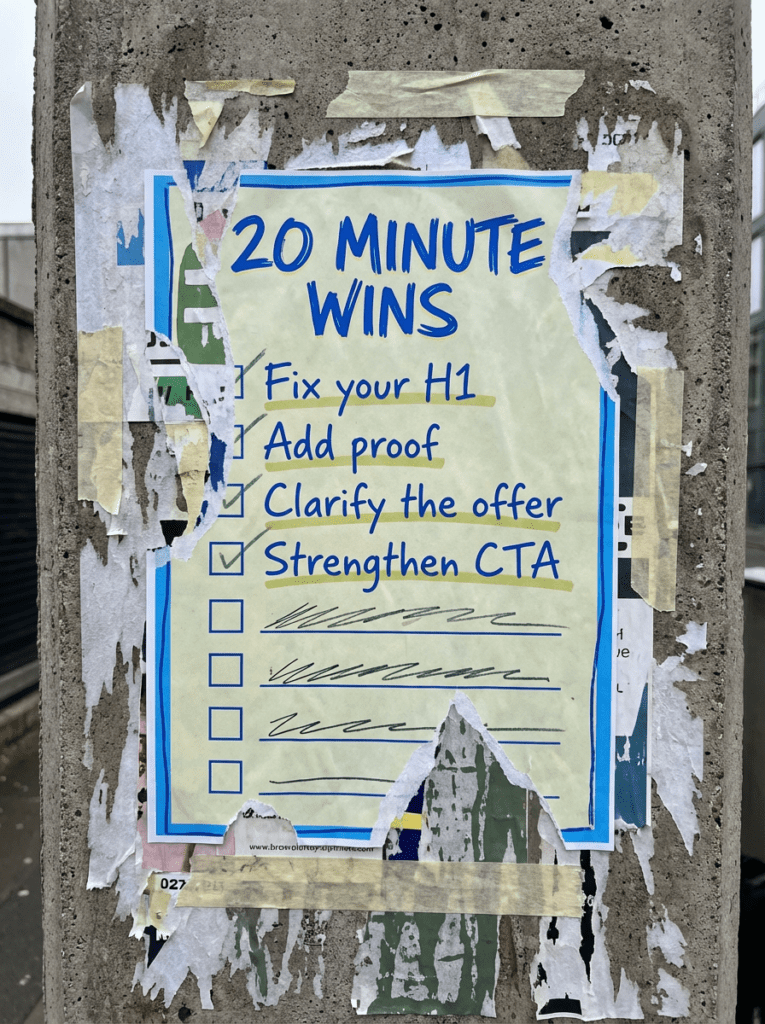
If you only have 20 minutes, do these first. These are the fastest wins in our service page checklist.
- Make sure the page clearly says what the service is in the headline and opening copy
- Add proof so the page does not rely on claims alone
- Explain who the service is for and what problem it solves
- Give people a clear next step instead of hoping they work it out
- Remove filler copy that looks nice but says absolutely nothing
If that already feels like a lot, do not worry. Below is the full fix order in the right sequence.
Not sure why your service pages are not doing much?
A lot of service pages look tidy enough on the surface. Nice heading. Nice image. A few polished lines about quality, results, and bespoke support. Lovely stuff. Still not doing much.
That usually happens because the page is too vague, too broad, or too light on the things people actually need before they enquire.
That is where a service page checklist helps. It gives the page a job to do. Not just exist. Not just “be on the site”. Actually help someone understand the service, trust the business, and take the next step.
If your page is getting traffic but not many good leads, the issue is not always traffic. Sometimes the page itself is the weak link
Our full service page checklist
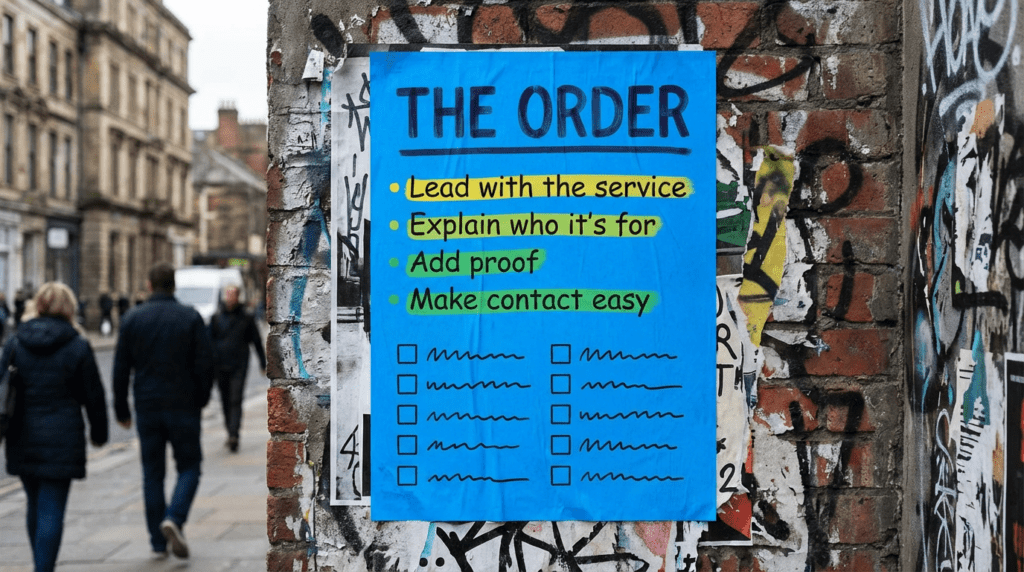
Work through this in order. A better page usually comes from fixing the basics properly, not piling on more words for the sake of it.
Step 1: Lead with the actual service
Do not make people guess what the page is about.
The headline and opening copy should say what the service is in plain English. If someone lands on the page and still is not sure what you do after five seconds, the page needs work.
Good service pages usually make these things clear early:
- What the service is
- Who it is for
- What kind of problem it helps solve
- What happens next if someone wants it
That does not mean the page needs to sound robotic. It just needs to stop dancing around the point.
Step 2: Explain who it is for
A page gets much stronger when the right person can see themselves in it. That means explaining who the service is aimed at without turning the page into a giant list of industries unless that genuinely helps.
For most small businesses, this usually means clarifying things like:
- Whether the service suits local businesses, ecommerce brands, or service-led companies
- Whether it is best for people starting from scratch or improving what they already have
- Whether it is for one-off help, ongoing support, or both
- Whether there is a clear fit and a clear not-fit
You are not trying to exclude everyone. You are trying to make the right people feel like they are in the right place.
Step 3: Show the problem it solves
A lot of service pages talk about deliverables but forget to connect them to the actual problem.
People are not buying “a process”. They are buying help with something annoying, expensive, confusing, or slow.
So instead of only listing what is included, show what the service helps fix.
For example:
- SEO & AI that helps a business get found when search visibility is weak
- PPC that helps cut wasted spend and improve lead quality
- Social support that turns random posting into something more consistent
- Website pages that make it easier for visitors to turn into enquiries
That is the bit that makes a service page feel useful instead of padded.
Step 4: Add proof so the page is not all talk
This is where a lot of pages go soft.
If the whole page is just you saying you are experienced, results-driven, tailored, passionate, and customer-focused, then congratulations, you sound like the other 400 service pages people looked at that day.
Add proof.
That could be:
- Results
- Case study snippets
- Testimonials
- Specific outcomes
- Notable experience
- Clear examples of the kind of work you do
The proof does not need to be massive. It just needs to exist.
Step 5: Make the structure easy to scan
Most people do not read every word. They scan first, then decide whether the page is worth more of their time.
A good service page checklist should leave you with a page that is easy to skim.
That means using:
- Clear subheadings
- Short paragraphs
- Useful bullets where needed
- Simple CTAs
- Logical section order
If the page is one giant slab of text, it is harder to trust and harder to use.
Step 6: Make the CTA obvious
A surprising number of service pages still manage to hide the next step like it is a secret.
Do not make people work to contact you.
Your CTA should be obvious and should feel like a natural continuation of the page. That might be:
- Book a call
- Request a quote
- Send an enquiry
- Ask for advice
- Get in touch
Keep it simple. One clear next step is usually better than five half-hearted ones.
Step 7: Support the page with the right links
A service page should not be left floating on its own. Link to supporting guides, FAQs, contact pages, and related services where it makes sense. That helps users move deeper into the site and gives the page more context.
For example:
- A service page can link to a relevant Blog
- A Blog can link back to the service page
- Related services can support each other without cannibalising each other
- Contact links should appear at natural decision points
This is one of the easiest ways to make service pages feel more connected.
Step 8: Cover the trust questions before people ask them
Most decent enquiries need a bit of reassurance before they happen.
Think about what someone wants to know before they contact you:
- Do you actually understand this kind of work?
- Have you done this before?
- Is this service right for a business like mine?
- What happens after I enquire?
- Is there a clear process or not?
The page does not need to answer every possible question in forensic detail. It just needs to reduce hesitation.
Step 9: Keep the page specific, not generic
The quickest way to flatten a service page is to make it sound like it could belong to any agency, consultant, or freelancer in the country. Specific beats generic every time.
That means naming real problems, real outcomes, real deliverables, and real fit. Not endless talk about tailored solutions and excellence.
This is also the bit that helps with AI search visibility. Pages that are clearer, more specific, and better connected tend to be easier to understand.
Common mistakes that make service pages feel weak
These are the classic reasons service pages underperform.
- Leading with fluff instead of the actual service
- Saying what you do but not why it matters
- Giving no proof
- Hiding the CTA
- Using vague headings and filler copy
- Making the page too broad to feel relevant
- Leaving the page disconnected from the rest of the site
- Forgetting that the page needs to help someone make a decision
DIY lane vs done for you lane
DIY lane:
If you want to DIY our service page checklist, start by fixing the headline, tightening the opening copy, adding proof, and making the CTA more obvious. That will usually do more than adding another 600 words of waffle.
Done for you lane:
If you want the time-saving version, we build service pages that are clearer, sharper, and more useful from both an SEO & AI and conversion point of view so the page has a better chance of turning traffic into proper enquiries.
Related Guides on the wall
If you’re reading a service page checklist, these guides will help you improve the traffic coming in, the clarity of the page, and the wider structure around it.
- Read the Landing Page Checklist if the page is getting visits but still is not doing enough to convert them.
- Check the Page Not Indexed guide if the page is live but struggling to be found in the first place.
- Use Local SEO Checklist if the service page also needs to support local intent and location-based visibility.
- Read Google Business Profile optimisation checklist if local service visibility matters and you want the page and profile working together.
- Read AI Search Visibility if you want the page to be clearer, more specific, and easier to understand across modern search experiences.
Service Page Checklist FAQs

A service page checklist is a simple framework for making sure a service page explains the offer clearly, builds trust, and gives people a strong next step.
At a minimum, it should include a clear headline, who the service is for, what it helps solve, proof, a strong CTA, and a structure that is easy to scan.
There is no perfect length. The page should be long enough to explain the service properly and answer the trust questions, but not padded for the sake of it.
Yes. If the right people are landing on the page, a clearer and stronger page can improve how many of them turn into enquiries.
Check the headline, opening paragraph, proof, and CTA on one service page. That is the fastest starting point for this service page checklist.

Quick tip
Rather have us handle this instead of DIY-ing it? That is literally the job.



Straight talking marketing that gets results.
No pressure, no jargon. Just a clear look at what’s stopping your site from bringing in more enquiries.
Get my free website reviewLike this guide?
Tell Google you want more like it. One click, no sign-up, and FlyPost guides start showing up more often in your search results.
Add FlyPost as a preferred sourceTakes you to Google, then straight back here.