


Digital Marketing News July 2026: Google June Spam Update


Google’s June spam update moved fast. The chatter around it did not. Here is what changed, what people noticed, and what small businesses should actually do next.
Digital marketing news July 2026 starts with one clear topic: Google’s June spam update.
Google confirmed the Google June 2026 spam update on the Google Search Status Dashboard. It started on 24 June, finished on 26 June, and applied globally across all languages.
Very neat on paper. Less neat in the real world.
The SEO community reported ranking volatility around the same period, including movement that seemed to start before the official rollout. That does not mean every traffic drop came from the spam update. June also had noise from the May core update, AI search changes, normal ranking movement, competitor shifts and the usual “Google is being Google” behaviour.
So this is not a panic post. It is a clean up your act post.
The quick version
Google completed the Google June 2026 spam update between 24 and 26 June. It was global, covered all languages, and focused on spam systems rather than a full core update.
The noisy bit is that June already looked volatile before the official rollout. That means a late-June dip does not automatically mean Google treated your site as spam.
The sensible move is to compare dates, look at affected pages and check whether the site has weak content, AI sludge, duplicate location pages, hacked junk or pages built mainly to chase rankings.
AI search matters too. Google’s guidance now makes it clear that normal SEO still applies to AI Overviews and AI Mode, and its spam policies also apply to attempts to manipulate generative AI responses in Search.
Short version: do not panic, but do not ignore it either.
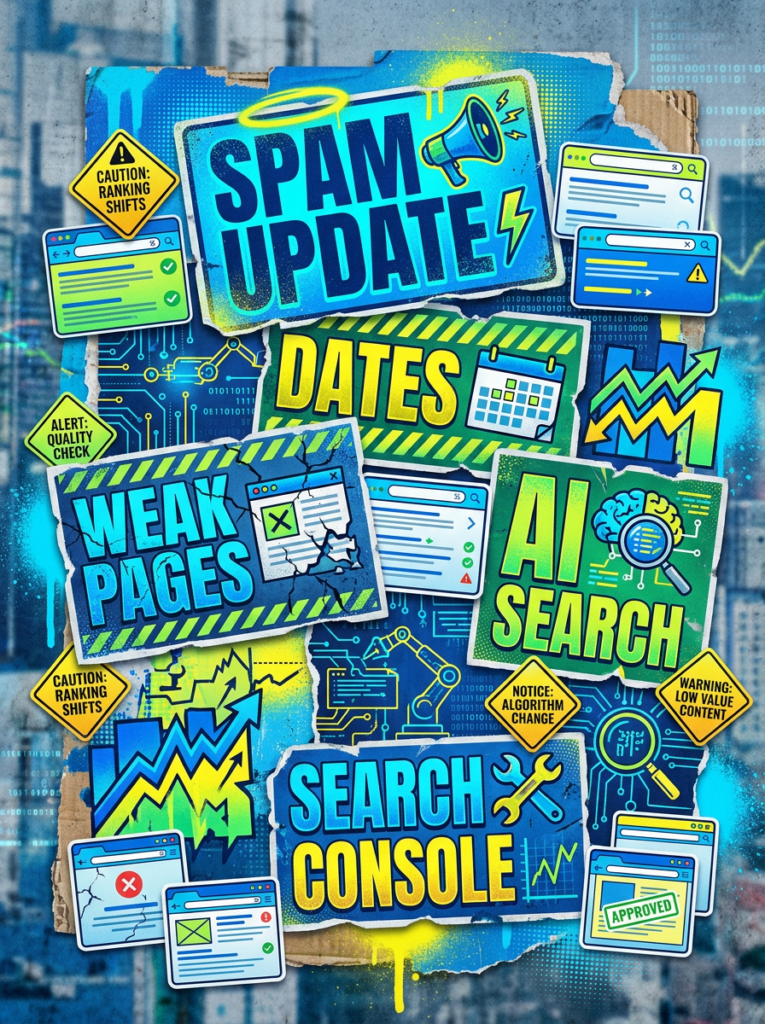
An overview
Spam updates are not the same as core updates.
A core update can change how Google evaluates quality and relevance more broadly. A spam update focuses on systems that catch manipulative or policy-breaking behaviour.
For most small businesses, the risk rarely looks like cartoon villain SEO. It usually looks more boring than that.
Thin AI-written posts with no proper editing. Location pages copied across towns with tiny changes. Old SEO pages nobody remembers creating. Indexed junk from plugins. Scraped articles. Search result pages in Google. Spam comments. Hacked pages quietly sitting in the index.
That is where this update becomes useful.
Not because every small business should panic, but because it gives you a reason to check whether the site has collected rubbish over time.
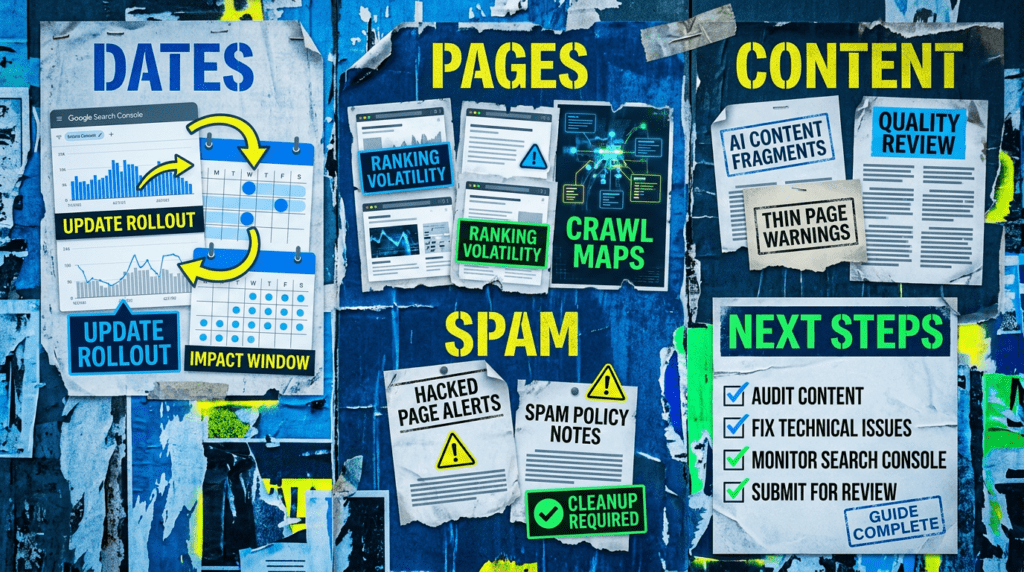
What Google confirmed for Digital marketing news July 2026
Google confirmed the update through the Search Status Dashboard.
The official version is simple: the update launched on 24 June, completed on 26 June, covered all regions and languages, and focused on spam.
Google’s spam update guidance says these updates improve its automated spam detection systems, including systems like SpamBrain. So, while the rollout only took a couple of days, that does not mean it had no teeth.
A spam update can hit sharply if a site sits in the wrong bucket. That still leaves one big warning: dates are only a starting point.
If your traffic dipped around 24 to 26 June, the spam update might matter. If the slide started earlier, continued well after, or only affected one small page group, you need a proper look before naming the culprit.
The public chatter was louder than Google’s announcement.
Search Engine Roundtable reported that the June spam update felt broader than a typical spam update and that some movement appeared before Google announced the rollout. That is worth noting, not worshipping.
Volatility tools and SEO chatter can tell us something moved. They cannot diagnose your site. A business with a traffic drop still needs to ask better questions.
Was the movement tied to the 24 to 26 June window, or did it start earlier in the month?
Did commercial pages lose visibility, or did low-value blog traffic wobble?
Did impressions drop, or did clicks fall because the search result changed?
Were competitors moving at the same time?
Has anything on the site changed recently, including content updates, page removals, new plugins or technical edits? That is the difference between investigation and update astrology.
This update also lands in a period where Google keeps tightening its language around AI search.
Google’s AI search guidance says optimisation for AI features like AI Overviews and AI Mode still sits within normal SEO. In plain English, you do not need to chase a separate magic trick called GEO just because someone on LinkedIn gave it a shiny name.
Google’s spam policies also now apply to generative AI responses in Search. That means attempts to manipulate AI answers can fall under spam too.
The FlyPost view is simple.
Trying to trick AI search is not a strategy. It is just old-school spam wearing a new jacket.
Better work still looks familiar: clear service pages, useful answers, consistent business information, strong technical basics, real proof and content that helps people choose.
If your site relies on mass-produced AI articles, copied local pages or vague “expert” content with no actual judgement, this is a good moment to rethink it.
Our AI search visibility guide covers the cleaner approach: make your business easier to understand, not easier to distrust.
What small businesses should check next
The useful response is boring, which is usually how you know it is sensible.
Start in Search Console and look at timing. Compare performance before 24 June, during the rollout window, and after 26 June. If the drop started well before the update, do not force the spam update story.
Next, look at pages rather than total traffic. A whole-site graph can make everything look dramatic. Page data tells you whether the problem sits in service pages, blogs, locations, technical junk or something else entirely.
Then review the content that actually moved. Thin pages, repeated local pages, old SEO clutter and unedited AI content deserve the most attention. A useful article that lost one query does not need the same treatment as 40 near-identical town pages.
Finally, look for junk you did not mean to create. Hacked pages, spam comments, indexed internal search pages, plugin URLs and old test pages can sit around quietly until Google starts caring. Search Console often makes this look messy, so use judgement. Not every weird URL needs a funeral.
What this means for small businesses
For most small businesses, the Google June 2026 spam update should act like a reminder, not a disaster alarm.
If the site has useful service pages, clean technical basics, honest content and no manipulative shortcuts, you probably do not need to throw the plan in the bin.
If the site has thin AI posts, copied location pages, forgotten SEO clutter or strange indexed junk, this is a good time to clean house.
The right response is simple:
Check the dates. Find the affected pages. Review the content honestly. Remove or improve the rubbish. Fix anything spammy, hacked or pointless. Then keep building pages that help customers make decisions.
Not dramatic. Still the right move.
Useful FlyPost pages
These guides will help if the June spam update has you checking your site.
- AI search visibility
Useful if you want your business to make more sense to search engines and AI tools. - Is AI Content Bad For SEO
Useful if your site has AI-written content and you need to decide what to keep, improve or rethink. - Do I Still Need SEO
Useful if AI search changes have made you wonder whether traditional SEO still matters. - SEO audit checklist
Useful if your traffic moved and you need a calmer way to investigate. - Google crawling weird URLs
Useful if Search Console shows junk URLs, plugin paths or odd pages.
digital marketing news July 2026 FAQs
The Google June 2026 spam update was a Google Search update focused on spam detection systems. Google rolled it out globally across all languages between 24 and 26 June 2026.
No. Google did not announce a new spam policy alongside this specific rollout. The update appears to improve enforcement under existing spam policies.
No. A June traffic drop could relate to the May core update, the June spam update, normal volatility, AI search changes, seasonality, competitor movement, tracking issues or site changes. Check timing and affected pages before deciding.
Start with Search Console. Look at affected pages, query drops, thin content, AI-heavy pages, strange indexed URLs, duplicate location pages, hacked content and pages created mainly for SEO rather than users.
AI content is not the automatic problem. Thin, generic or unedited AI content is. If a page does not help users or add useful judgement, it can become a liability.
Small businesses should pay attention, but they should not panic. A clean site with useful content, honest service pages and no manipulative shortcuts has far less to worry about than a site full of thin, copied or spammy pages.


Quick tip
Want this round-up without hunting for it? Come talk to us about handling it all instead.

Straight talking marketing that gets results.
No pressure, no jargon. Just a clear look at what’s stopping your site from bringing in more enquiries.
Get my free website reviewLike this guide?
Tell Google you want more like it. One click, no sign-up, and FlyPost guides start showing up more often in your search results.
Add FlyPost as a preferred sourceTakes you to Google, then straight back here.