


What Does An SEO Agency Do? Monthly SEO Work Explained

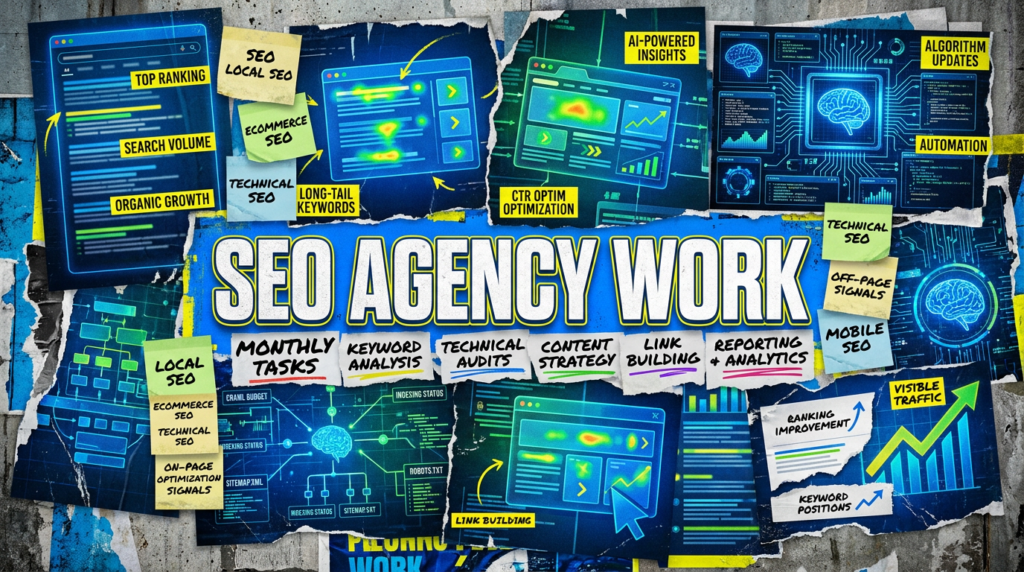
If you are paying for SEO every month, you should know what is actually being worked on. Here is what good monthly SEO should include.
What does an SEO agency do each month? Fair question, because from the outside SEO can look suspiciously like someone tweaking a few titles, sending a report, and hoping nobody asks too many questions.
A proper agency should help the right people find your website, understand your offer, trust your business and choose you. That means technical fixes, service page improvements, content planning, internal links, local visibility, reporting, tracking and adapting to how people search across Google and AI tools.
Some months look busy from the outside. Some months are more behind the scenes. But every month should have a clear reason behind the work.
You can use this guide to understand what should be happening. If you want the practical version handled for you, we can do that too.
The quick version
If you only have 20 minutes, this is what an agency should usually be doing as part of monthly SEO work.
- Checking what is ranking, what is slipping, and what needs attention
- Fixing technical issues that block crawling, indexing or conversions
- Improving existing pages so they match search intent better
- Creating useful content that supports your services, not random blog filler
- Strengthening internal links between guides, service pages and money pages
- Reviewing enquiries, calls, traffic quality and lead performance
- Making your business clearer for both Google and AI search tools
If your monthly SEO report only says “traffic is up” and gives no clear work, priorities or next steps, that is not enough.

Not sure where to start?
Start by asking one blunt question:
What changed this month that should help the business?
Not “what changed in a graph?”
Not “what did a ranking tool say?
What actual work happened on the website, in the content, in the structure, in the tracking, or around your visibility?
A good SEO agency should be able to explain:
- What your agency did
- Why it mattered
- Which pages it affected
- What it should improve
- What happens next
If the answer is always “SEO takes time,” that might be true, but it is not a strategy.
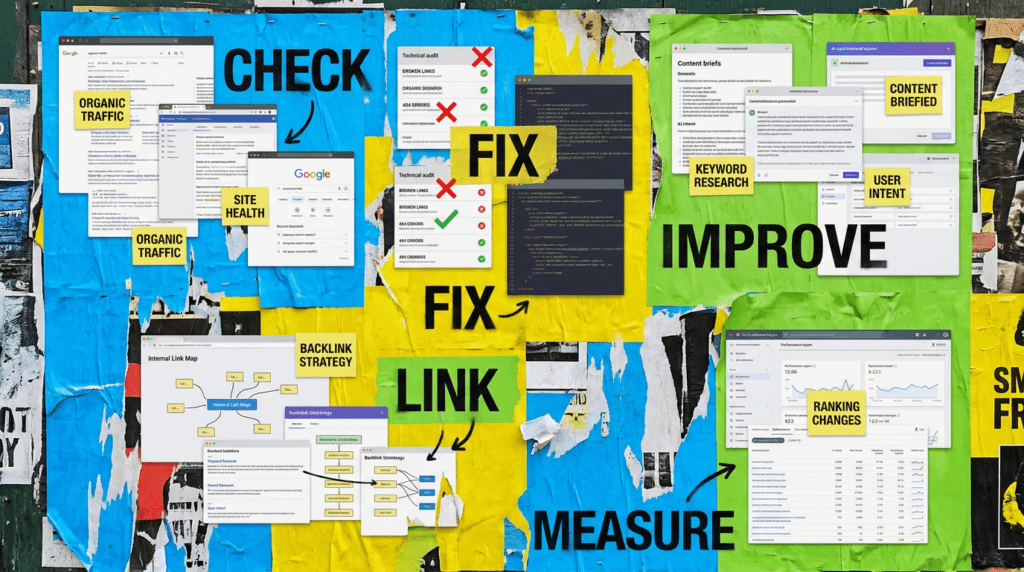
Our full guide on what does an SEO agency do
Work through this in order. It is designed to show what should actually sit behind proper SEO agency services, not just the shiny report at the end of the month.
Step 1: Check whether Google can understand the site
Before content plans and keyword ideas, the basics need to work.
Google’s SEO Starter Guide explains the foundations of helping search engines discover, crawl and understand your content. That is the starting point. If Google struggles to access or understand key pages, everything else gets harder.
Checklist:
- Key service pages are indexable
- Sitemap includes the pages that matter
- Robots.txt is not blocking important sections
- Canonicals point to the correct versions
- Important pages sit close enough to your main structure
- Your agency checks Search Console for indexing issues
- Broken links and redirect chains are reviewed
Plain English: if Google cannot crawl it, understand it or trust it, do not expect miracles.
Step 2: Review what is already ranking
Good ongoing SEO starts with what is already happening.
You do not always need to start from scratch. Often, the quickest wins are pages that already have impressions, low rankings, weak click-through rates or traffic that is not turning into enquiries.
Checklist:
- Which pages are gaining visibility?
- Which pages are losing visibility?
- Which keywords are close to page one?
- Which pages get traffic but no enquiries?
- Which pages rank for the wrong intent?
- Which titles and descriptions need improving?
- Which topics deserve more support?
Do not ignore existing pages just because new content feels more exciting. Existing pages often have the money hiding in them.
Step 3: Improve service pages first
For most small businesses, service pages do the selling.
Blogs help support the site, but service pages usually handle the enquiries, bookings and calls. If those pages are thin, vague or badly structured, more blog posts will not magically save the day.
Checklist:
- Each core service has its own clear page
- The page explains who the service is for
- The offer is obvious above the fold
- The copy answers buying questions
- Proof is added where useful
- FAQs handle objections
- Internal links point to the page
- The next step is clear
Service pages need to sell the service, not politely exist.
Step 4: Create content with a job
Content should not be written because someone promised “four blogs per month” and now everyone is stuck feeding the machine.
Useful SEO content usually has a clear purpose.
Checklist:
- Answers a real customer question
- Supports a service or money page
- Targets a clear search intent
- Avoids competing with existing pages
- Links naturally to relevant pages
- Gives genuinely useful advice
- Does not exist just to hit a keyword count
Content without a job is just website clutter wearing a nice heading.
Step 5: Strengthen internal links
Internal links help Google understand which pages matter and how your topics connect.
They also help real people move from useful information to the next practical step. That is the bit many sites miss.
Checklist:
- New guides link to relevant service pages
- Older guides link to newer related guides
- Service pages link to useful support content
- Anchor text is clear and natural
- Important pages are not orphaned
- Internal links support commercial pages
- Links are updated when new content goes live
Publishing a guide without linking it into the rest of the site is like putting up a sign in a cupboard.
Step 6: Keep an eye on competitors
Competitor research is useful. Competitor obsession is not.
An agency should look at what others are doing well, then use that information to make better decisions for your site.
Checklist:
- Which competitors are gaining visibility?
- Which pages are outranking yours?
- What questions do they answer better?
- What proof or trust signals do they use?
- Are they building stronger local visibility?
- Are they earning useful links or mentions?
- Are they clearer about their offer?
Do not copy competitors blindly. Work out why they are winning, then build something better.
Step 7: Check lead quality, not just traffic
Traffic is nice. Rankings are nice. But small businesses need enquiries, bookings, calls and sales.
A good agency should care about whether SEO activity is attracting the right people, not just more people.
Checklist:
- Organic traffic is reviewed by page
- Enquiries are checked where tracking allows
- Calls and forms are reviewed
- Lead quality is discussed
- High-traffic, low-lead pages are flagged
- Service pages are judged commercially
- Reports explain what matters, not just what moved
Traffic that never turns into anything useful is not a win. It is a busy waiting room with no customers.
Step 8: Improve local visibility where relevant
If your business serves a local area, local SEO should not be ignored.
That includes your website, your Google Business Profile, your location signals, your reviews and the way your services connect to the places you cover.
Checklist:
- Google Business Profile details are accurate
- Service areas are clear
- Reviews are encouraged naturally
- Local pages are useful, not duplicated rubbish
- Address and contact details are consistent
- Local internal links make sense
- Key services are connected to relevant locations
Google is clever, but it still needs clear signals. Do not make it solve a puzzle you created.
Step 9: Make the business easier for AI search to understand
SEO & AI is not about throwing your old SEO plan in the bin.
It is about making your business clearer, more useful and easier to understand across search engines and AI answer tools.
Checklist:
- Services are explained clearly
- The business name and offer are consistent
- Helpful guides answer real questions
- Pages show experience and trust
- FAQs answer decision-making queries
- Content is structured clearly
- Thin, vague content is improved or removed
AI tools need clear information to work with. If your site sounds like every other business in your industry, you are not giving them much to choose from.
Step 10: Report clearly and plan the next month
A report should not just show numbers. It should explain what happened, what was done, what changed and what comes next.
Checklist:
- Completed work is listed clearly
- Results are explained in plain English
- Priority pages are reviewed
- Issues are flagged without drama
- Next steps are included
- Commercial outcomes are discussed
- The plan adjusts based on performance
Good SEO takes time, judgement and consistency.
You can absolutely do parts of it yourself. You can improve titles, tidy service pages, add better FAQs, check Search Console and link related pages together.
The hard part is knowing what matters most this month.
That is where FlyPost can help. Our SEO & AI work focuses on practical priorities, clear actions and commercially useful improvements. No mystery retainer energy. No pretending every small issue is a disaster. Just focused SEO work built around what your business actually needs.
If you want to compare the support options, start with our SEO packages
Common mistakes
These are the usual reasons businesses end up asking what an agency is actually doing.
- Paying for content volume instead of useful content
- Ignoring service pages while publishing more blogs
- Treating every SEO tool warning like an emergency
- Reporting on traffic but not enquiries
- Forgetting internal links after new content goes live
- Chasing keywords that do not match buying intent
- Letting old pages go stale
- Assuming AI search needs a totally separate magic strategy
DIY lane vs done for you lane
DIY lane:
If you want to DIY this, start with the basics. Review your key service pages, check they are indexable, improve weak titles, add useful FAQs, link related guides together and use Search Console to find pages that are close to ranking better.
Done for you lane:
If you want the time-saving version, we will audit the site, prioritise the work, improve the pages that matter, build useful supporting content, strengthen internal links and keep the monthly work tied to commercial outcomes.
Related Guides on the wall
If you are working out what an SEO agency should be doing each month, these guides will help you understand the main moving parts.
- Read our SEO audit checklist if you want to understand what should be checked before serious SEO work starts.
- Use internal linking guide if you want to make your pages easier to crawl and connect your guides properly.
- Learn how to do keyword research if you want to understand how topics should be chosen without chasing useless keywords.
- Read our Google Business Profile optimisation guide if local visibility is part of what you are paying for each month.
what does an SEO agency do FAQs

An SEO agency helps improve how your website appears in search. That can include technical fixes, page improvements, content planning, internal links, local SEO, reporting and adapting your site for SEO & AI visibility.
Each month should usually include performance checks, technical fixes, page improvements, content work, internal linking, reporting and next-step planning. The exact mix should depend on your site and goals.
You should be able to see what was done, why it mattered, which pages were affected and what the next priority is. If reports are vague every month, ask sharper questions.
For most competitive businesses, yes. Search results change, competitors improve, pages age and technical issues appear. Ongoing SEO keeps the site improving instead of slowly going stale.
Yes, Good SEO & AI work makes your business clearer, more useful and easier for both search engines and AI tools to understand.

Quick tip
Rather have us handle this instead of DIY-ing it? That is literally the job.


Straight talking marketing that gets results.
No pressure, no jargon. Just a clear look at what’s stopping your site from bringing in more enquiries.
Get my free website reviewLike this guide?
Tell Google you want more like it. One click, no sign-up, and FlyPost guides start showing up more often in your search results.
Add FlyPost as a preferred sourceTakes you to Google, then straight back here.