


Google I/O 2026: What Changed In Search And What Small Businesses Should Actually Do Next

Google I/O 2026 was full of AI announcements, but the useful bit is simpler: Google is pushing Search further into AI Mode, agents, Shopping, YouTube and more AI-led ad experiences.
Google’s official I/O site now points users to keynote recaps and on-demand sessions, so this is not just one keynote moment. It is a wider product direction across Search, AI, YouTube, ads and commerce.
That matters because Google is no longer just nudging people toward a list of links. It is pushing users toward longer prompts, follow-up questions, AI-generated summaries, product discovery, video discovery, and agent-led actions. The Verge reported that Google showed a redesigned Search box built for longer queries, AI-powered autocomplete, and smoother movement between AI Overviews and AI Mode.
So no, this is not “SEO is dead” nonsense. We have heard that one roughly 400 times and, somehow, people still Google plumbers, wedding venues, accountants and “why is my sitemap broken?”
The real takeaway is sharper than that: the way people search is changing again, and the businesses that give Google clear, useful, trustworthy information will be in a better position than those still relying on thin pages and vague copy.
The quick version
If you only have 20 minutes, start here. These are the main things small businesses should take from Google I/O 2026
- Google is making Search more conversational and AI-led
- AI Mode and AI Overviews are becoming a bigger part of the search journey
- Shopping and YouTube are moving closer to search and discovery
- Ads are starting to move deeper into AI-led Search and AI Mode
- The basics still matter: crawlable pages, useful content, clear business information and trustworthy answers
If that already feels like a lot, do not worry. Below is the full update in the right order.
Not sure where to start?
The biggest mistake people make after events like Google I/O 2026 is treating every announcement like an emergency.
It is not.
Some features are live now. Some are rolling out. Some are US-first. Some are subscriber-first. Some sound impressive but will not change what a small UK business needs to do tomorrow morning.
The better place to start is with the announcements that affect how people find, compare and choose businesses. That means Search, AI Mode, Shopping, YouTube, ads, and the quality of the information Google can understand from your website.
Our full Google I/O 2026 search update
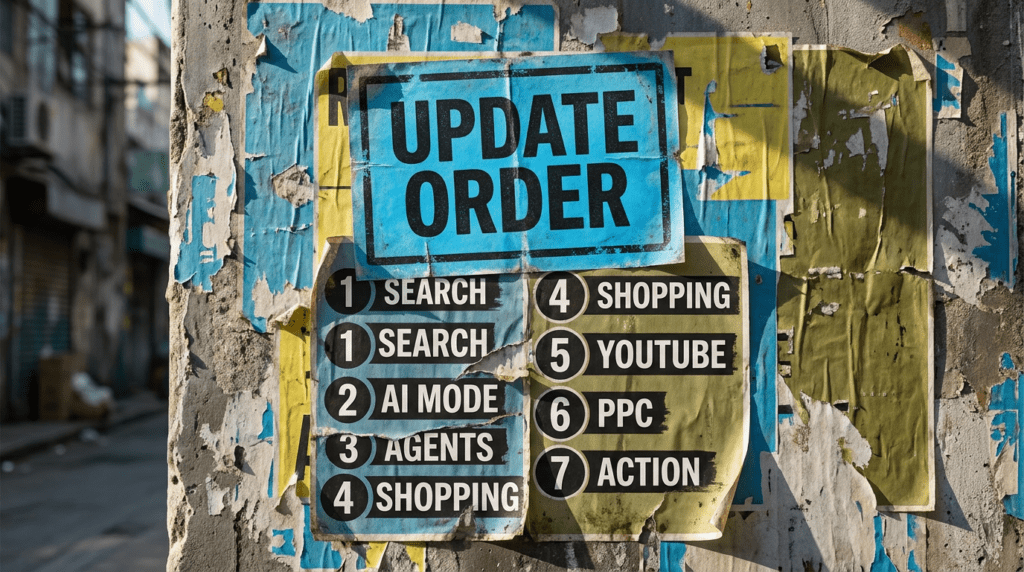
Work through this in order. The headline-grabbing AI demos are not always the parts that matter most for small business marketing.
Step 1: Search is becoming more conversational
The biggest Search announcement was not one tiny ranking factor or a new SEO trick. It was the direction of travel.
Google is pushing users toward longer, more natural prompts, AI-assisted follow-up questions, and richer ways to search using text, images, files, video and browser context. The Verge reported that Google’s redesigned Search box supports longer queries and makes it easier for users to move between AI Overviews and AI Mode.
- Short keyword searches still matter
- Longer question-led searches matter more than they used to
- Pages need to answer real follow-up questions
- Generic “SEO copy” will struggle harder
- Useful comparison, decision and explanation content becomes more important
This is where AI search visibility becomes more than a buzzword. It is about making your site clear enough, useful enough and trustworthy enough to appear when Google answers more complex questions.
Step 2: AI Mode is becoming harder to ignore
The AI Mode update matters because Google is making AI-led search feel less like a separate experiment and more like part of the normal search journey.
The key shift is simple: users can ask broader questions, continue the search with follow-ups, and spend more of the decision-making process inside Google. That means your website has to help answer proper buyer questions, not just repeat a keyword and hope for the best.
- Users may ask broader questions before choosing a business
- Follow-up searches may happen inside Google
- Comparison-style content becomes more important
- Clear answers and strong page structure matter
- Brand visibility may depend on being useful earlier in the journey
This does not mean you need a weird new “AI SEO hack”. It means your content has to help people make decisions, not just match a keyword once.
Step 3: Search agents are moving from answers to actions
The more interesting bit is not just that Google can answer more questions. It is that Google wants Search to do more work for the user.
Reuters reported that Google used I/O to push deeper AI integration across its core products, including Search, while The Verge reported that Search is getting information agents and mini-app-style experiences designed to help users with more complex tasks.
- Local businesses need clear service information
- Ecommerce businesses need accurate product data
- Booking and enquiry routes need to be simple
- Business details need to stay consistent
- Trust signals matter because Google may support more of the decision journey
For UK small businesses, a lot of this is still “watch closely” rather than “rip up the website tonight.” But the direction is obvious: Google wants to help users get things done, not just find pages.
Step 4: Shopping became one of the most important parts of the update
Universal Cart was one of the more commercially important announcements from Google I/O 2026. The Verge reported that Google is launching a Universal Cart that lets users add products from YouTube, Search, Gemini and Gmail, with checkout across different merchants and services.
For ecommerce brands, this matters because messy product data is becoming harder to hide.
- Product feeds matter
- Accurate pricing matters
- Stock data matters
- Product content matters
- Clear comparison information matters
If you sell online and your product data is thin, outdated or inconsistent, that is not just a Merchant Center problem anymore. It is a visibility problem.
Step 5: YouTube is becoming more search-led
Ask YouTube is another update worth watching. TechRadar reported that Ask YouTube will let users ask conversational questions and receive written AI-generated answers with relevant video recommendations, including links to specific parts of videos. At launch, TechRadar reported that it is due to arrive in the US first.
This matters because video discovery is moving closer to search behaviour. People are not just scrolling. They are asking, comparing and refining.
- Useful video content may become easier to discover
- Shorts and long-form content both matter
- Question-led video ideas become more valuable
- Clear titles, descriptions and topics matter
- Brands need content that answers real questions, not just polished filler
Step 6: PPC did not get the keynote spotlight, but ads are clearly coming with it
For PPC, the honest answer is that Google I/O 2026 was still more of a Search, AI, Shopping and YouTube story than a classic paid media roadmap.
But there is now a clearer commercial thread running through it. The Verge reported that Google is working AI-powered ads deeper into Search and AI Mode, including sponsored product-style explainers and conversational ad experiences.
That matters because AI-led search is not just an organic visibility issue. It is also becoming a paid visibility issue.
- More search journeys may start with conversational queries
- Shopping journeys may become more feed-led
- Sponsored results may sit inside AI-assisted answers
- Product data and landing pages need to be cleaner
- Conversion tracking still needs to be reliable
For now, the boring-but-useful advice wins: keep your campaigns clean, your feeds accurate, your landing pages strong and your tracking reliable.
Step 7: Website owners should not panic, but they should tighten the basics
The most practical takeaway from the Google search update is still annoyingly simple: better content, cleaner structure, stronger signals and more useful information.
A recent arXiv study on AI Overviews found that AI Overviews appeared for 13.7% of tested trending queries and rose to 64.7% for question-form queries. The same study also reported that AI Overview-cited domains can differ from traditional first-page rankings, which supports the idea that AI-led search visibility is not always identical to classic blue-link SEO.
- Monitor Search Console trends
- Watch pages that used to get simple informational clicks
- Improve pages that answer common questions
- Add stronger proof, examples and first-hand detail
- Keep service and product information clear
This is not the time to chase fake AI optimisation rituals. It is the time to make your website less vague. Painful, but true.
Step 8: What small businesses should do next
Do not rebuild your whole marketing plan because Google had a flashy keynote. Do tighten the parts that Google keeps leaning into.
- Update key service pages so they answer real buyer questions
- Make sure Google Business Profile information is accurate
- Review product feeds if you sell online
- Add useful images, videos and examples where they genuinely help
- Track traffic, enquiries and conversions together
- Keep an eye on AI Mode and AI Overviews, but do not panic-refresh Search Console every 12 minutes
If your site is thin, messy or unclear, Google I/O 2026 is another warning shot. If your site is useful, structured and genuinely helpful, the direction of travel is not bad news. It just raises the standard.
Common mistakes
These are the things businesses will probably get wrong after Google I/O 2026, especially if they react to the hype instead of the useful bits.
- Treating every AI feature as an emergency
- Assuming SEO is dead because Search looks different
- Ignoring product feeds and business data
- Publishing more generic AI content instead of better content
- Forgetting that YouTube is becoming more search-led
- Forgetting that AI-led Search will affect paid visibility as well as organic visibility
- Chasing AI tricks instead of fixing weak pages
DIY lane vs done for you lane
DIY lane:
If you want to respond to Google I/O 2026 yourself, start by reviewing your key pages, business information, product data, content quality and tracking setup. Do the dull bits properly before chasing the shiny bits.
Done for you lane:
If you want the quicker route, we can help you tighten your SEO & AI, PPC and content strategy around how people actually search, compare and choose businesses now.
Related Guides on the wall
If you’re working through what Google I/O 2026 means for your business, these guides will help you tighten the parts that matter most.
- Read AI Search Visibility if you want to understand how small businesses can get cited in AI-led search results
- Use Organic Social Media Guide if you want to make content easier to find and more useful across social and video
- Read Google Ads Enhanced Conversion Guide if you need cleaner conversion tracking before making PPC decisions
Google I/O 2026 FAQs

Yes, but not in the lazy “SEO is dead” way. Google pushed Search further toward AI Mode, longer prompts, agents and richer answers. That makes useful, trustworthy and well-structured content more important, not less important.
The biggest practical update was the move toward a more AI-led Search experience, including a redesigned Search box, smoother movement between AI Overviews and AI Mode, and more agent-style features.
It might for some query types, especially simple informational searches, but the full impact is still unclear. Early research suggests AI Overviews can appear much more often for question-style searches, but Google still surfaces links inside AI-led results.
Not as the main keynote story, but ads are clearly part of the direction of travel. Reporting after I/O showed Google working AI-powered ads deeper into Search and AI Mode, including sponsored product-style explainers and conversational ad experiences. For advertisers, the practical takeaway is simple: clean feeds, strong landing pages, clear offers and reliable tracking matter even more.
Start with the basics. Improve key pages, answer real customer questions, keep business and product data accurate, review Search Console trends, and make sure your tracking shows which channels actually drive enquiries or sales.


Quick tip
Want this round-up without hunting for it? Come talk to us about handling it all instead.

Straight talking marketing that gets results.
No pressure, no jargon. Just a clear look at what’s stopping your site from bringing in more enquiries.
Get my free website reviewLike this guide?
Tell Google you want more like it. One click, no sign-up, and FlyPost guides start showing up more often in your search results.
Add FlyPost as a preferred sourceTakes you to Google, then straight back here.