


Boosted Posts vs Ads: What Small Businesses Should Use

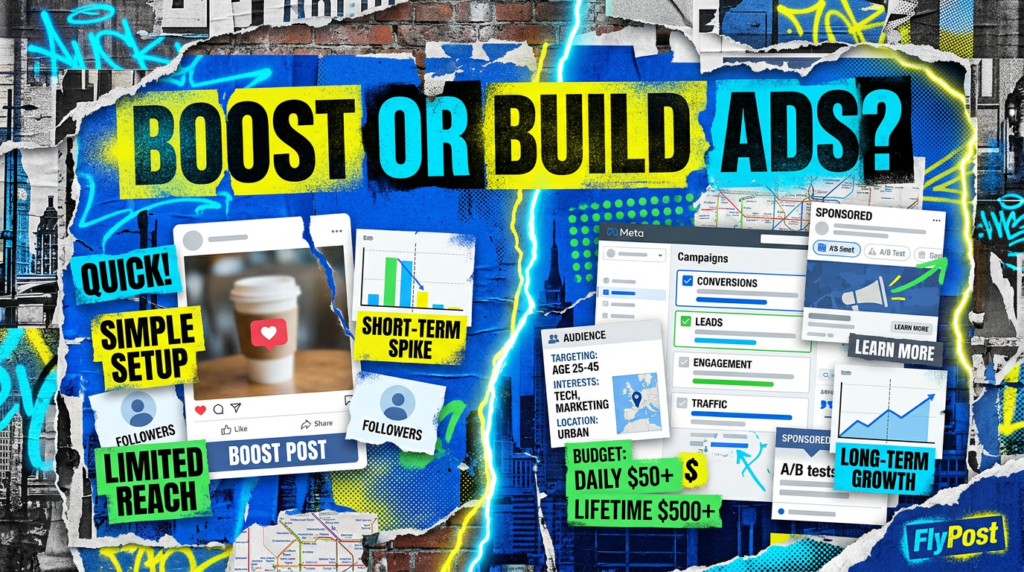
Boosted Posts vs Ads: What Should Small Businesses Use?
Boosting a post can help, but it is not a magic lead machine. Here is when to use it, when to build proper ads, and when to stop feeding Meta your loose change.
Boosted posts vs ads is one of those questions small businesses run into as soon as a post gets a few likes.
Meta makes the boost button look dangerously easy. Pick a budget, choose a rough audience, press the button, and your post gets more reach.
Sometimes that helps.
Sometimes you just pay to show a fairly average post to more people and call it marketing.
That does not make boosting useless. It means you need to understand the job. A boosted post can give strong organic content a little push. Proper Meta ads give you more control when you want leads, sales, bookings, testing, retargeting or cleaner reporting.
The trick is knowing which tool fits the job before you spend anything.
You can use this guide to make that call. If you want someone to plan the paid social side properly, we can help.
The quick version
If you only have 20 minutes, use this rule. Boost a post when you want more people to see something that already works organically. Build proper ads when you need a clearer business result.
- A strong post with real comments, saves or local interest can earn a small boost.
- Proper Meta ads make more sense when leads, bookings or sales matter.
- Weak posts rarely improve just because you add budget.
- Likes can look nice while doing absolutely nothing for the pipeline.
- The campaign goal should come before the budget, not after it.
- Small boosts work best when the audience stays tight and the reason feels obvious.
If a post already fell flat organically, boosting usually just helps it disappoint more people.
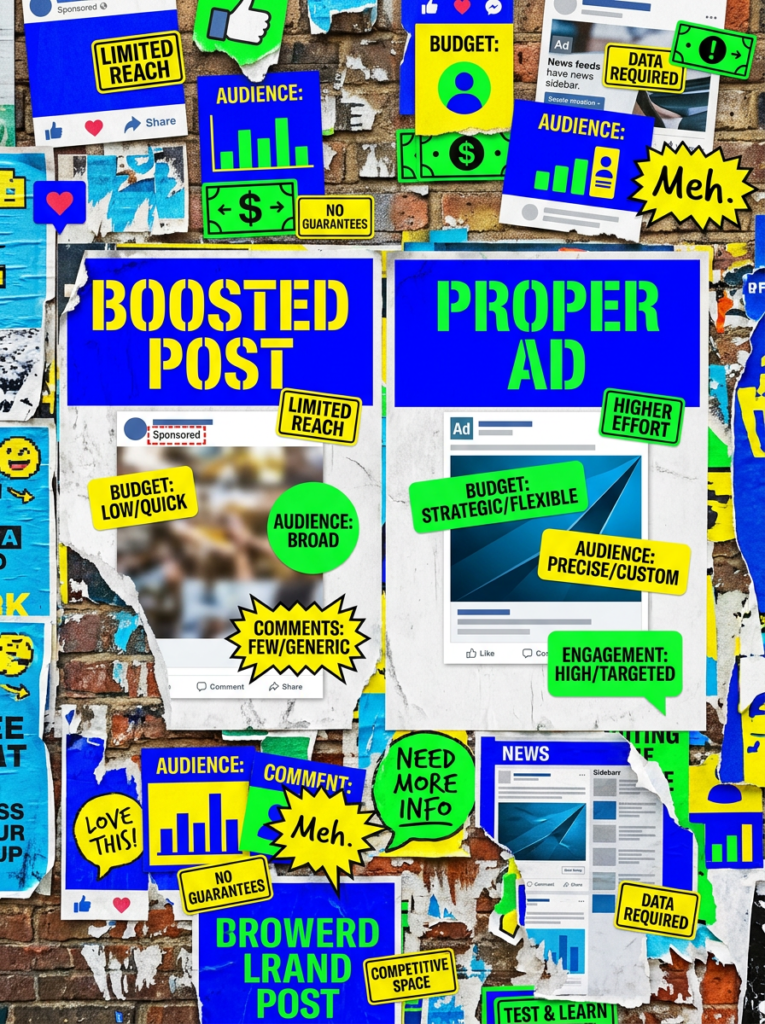
Not sure where to start?
Start with the goal. Not the button. Not the budget.
Not “Meta keeps suggesting I boost this post, so maybe the robots know something.” Ask what you want the spend to do.
Most small businesses want one of these things:
- Local awareness from people nearby
- More eyes on a strong post
- Traffic to a useful page
- Enquiries from people who already need the service
- Bookings for an event, appointment or consultation
- Retargeting for people who already visited the site
- Extra visibility for an offer with a real deadline
Once you know the job, the choice gets easier.
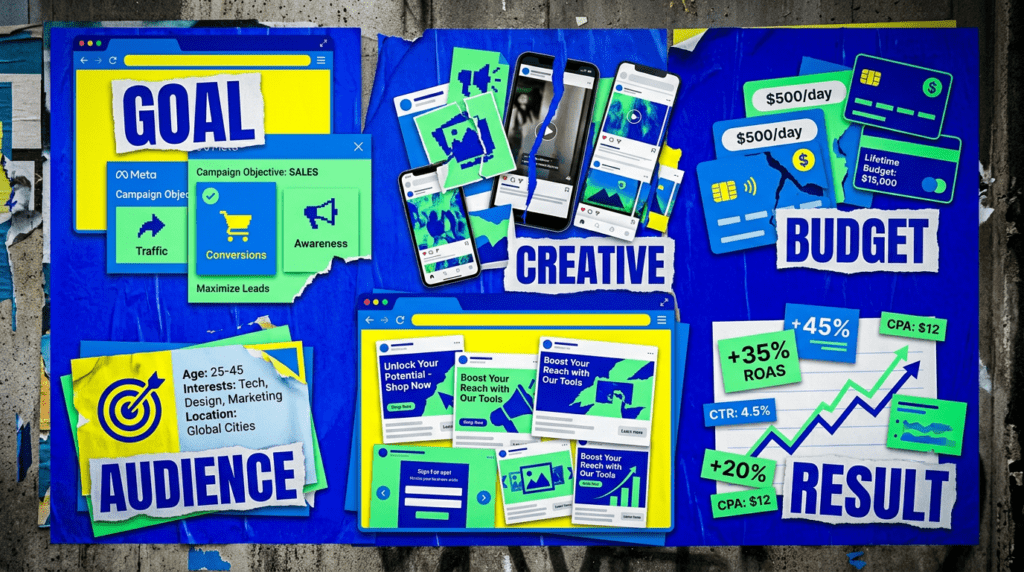
Our full boosted posts vs ads guide
Work through this in order. The point is not to make boosting sound evil. The point is to stop treating every blue boost button like a marketing strategy.
Step 1: Understand the real difference
Meta’s own boosted posts guidance explains that a boosted post still counts as an ad, but Ads Manager and Business Suite give you more advanced customisation. That difference matters. A boosted post starts as normal organic content. You pay to push it further.
A proper ad starts with a campaign setup. You choose the objective, build the audience, control the placement, test the creative and judge the result against a clear target. Think of it like this:
- Boosted posts suit simple visibility.
- Ads Manager suits proper campaign planning.
- Boosting gives you speed.
- Proper paid social ads give you control.
- A boost can help a good post travel further.
- A campaign can test what actually drives action.
- Both options spend real money, so neither deserves autopilot treatment.
A boosted post can nudge good content. It cannot turn weak content into a proper paid social strategy.
Step 2: Use boosted posts for simple reach
Boosting works best when the post already has some life in it.
Maybe people commented. Maybe it picked up saves. Maybe local followers reacted well. Maybe the post explains something useful and deserves a wider audience. That is a decent reason to boost. Boosting may work when:
- The post already shows real interest.
- People nearby need to see an update.
- An event, offer or announcement needs a quick push.
- The audience does not need complex targeting.
- A small budget can do the job.
- You want reach rather than detailed testing.
- Success means visibility, not direct enquiries.
Avoid boosting when:
- The post already flopped.
- The image, video or copy feels rushed.
- Nobody can tell what the post actually says.
- The destination page needs work.
- Tracking matters and the setup cannot prove much.
- The business needs to compare audiences or creative.
- You expect lead generation from a casual boost.
Boosting a weak post is like putting a louder speaker on a boring announcement. More people hear it, but nobody suddenly cares.
Step 3: Use proper ads when you need control
Proper Facebook ads and Instagram ads take more setup, but that setup gives you more control. That matters when the result matters.
A proper campaign can test different messages, send people to a specific page, retarget website visitors, compare audiences and track leads more clearly. Use proper ads when you need to:
- Test different angles without guessing.
- Compare visuals instead of arguing over opinions.
- Reach separate audiences with separate messages.
- Retarget people who already know the brand.
- Send traffic to a landing page built for action.
- Measure leads, bookings or purchases properly.
- Control where the ads appear.
- Spend enough to learn something useful.
This does not mean every small business needs a giant campaign structure. It means you should not use the simplest tool for a job that needs more control.
If the result matters, build the campaign properly. Do not boost and hope.
Step 4: Match the objective to the real goal
Small businesses often say they want leads, then choose a setup that rewards engagement. Meta then finds people likely to engage.
That does not mean those people want to buy. It means they like clicking, reacting or commenting. Pick the goal before you choose the setup.
- Awareness works when more local people need to recognise the business.
- Engagement can help when a useful post deserves more comments or shares.
- Website traffic only helps when the landing page can handle visitors.
- Lead campaigns need a proper offer, clear form and sensible follow-up.
- Booking campaigns need a clean booking journey, not a maze.
- Retargeting suits people who already know the brand.
- Offer testing needs proper ads, not one boosted post and crossed fingers.
Do not ask Meta for engagement and then get annoyed when it brings you people who like engaging.
Step 5: Check the post before you boost it
Before spending money, look at the post like a stranger would. Would they understand it? Would they care? Would they know what to do next?
A post usually deserves a boost when:
- The hook makes sense immediately.
- The visual actually stops someone scrolling.
- One clear message carries the post.
- The audience can understand why it matters.
- The offer does not need a translator.
- Next steps feel obvious.
- Comments and questions have replies.
- Organic performance shows at least some promise.
If the post feels vague before you spend money, paid reach will not fix it.
Paid spend amplifies what you already have. It does not perform emergency CPR on lazy content.
Step 6: Keep the budget sensible
Boosted posts can burn money quietly because each spend feels small.
A tenner here. Twenty quid there. Another quick boost because Meta suggested it. Suddenly you have spent proper money on random visibility with no plan. For boosted posts:
- Start small.
- Give the boost a clear end date.
- Keep the audience tighter than Meta would like.
- Watch who actually engages.
- Stop early if the wrong crowd turns up.
- Avoid repeat boosts just because the button sits there looking friendly.
For proper ads:
- Give the campaign enough budget to test properly.
- Set one clear goal.
- Track the outcome that matters.
- Look at lead quality, not just lead volume.
- Cut weak creative once the data makes the answer obvious.
- Keep the version that brings useful results.
- Avoid judging a campaign before it has enough room to breathe.
Small budgets still deserve a plan. “It was only £20” sounds harmless until you do it 15 times.
Step 7: Watch the right numbers
The right metric depends on the job. If you boost for visibility, reach and engagement can help. If you want leads, likes will not pay the bills. Use numbers that match the goal.
- Reach matters when awareness is the point.
- Engagement helps when you want social proof or conversation.
- Link clicks only matter if people reach the right page.
- Landing page views beat cheap, accidental clicks.
- Leads matter when the business needs enquiries.
- Cost per lead only means something once enough data exists.
- Lead quality decides whether the campaign helped or just looked busy.
- Comments can show useful interest, objections or problems.
Ignore the vanity stuff when it does not match the goal.
- Likes do not prove buying intent.
- Cheap clicks can hide terrible traffic.
- Big reach means little if the audience makes no sense.
- Enquiry numbers need a quality check.
- Spend tells you nothing without context.
A post can get likes and still do nothing useful for the business. Annoying, but true.
Step 8: Connect paid reach to your wider social plan
Paid social works better when the organic side does not look abandoned.
If someone clicks through from a boost or ad and lands on a dead-looking page, you have created a weak first impression. Before spending regularly, tighten the basics:
- Keep the page alive between paid pushes.
- Make the profile clear enough for a stranger.
- Post useful content consistently.
- Show proof when you have it.
- Reply to comments and messages.
- Send people to pages that match the post.
- Plan content before panic-posting takes over.
- Give paid traffic something decent to land on.
This is where a proper content calendar guide helps. Paid social works better when your organic social does not look like it gave up in March.
Step 9: Know when boosting does enough
Boosting can absolutely make sense. Not every post needs a full ad campaign. Sometimes you only need a light nudge. Boosting may do enough when:
- Local visibility is the main goal.
- An announcement needs a quick push.
- A strong post deserves extra reach.
- Detailed tracking does not matter.
- The budget is small.
- The job only needs a simple visibility lift.
That is fine. The problem starts when businesses expect boosted posts to behave like proper lead-generation campaigns.
Boosting is a nudge. Ads Manager is a campaign tool. Use the right one.
Step 10: Move to proper ads when the stakes rise
Once paid social becomes a regular growth channel, boosting usually becomes too blunt. Proper ads become the better option when:
- Paid social has a monthly budget.
- The business needs enquiries, bookings or sales.
- Retargeting would help.
- Audience control matters.
- Creative testing could improve results.
- Reports need to show what worked.
- The plan involves scaling, not dabbling.
At that point, the casual boost button starts holding you back. Once paid social becomes part of your growth plan, stop treating it like a casual button click.
Common mistakes
These are the mistakes that make boosted posts vs ads more expensive than they need to be.
- Boosting posts just because Meta nudges you.
- Putting money behind content that already failed.
- Choosing engagement while secretly wanting leads.
- Treating likes like sales signals.
- Sending paid traffic to a weak page.
- Spending lots of tiny budgets with no plan.
- Ignoring comments and messages after the boost.
- Calling boosted posts a full ad strategy.
- Running proper ads without tracking the result.
DIY lane vs done for you lane
DIY lane:
If you want to DIY this, keep boosted posts simple. Use them for strong posts, local awareness, events, announcements and content that already shows some life. Keep the budget small, choose a sensible audience, and stop if the results look soft. Do not boost everything. That is not a strategy. That is feeding the machine snacks.
Done for you lane:
If you want proper paid social support, we can help you decide when to boost, when to build campaigns, what creative to test, where to send traffic, and how to judge whether the money actually did anything useful. If you want help choosing the right setup, start with our Social Media Marketing service.
Related Guides on the wall
If you are comparing boosted posts vs ads, these guides will help you strengthen the content and planning around your paid social activity.
- Read social media content ideas if you need better posts before you start putting money behind them.
- Use organic social media guide if your page needs a stronger foundation before paid reach sends people there.
- Check content calendar guide if you keep posting last minute and then boosting random posts to make up for it.
- Read social media for small business if you want the wider basics before choosing between boosting and paid social campaigns.
boosted posts vs ads FAQs

Boosted posts vs ads comes down to control. A boosted post pushes an existing organic post to more people. Proper Meta ads give you more control over objectives, audiences, creative testing, placements and reporting.
Boosted posts can help when you want simple reach, awareness or extra visibility for a strong post. They work less well when you need leads, sales, bookings or proper campaign testing.
Use boosted posts for simple visibility. Use Facebook ads or Meta ads through Ads Manager when you need better targeting, testing, tracking or lead generation.
Boosted posts often optimise around engagement or visibility. That can bring likes, comments and clicks from people who do not plan to buy. If you want sales or leads, build the campaign around that goal.
Yes. FlyPost can help with Social Media Marketing, including organic planning, paid social ads, creative direction, landing page thinking and practical reporting.

Quick tip
Rather have us handle this instead of DIY-ing it? That is literally the job.

Straight talking marketing that gets results.
No pressure, no jargon. Just a clear look at what’s stopping your site from bringing in more enquiries.
Get my free website reviewLike this guide?
Tell Google you want more like it. One click, no sign-up, and FlyPost guides start showing up more often in your search results.
Add FlyPost as a preferred sourceTakes you to Google, then straight back here.