



SEO Audit Checklist


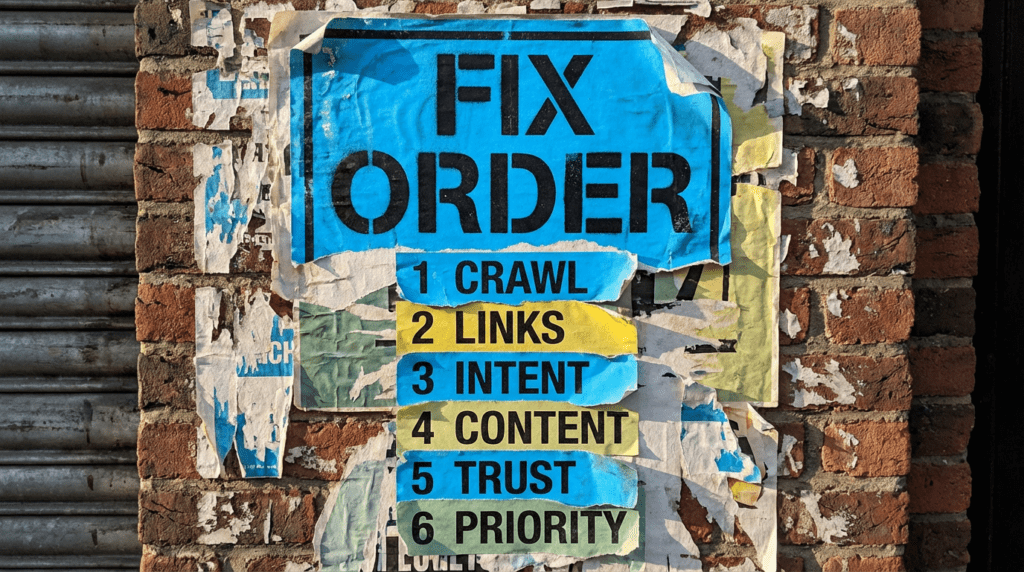
SEO audit checklist work gets messy fast when you try to check everything at once. This is the fix order we use to find the real blockers before you waste time polishing the wrong page.
A lot of businesses know something is off, but they are not sure whether the problem is indexing, weak pages, poor internal linking, local signals, or a site that just does not make sense to Google. That is where a proper SEO audit helps.
This is not about ticking boxes for the sake of it. It is about finding what matters, what can wait, and what is quietly costing you traffic, leads, or sales. A good website audit should leave you with a clear plan, not a 14-page export nobody wants to look at again.
You can work through this yourself if you want the DIY version. If you would rather skip the trial and error, we can handle the audit, sort the priorities, and help fix the bits that are actually worth your time.
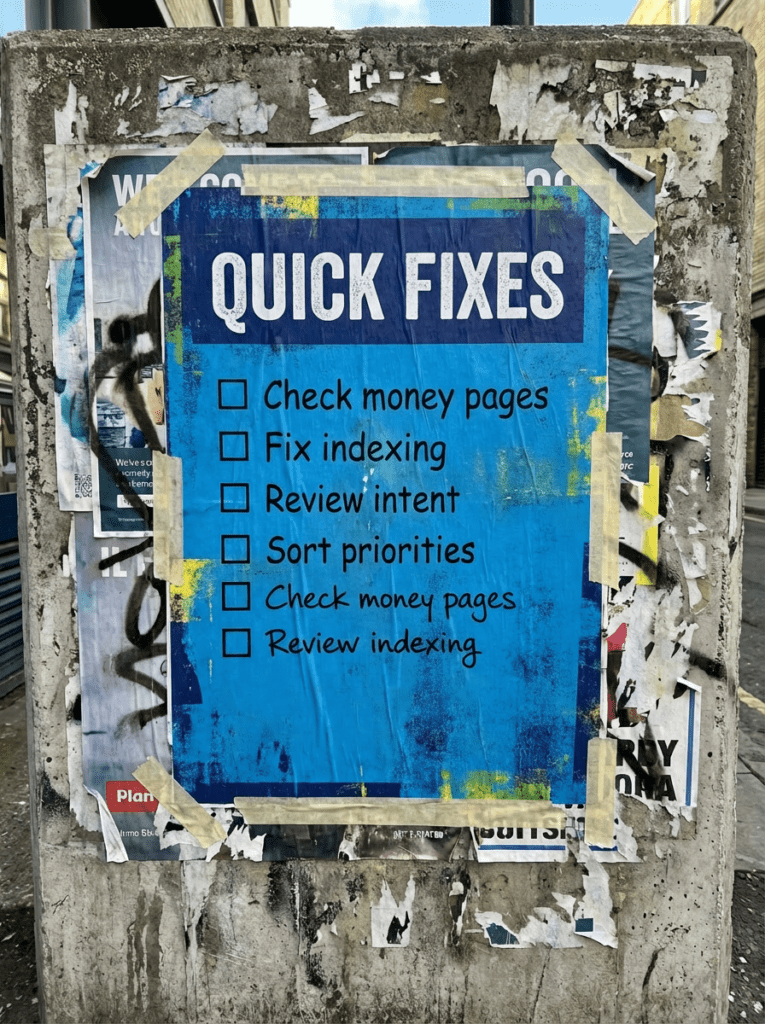
The quick version
If you only have 20 minutes, do these first. These are the fastest wins in our SEO audit checklist.
- Check the pages that actually make money first
- Make sure your important pages are indexable
- Review titles, H1s, and search intent before writing more copy
- Look for duplicate, thin, or overlapping pages
- Turn your findings into priorities, not a giant to-do list
If that already feels like a lot, do not worry. Below is our full SEO audit checklist in the right order.
Not sure where to start?
Most people do a bad SEO audit because they start with whatever tool shouts the loudest. One says your site is slow. Another says your score is poor. Another throws out a list of “errors” that look dramatic but change nothing.
That is how you end up fixing trivia while the real issue is that your best service page is buried, duplicated, or barely says anything useful.
A proper technical SEO audit starts with access, structure, and page purpose. Once that is sorted, you move into content quality, trust signals, and prioritisation. In that order.
Our full SEO audit checklist
Work through this in order. Skipping ahead is how you end up fixing the wrong thing first.
Step 1: Decide what actually matters before you audit anything
Do not treat every page equally. Start with the pages that matter most.
- List your key service pages
- Include top revenue or lead page
- Include location pages if local search matters
- Include strong supporting guides if they drive traffic
- Ignore low-value pages unless they are causing a problem
If everything is a priority, nothing is. A useful website audit starts by separating the pages that matter from the ones that are just along for the ride.
Step 2: Check indexability and crawl basics
Before you worry about rankings, make sure Google can actually access and understand the pages you care about. The URL Inspection tool is the quickest place to start.
- Important pages return a proper 200 status
- Key pages are not set to noindex
- Robots rules are not blocking the wrong sections
- Canonicals point to the right version
- Important URLs are included in the sitemap
If Google cannot crawl the page properly, the rest of the work is already on the back foot. If one of your key URLs is stuck, read Page not indexed in Google Search Console next.
Step 3: Check site structure and internal linking
A lot of ranking problems are really structure problems in disguise.
- Your homepage links to core service pages
- Important pages are not buried too deep
- Related pages link to each other naturally
- Blog posts support service pages where it makes sense
- Anchor text reflects what the destination page is about
If your best pages are hard to find internally, Google and users both get a weaker version of the site than they should. If that sounds familiar, Technical SEO checklist for WordPress is the next guide to read.
Step 4: Review search intent, titles, and headings
Ask the blunt question here. Does the page clearly match what someone searched for?
- One clear topic per page
- Title tag matches the real search intent
- H1 supports the title instead of competing with it
- The opening paragraph answers the query quickly
- The CTA fits the stage of the journey
A page does not need to be technically broken to underperform. Sometimes it is just vague. A proper SEO audit should show you where a page is mismatched before you start pumping out more content.
Step 5: Check content depth, duplication, and overlap
This is usually where weak pages show themselves.
- Thin pages are identified
- Near-duplicate pages are flagged
- Similar service pages are not saying the same thing
- Location pages are not just place-name swaps
- Important pages include proof, specifics, and clarity
This is where a website audit stops being cosmetic and starts being useful. A page does not need to be huge, but it does need a reason to exist.
Step 6: Check local and trust signals if they matter
Not every business needs this, but when local matters, it really matters.
- Contact details are clear and consistent
- Service areas are explained properly
- Reviews or testimonials are visible
- Google Business Profile supports the site
- Service pages mention the actual places or problems covered
If you serve real locations, local signals should not be treated like an afterthought. If local visibility is part of the problem, read Local SEO checklist for small business and Google Business Profile optimisation next.
Step 7: Check technical friction that affects real users
This is where people usually disappear into speed scores and never come back. Do not do that.
- Mobile pages load sensibly
- Images are not ridiculously oversized
- Broken internal links are cleaned up
- Redirect chains are reduced
- Heavy scripts and plugin clutter are noted
You do not need a science project. You need a site that works cleanly and does not trip people up. If you want a quick sense check, run the page through PageSpeed Insights.
Step 8: Check authority and off-site trust last
This matters, but it is not the first fix on most small business sites.
- Relevant backlinks are noted
- Brand mentions exist in sensible places
- Local citations are consistent if local matters
- Obvious spam patterns are flagged
- Gaps are identified without turning the audit into a link obsession
A lot of people start here because it sounds advanced. Usually it is not the first thing holding the site back.
Step 9: Turn the audit into an action plan
This is the point of the whole exercise.
- Split quick wins from bigger fixes
- Prioritise high-impact pages first
- Group tasks by content, technical, and structure
- Assign owners
- Build a 30, 60, and 90 day plan
An SEO audit is only useful if it ends with action.
Common mistakes
These are the things that make an SEO audit checklist far less useful than it should be.
- Auditing every page equally
- Starting with random tool scores
- Chasing speed while ignoring weak service pages
- Ignoring internal linking
- Leaving duplicate or overlapping pages live
- Writing more content before sorting indexability
- Finishing with notes instead of priorities
DIY lane vs done for you lane
DIY lane:
If you want to DIY our SEO audit checklist, start with priorities, indexability, internal linking, and page intent. That usually exposes the biggest issues fastest.
Done for you lane:
If you want the time-saving version, we can audit the site properly, sort the findings by impact, and help fix the pages and technical blockers that are actually worth your time.
Related Guides on the wall
If you’re working through an SEO audit checklist, these guides will help you tighten the bits that usually need fixing next.
- Read Technical SEO checklist for WordPress if you need to sort crawl, indexation, and setup problems
- Use Page not indexed in Google Search Console if key pages are published but still not appearing properly
- Check Local SEO checklist for small business if local visibility and service-area pages are part of the issue
- Read Google Business Profile optimisation if you need your website and profile working together better
SEO audit checklist FAQs

It should cover priorities first, then indexability, internal linking, page intent, content quality, local signals if relevant, technical friction, and off-site trust. The goal is not to check everything. The goal is to find what matters first.
For most small businesses, a proper audit every few months is enough, with lighter monthly checks on core pages, indexing, and obvious issues.
A technical SEO audit looks more closely at crawlability, indexation, canonicals, redirects, speed, and structure. A broader SEO audit also covers content, intent, trust, and how the site supports leads or sales.
Use them for clues, not conclusions. Tools are good at spotting patterns. They are not good at understanding business priorities on their own.
List your top pages, check whether they are indexable, and make sure they are properly linked from somewhere important. That is the fastest start for anyone using our SEO audit checklist.

Quick tip
Rather have us handle this instead of DIY-ing it? That is literally the job.



Straight talking marketing that gets results.
No pressure, no jargon. Just a clear look at what’s stopping your site from bringing in more enquiries.
Get my free website reviewLike this guide?
Tell Google you want more like it. One click, no sign-up, and FlyPost guides start showing up more often in your search results.
Add FlyPost as a preferred sourceTakes you to Google, then straight back here.