


Organic Social Media Guide

This Organic Social Media Guide is for businesses that want more reach, better engagement, and stronger content without throwing money at ads every time results dip.
That matters more now than it did a couple of years ago. Sprout’s latest UK social reporting says 43% of UK consumers use social platforms for daily search, and its March 2026 UK trends piece says social is now acting as the UK’s “primary answer engine.” Hootsuite’s 2026 trends report also says content now needs to adapt to search-first, multi-modal discovery.
So if your reach feels patchy, your engagement is inconsistent, or your content is technically fine but still going nowhere, the answer usually is not “post more often.” The answer is usually better positioning, better content choices, and better signals around why the content deserves to travel.
The quick version
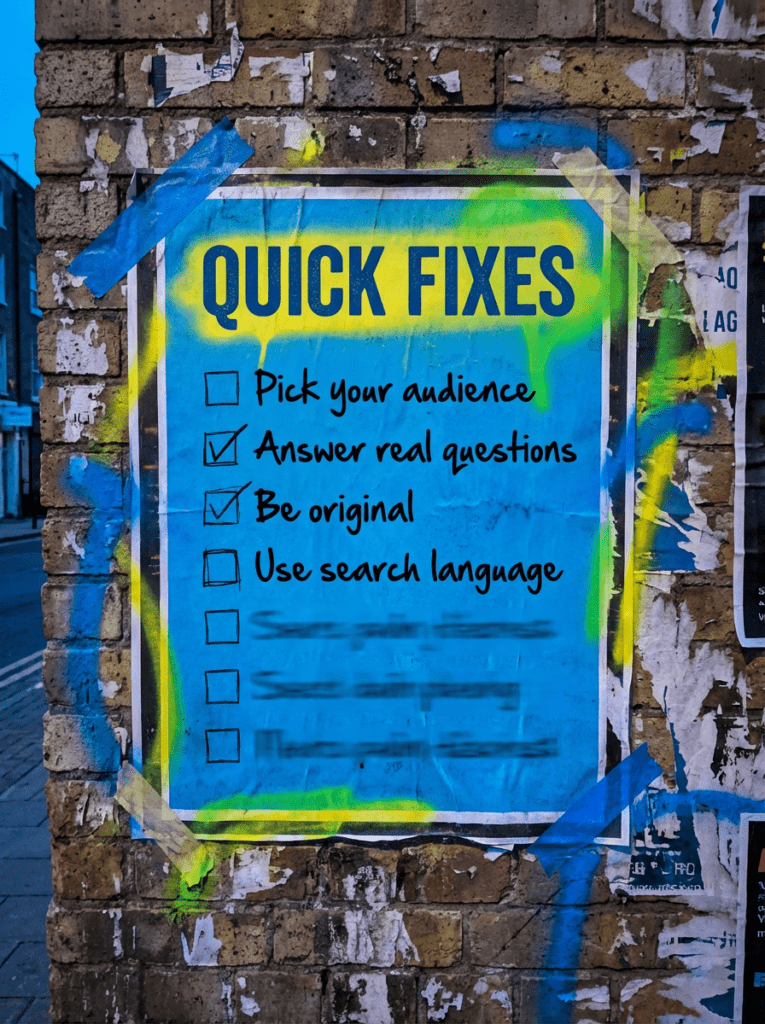
If you only have 20 minutes, start here. These are the fastest wins from our Organic Social Media Guide.
- Pick one clear audience and one clear content lane
- Answer real questions instead of posting filler
- Make the content feel original, useful, and human
- Use captions, profile text, and on-screen wording people actually search for
- Judge success on saves, replies, shares, DMs, and clicks, not just likes
If that already feels like a lot, do not worry. Below is the full process in the right order.
Not sure where to start?
he biggest mistake people make with any Organic Social Media Guide is assuming the answer is just posting more often.
It usually is not.
If the content is vague, recycled, too broad, or disconnected from what your audience actually cares about, posting more of it just gives you more average content. That is not a strategy. That is just a louder version of the same problem.
The better place to start is figuring out who you want to reach, what they actually care about, and what type of post would be worth stopping for in a feed full of noise.
Our full Organic Social Media Guide
Work through this in order. Skipping ahead is how you end up posting plenty but getting very little back
Step 1: Pick one audience before you pick your content
A good Organic Social Media Guide starts here, because broad content usually disappears into the feed without doing much for anyone.
- Be clear about who the content is for
- Focus on one main audience type at a time
- Think about the problems, questions, or interests they already have
- Avoid trying to sound relevant to everybody
- Keep the message tight enough that the right people recognise themselves in it
If your audience is fuzzy, the content usually ends up fuzzy too.
Step 2: Build content around real questions, not filler ideas
This is where a lot of organic strategies either sharpen up or quietly fall apart.
Sprout’s current UK social reporting says people are increasingly using social to search for information, which means the brands that win organically are much more likely to be useful than random. TikTok’s own Creator Search Insights documentation also says creators can use search data to find popular topics and content gaps.
- Pull ideas from customer questions, comments, DMs, and sales calls
- Turn repeated objections into posts
- Turn common mistakes into posts
- Turn simple wins into posts
- Build content around what people are already asking instead of what you randomly feel like saying that day
If you want inspiration from search behaviour directly, check Creator Search Insights on TikTok.
Step 3: Choose formats that suit the message
A strong Organic Social Media Guide is not just about what you say. It is also about choosing the right format for the point you are making.
- Use short video when the message needs tone, personality, or demonstration
- Use carousels when the message needs structure
- Use static graphics when the point is quick and visual
- Use text-led posts when strong wording is the main asset
- Stop forcing every idea into the same content format
Not every good point needs a Reel. Not every useful idea needs to become a carousel.
Step 4: Write for discovery, not just for followers
This is one of the biggest shifts in organic social right now.
Sprout says social search is having its moment in the UK, and Hootsuite says social content now has to adapt to search-first discovery. That means captions, on-screen text, spoken wording, profile descriptions, and post topics all matter more than they used to.
- Use the phrases your audience would actually search for
- Put the main topic in the opening line or opening frame
- Keep profile bios and descriptions clear
- Use on-screen text that supports discoverability
- Avoid clever wording that hides the real topic
This is where How to Do Keyword Research can help, even if the platform is social rather than Google.
Step 5: Make the content feel human and original
This matters more now because feeds are full of polished sameness.
Hootsuite’s 2026 trends report says AI tools are now table stakes, but authenticity is the differentiator. Sprout’s Q1 2026 Pulse data also says 66% of users are more selective about what they engage with than they were a year ago, while 56% say they see “AI slop” often or very often on social.
- Use natural language instead of over-scripting everything
- Add a point of view, not just information
- Show a real opinion where it makes sense
- Keep the tone human, not brand-bot
- Do not over-polish the life out of the content
Original does not mean complicated. It usually just means it sounds like a person made it.
Step 6: Aim for stronger signals than likes
A useful Organic Social Media Guide has to say this plainly: likes are not the whole story.
If the content gets saved, shared, replied to, or drives DMs and clicks, that usually tells you much more than a shallow engagement number on its own.
- Look at saves for useful educational posts
- Look at shares for relatable or practical posts
- Look at replies and DMs for trust and conversation
- Look at profile visits and clicks for commercial interest
- Stop judging every post by the same single metric
Better signals give you better clues about what is actually landing.
Step 7: Build community in the places that still feel personal
Public feeds are noisy. Private and semi-private interaction matters more than a lot of brands realise.
Sprout’s March 2026 UK social trends reporting says organic reach is becoming harder to secure and that UK users are moving toward smaller, more private digital spaces, with especially strong brand interaction on WhatsApp.
- Reply to comments properly
- Use stories for lighter interaction
- Treat DMs as part of the strategy, not an afterthought
- Notice which topics spark private replies
- Build repeat familiarity instead of chasing one-off virality
A smaller, stronger audience beats a bigger, colder one most of the time.
Step 8: Review what is actually working and do more of that
This should be obvious. It often is not.
A lot of brands keep posting by habit instead of by evidence. They repeat formats that feel safe, ignore the posts that actually performed, and never really tighten the plan.
- Review your best posts monthly
- Look for patterns in hook style, topic, and format
- Notice what got saved, shared, or replied to
- Cut the themes that keep doing nothing
- Double down on the posts that actually earned attention
Good organic social media gets better when you pay attention to what the audience already told yo
Common mistakes
These are the things that make an Organic Social Media Guide necessary in the first place.
- Posting more instead of posting better
- Copying trends with no relevance to the business
- Using vague captions that hide the actual point
- Chasing likes instead of meaningful engagement
- Sounding too polished, too generic, or too safe
- Ignoring search-style discovery
- Treating every platform exactly the same
DIY lane vs done for you lane
DIY lane:
If you want to use this Organic Social Media Guide yourself, start with audience focus, useful topics, search-friendly wording, and stronger engagement signals.
Done for you lane:
If you want the quicker route, we can help you tighten the content strategy, sharpen the message, and build a more useful organic plan around what your audience actually wants to see.
Related Guides on the wall
If you’re working through this Organic Social Media Guide, these follow-on reads will help you tighten the wider strategy around your content.
- Read How to Do Keyword Research if you need help finding the language your audience actually uses
- Use Service Page Checklist if your social content is sending people to pages that are not doing enough after the click
- Read Technical SEO checklist for WordPress if the site behind the content is creating friction once people arrive
Organic Social Media Guide FAQs

It helps you create better content, improve reach, and build stronger engagement without relying on paid ads every time results dip.
No. A lot of brands would be better off posting fewer, stronger pieces than posting daily filler. Quality and relevance usually matter more than forcing volume.
Yes. Current UK social reporting says people are increasingly using social platforms to search, and Hootsuite’s 2026 trends report says social content now has to adapt to search-first discovery.
Look at saves, shares, replies, DMs, profile visits, and clicks. Those signals usually tell you much more about whether the content actually landed.
Pick one audience, list the real questions they ask, and turn one of those questions into a genuinely useful post. That is the cleanest starting point.

Quick tip
Rather have us handle this instead of DIY-ing it? That is literally the job.

Straight talking marketing that gets results.
No pressure, no jargon. Just a clear look at what’s stopping your site from bringing in more enquiries.
Get my free website reviewLike this guide?
Tell Google you want more like it. One click, no sign-up, and FlyPost guides start showing up more often in your search results.
Add FlyPost as a preferred sourceTakes you to Google, then straight back here.